

About Wavy Cap (Psilocybe cyanescens): Taxonomy, Spores and Type History Mushrooms
This article on the wavy cap mushroom is for educational and taxonomic purposes only and is not medical or legal advice. Mushly supplies spores for microscopy and research only and does not support consumption or cultivation, which are illegal in many jurisdictions.
Short answer: Psilocybe cyanescens Wakef., the wavy cap (in the UK, the blueleg brownie), is a true species, not a Psilocybe Cubensis strain. It grows on wood chips, not dung, and is recorded in Index Fungorum as RecordID 290108. Its smooth, ellipsoid spores support a species-level note under a microscope, but they overlap with close relatives, so cap, habitat and provenance matter as much as the slide.
In this guide
- Which wavy cap is which?
- Taxonomy
- Name and type history
- Spore and cap traits
- Ecology and distribution
- Look-alikes: Galerina and relatives
- Examining a slide
- Legal status
- References
- FAQ
Which wavy cap is which?
Short answer: three different things get called "wavy" or "cyanescens," and they are not the same.
- Wavy Cap at Mushly means Psilocybe cyanescens Wakef. (IF 290108), a separate wood-chip species. See the Wavy Cap (Psilocybe cyanescens) spore syringe.
- Cubensis "wavy" trade lines, such as Tidal Wave, are described by vendors as having wavy caps, but they remain Psilocybe cubensis. A wavy margin on a cubensis fruit body is not a species character. For the difference between a species and a trade name, see our species vs strain primer.
- Panaeolus cyanescens (IF 169479) is a black-spored dung fungus in a different genus, and the original Australian "blue meanie" (see our Blue Meanie page). Because both epithets are "cyanescens," always write the genus in full.
"Wavy cap mushroom is Psilocybe cyanescens, a wood-chip species, not a cubensis strain. Type history, spore size, purple-brown print and Galerina look-alike."


Taxonomy
| Rank | Entry |
|---|---|
| Kingdom | Fungi |
| Phylum | Basidiomycota |
| Class | Agaricomycetes |
| Order | Agaricales |
| Family | Hymenogastraceae in current phylogenetic treatments (Ramírez-Cruz et al. 2013); Index Fungorum still lists Agrocybaceae |
| Genus | Psilocybe |
| Species | Psilocybe cyanescens Wakef. (1946) |
Other name records: Species Fungorum, MycoBank, Wikidata and NCBI Taxonomy 93625.
Close relatives include P. azurescens, P. allenii (described in 2012), the European P. serbica group and the Australasian P. subaeruginosa group (Borovička et al. 2011).
Name and type history
Short answer: described from a Kew collection in 1946, probably native to western North America, and later introduced to Europe.
- The type. The species was described by Elsie M. Wakefield in Dennis & Wakefield, Trans. Br. Mycol. Soc. 29: 141 (1946) (DOI). The holotype, K(M) 63976, was collected by Wakefield at the Royal Botanic Gardens, Kew, on 25 October 1911. Because it is old and in poor condition, an epitype (PRM 901481, on mulch, Hamburg, Germany, 2003) was designated with DNA data in 2012 (Borovička, Rockefeller & Werner 2012).
- The collector. Wakefield collected it at Kew from 1911 and noted its indigo-blue staining (see Elsie Maud Wakefield).
- Native range. Although it was described from England, Borovička (2005, 2008) and Borovička et al. (2012) argue that the species is probably native to western North America, where it is known from natural habitats on the Pacific coast, and was introduced to Europe. European and American collections have identical ITS, LSU and EF-1α sequences. Shaw & Kibby (2001) consider the natural range unknown.
- Names. "Wavy cap" is mostly used in North America. In the UK it is the blueleg brownie (First Nature; Burke Herbarium).
- A caution on databases. Public names are not always reliable: GenBank sequences labelled P. cyanescens have turned out to belong to Panaeolus and Deconica (Bradshaw et al. 2022).
Spore and cap traits
Short answer: a wavy caramel cap, no distinct ring, blue bruising and a dark purple-brown print, with spores of about 10-12.5 × 7-7.5 µm.
Field marks at a glance
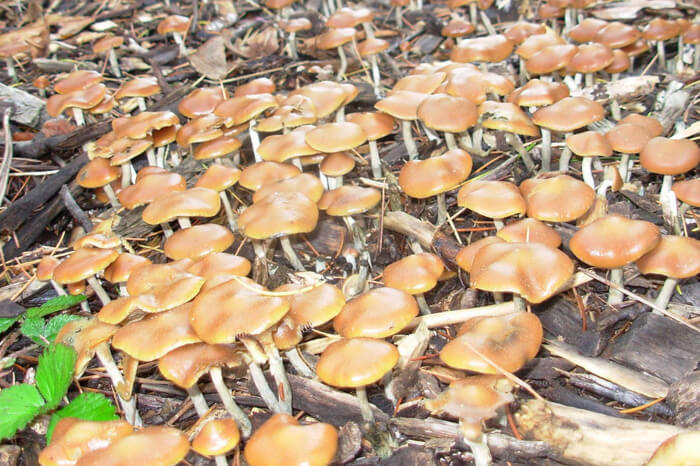
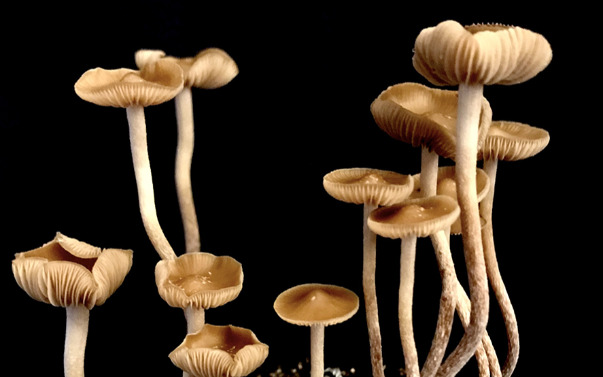
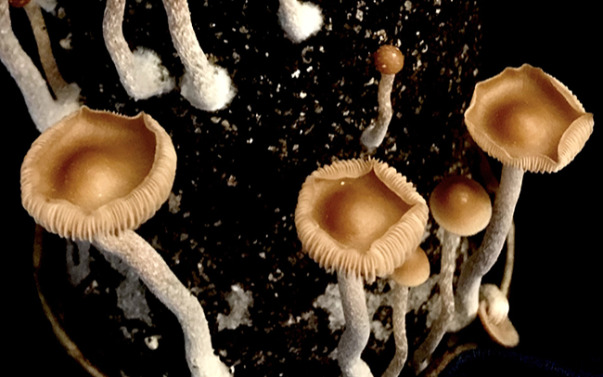
- Caramel to chestnut-brown cap that fades on drying (hygrophanous) and becomes distinctly wavy at maturity
- No distinct ring on the stem (at most a cobwebby veil zone)
- Blue to blue-green bruising, especially on the stem and cap margin
- Dark purple-brown spore print
- Grows on wood chips and other lignin-rich debris, not on dung
Details
- Cap: about 1.5-5 cm across (Arora, via Wikipedia); the Beaty Biodiversity Museum gives 1.5-6 cm. Caramel to chestnut-brown when moist, hygrophanous, viscid with a separable pellicle. Wavy margins also occur, rarely, in European relatives, so waviness alone is not diagnostic (Borovička 2008).
- Gills: adnate to subdecurrent, light brown becoming dark purple-brown with paler edges.
- Stem: roughly 4-9 cm × 2-8 mm, whitish and silky-fibrillose, often with a swollen base and blue-staining rhizomorphs, with no distinct ring.
- Spore print: dark purple-brown (Beaty; First Nature).
- Spores: ellipsoid to broadly ellipsoid, smooth, with a germ pore. Three published ranges:
- Borovička (2008), measuring European and North American collections including the holotype: (9.8-)10.0-12.5(-13.5) × (6.5-)7.0-7.5(-8.0) µm
- Stamets (1996), via Wikipedia: about 9-12 × 5-8 µm
- MykoWeb: 9-12 × 6-8 µm
- Cystidia: cheilo- and pleurocystidia present. Borovička (2008) reports pleurocystidia in the holotype as well.
- Bruising: damage triggers enzymes that convert psilocybin to psilocin and link it into blue pigments (Lenz et al. 2020). Many Psilocybe species bruise blue, so bluing is not proof of species.
What a microscope can and can't tell you. Spore size and shape are species-level characters and overlap with close relatives. Borovička et al. (2012) report that P. allenii cannot be told apart from P. cyanescens by the size or shape of its spores or cystidia. Published analyses also report highly variable tryptamine content in P. cyanescens collections (Gotvaldová et al. 2022). Mushly makes no potency claims.
Ecology and distribution
Short answer: a woodchip-mulch saprotroph of cool seasons, found in parks, gardens and cemeteries, never on dung.
Psilocybe cyanescens is a saprotroph of lignin-rich material, especially woodchip mulch and other woody debris. It is not typically found on bark mulch, and it does not grow on dung. The epitype itself was collected on mulch.
- Distribution: the Pacific coast of North America (southern British Columbia to California), the UK and Western/Central Europe, and New Zealand, where it is recorded as exotic (BiotaNZ). Borovička (2008) describes it in Europe as widespread but rare, found almost only in botanic gardens, parks and cemeteries.
- Spread: its range has expanded with commercial woodchip mulch, and Shaw & Kibby (2001) suggest the mycelium travelled through woodchip suppliers' distribution networks (Field Mycology). The Guardian reported a mass fruiting of about 100,000 fruit bodies at a racetrack in southern England (Brown, 2001).
- Season: cool-season fruiting, for example late October to February around San Francisco (Arora, via Wikipedia) and September to November in central Europe (Borovička 2008).
These notes describe documented habitat for identification context only. The species is expanding in Europe and New Zealand, and no conservation assessment for it is known.
Look-alikes
Short answer: the one that matters is Galerina marginata, a deadly wood-rotting species that can grow on the same wood chips.
This section is identification context for microscopy and documentation, not a foraging guide. Galerina marginata is a wood-rotting "little brown mushroom" that contains amatoxins. Enjalbert et al. found α-, β- and γ-amanitin in all 27 French specimens they tested (Enjalbert et al. 2004). Never eat a wild fungus on the basis of an online description.
| Character | Psilocybe cyanescens | Galerina marginata |
|---|---|---|
| Spore print | Dark purple-brown | Rusty brown |
| Ring | No distinct ring (cobwebby veil zone) | Distinct membranous ring (may wear off) |
| Bruising | Blue to blue-green | Never blue (stem darkens brown to blackish) |
| Cap margin | Wavy at maturity | Rarely wavy |
| Spores | Smooth, germ pore, about 10-12.5 × 7-7.5 µm (Borovička 2008) | Warty or wrinkled with a plage, about 8-10 × 5-6 µm (Smith & Singer, via Wikipedia) |
| Toxins | Not assessed here | Amatoxins (Enjalbert et al. 2004) |
- Psilocybe allenii: same wood-chip habitat on the Pacific coast. Its cap stays convex and rarely becomes wavy, its stem is thinner, and its spores and cystidia overlap with P. cyanescens (Borovička et al. 2012).
- Psilocybe azurescens: larger, with an umbonate cap that is never wavy and longer spores (Borovička 2008).
- Other small brown mushrooms on wood chips: Conocybe, Inocybe and Galerina are flagged by the Beaty Museum and MykoWeb. A spore print and a full set of characters are both needed.
Other true species on Mushly include Liberty Cap (Psilocybe semilanceata).
Examining a slide
Follow the general method in our Golden Teacher guide and the mushroom spores guide, and then:
- Measure at least 20 spores (length × width) and compare the range with Borovička's (2008) figures above, noting the magnification and mountant.
- Check that the wall is smooth and that a germ pore is visible.
- Record the colour in the mountant and the print colour separately.
- Note the substrate and where the sample came from.
- Remember the limit: a fit to P. cyanescens does not exclude close relatives such as P. allenii, and spores alone cannot separate them.
Legal status
- Psilocybin and psilocin are Schedule I substances under US federal law (21 CFR 1308.11).
- In the UK, since the Drugs Act 2005, fresh as well as prepared psilocybin mushrooms fall under the Misuse of Drugs Act as Class A (Drugs Act 2005, s.21).
- Spores contain no psilocybin or psilocin, but some US states restrict spores in some situations. Laws differ by jurisdiction and change over time (see this overview). This is not legal advice.
Wavy Cap spore syringe · All spore syringes
References
- Index Fungorum: Psilocybe cyanescens Wakef., RecordID 290108: current name, holotype and epitype.
- Borovička J. (2008), Czech Mycology 60(2): key to the P. cyanescens group, with spore measurements and European distribution.
- Borovička J., Rockefeller A. & Werner P.G. (2012), Czech Mycology 64(2): 181-195: holotype, epitype, P. allenii, native-range hypothesis.
- Borovička J. et al. (2011): relatives of the group.
- Ramírez-Cruz V. et al. (2013): family placement.
- First Nature: Psilocybe cyanescens, Blueleg Brownie: UK identification, distribution and taxonomic history.
- Beaty Biodiversity Museum (UBC), Mushrooms Up!: Psilocybe cyanescens: Pacific Northwest description and Galerina contrast.
- MykoWeb, California Fungi: Psilocybe cyanescens: description, spores and look-alike genera.
- Bradshaw A.J. et al. (2022), Applied and Environmental Microbiology: DNA barcoding of fungarium Psilocybe specimens, showing widespread misidentification.
- Gotvaldová K. et al. (2022), International Journal of Molecular Sciences: variability of tryptamine content in vouchered collections.
- Lenz C. et al. (2020): blue bruising.
- Enjalbert F. et al. (2004): amatoxins in Galerina marginata.
- Shaw & Kibby (2001), Field Mycology; Brown (2001), The Guardian
- Wikipedia: Psilocybe cyanescens: general overview.
- Stamets P. (1996), Psilocybin Mushrooms of the World, Ten Speed Press (print).


Are Wavy Cap spores legal?