

This page covers Psilocybe azurescens taxonomy for microscopy notes. Psilocybe azurescens Stamets & Gartz was published in 1995 (Integration 6: 21). It was described from wood-chip material in Oregon. It is still the current name in Index Fungorum and MycoBank (RecordID / taxon name ID 446057). For microscopy records, pair that name with its wood-loving ecology and the spore measures from the original description. Keep it clearly apart from other wood-rotting Psilocybe of the Pacific Coast. Leave out potency rankings, outdoor cultivation tips and cubensis shop nicknames. Pair this page with Mushly’s mushroom spores hub and the primer on species vs strain. See also the rare Psilocybe overview and the psilocybin fungi diversity page.

Authorship, Name Banks, and the Binomial
Write the label as Psilocybe azurescens Stamets & Gartz 1995. Check the name databases before you finalize your notes. Index Fungorum’s NamesRecord 446057 and current-name search list the current name. They point to the type specimen (WTU; Stamets, 21 Nov. 1993) on wood chips of Alnus rubra in Oregon. That is ecology for identification, not a grow recipe. Cross-check Species Fungorum’s current-name search, GSD species page and synonymy record. Also check MycoBank’s name details page, the MycoBank home and basic names search. Secondary sources are NCBI Taxonomy txid 93624 and Wikidata Q1939109. Under the International Code of Nomenclature for algae, fungi, and plants (ICN), Article 23 governs species names. The two-part name is the scientific name. English nicknames such as “flying saucer” are secondary field terms. They do not replace Stamets & Gartz.
Modern multi-gene work places Psilocybe in the strict sense in the Hymenogastraceae. Rely on DNA studies and name databases for the name. Do not invent family marketing copy. A readable species overview is on the P. azurescens Wikipedia page (secondary). Genus context is on the Psilocybe overview.
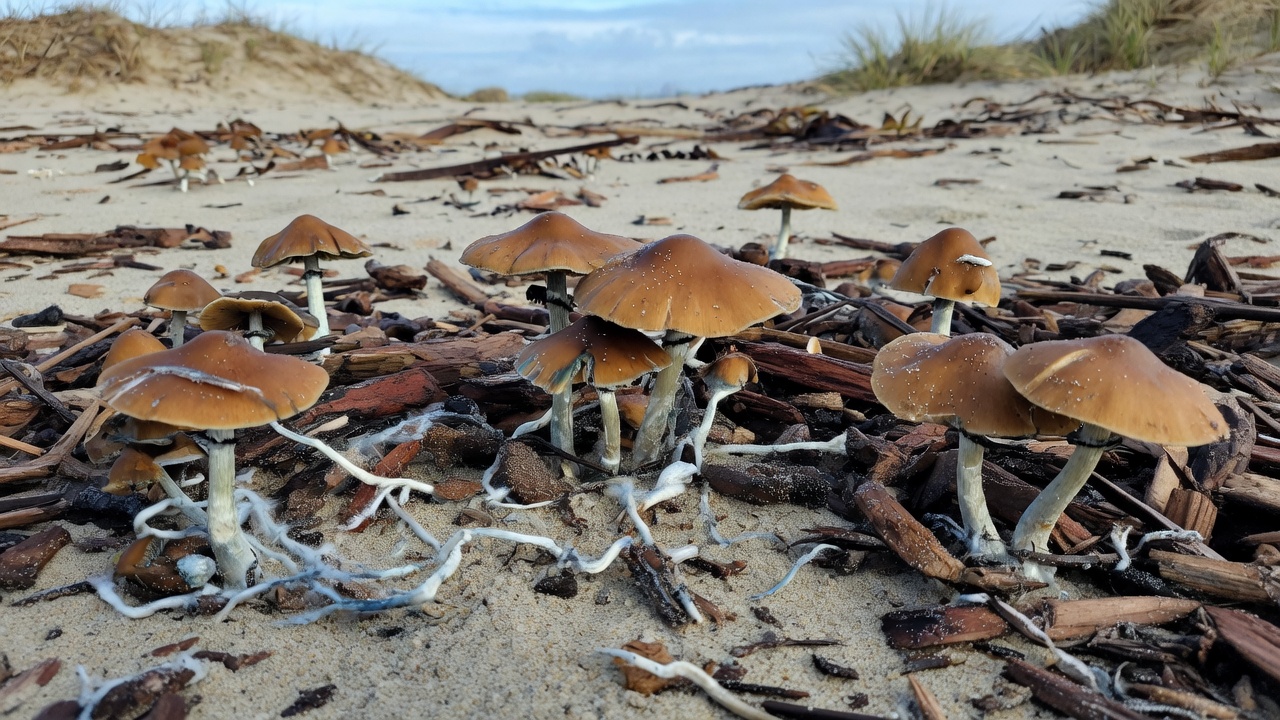
Wood-Loving Ecology (Documentation, Not Cultivation)
P. azurescens lives on and breaks down wood. It is not a dung and pasture fungus like Psilocybe Cubensis. Species accounts place it on hardwood chips and sandy soils rich in woody debris along the Pacific Northwest coast. The type area is the Columbia River delta, with coastal counties of Oregon and Washington in published notes. Index Fungorum’s note for the type specimen anchors that niche: wood chips of Alnus rubra, Oregon. Published descriptions often give a cap about 30–100 mm across. It is conical to broadly convex, with a lasting broad central bump. It bruises strongly blue. The stem is silky white with a root-like base. Treat these as species traits for ID notebooks. They are never targets or timing recipes for outdoor woodchip growing.
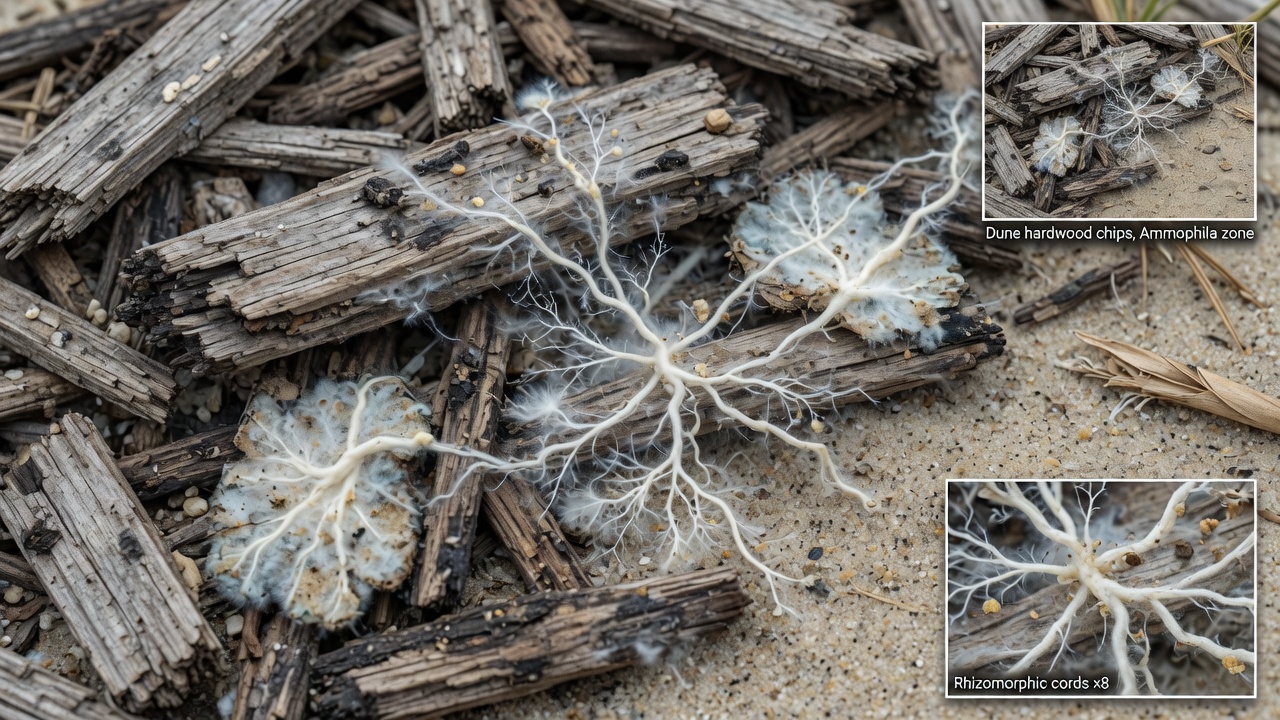
Describe substrates as habitat traits. Do not turn coastal dune or landscaped-chip ecology into step-by-step grow instructions. Field summaries note fruiting in autumn. Use that only as context on range. For how trade nicknames differ from formal species names, see species vs strain 101. To browse labeled research products across the catalog, use all strains.
Spore Characters from the Protologue
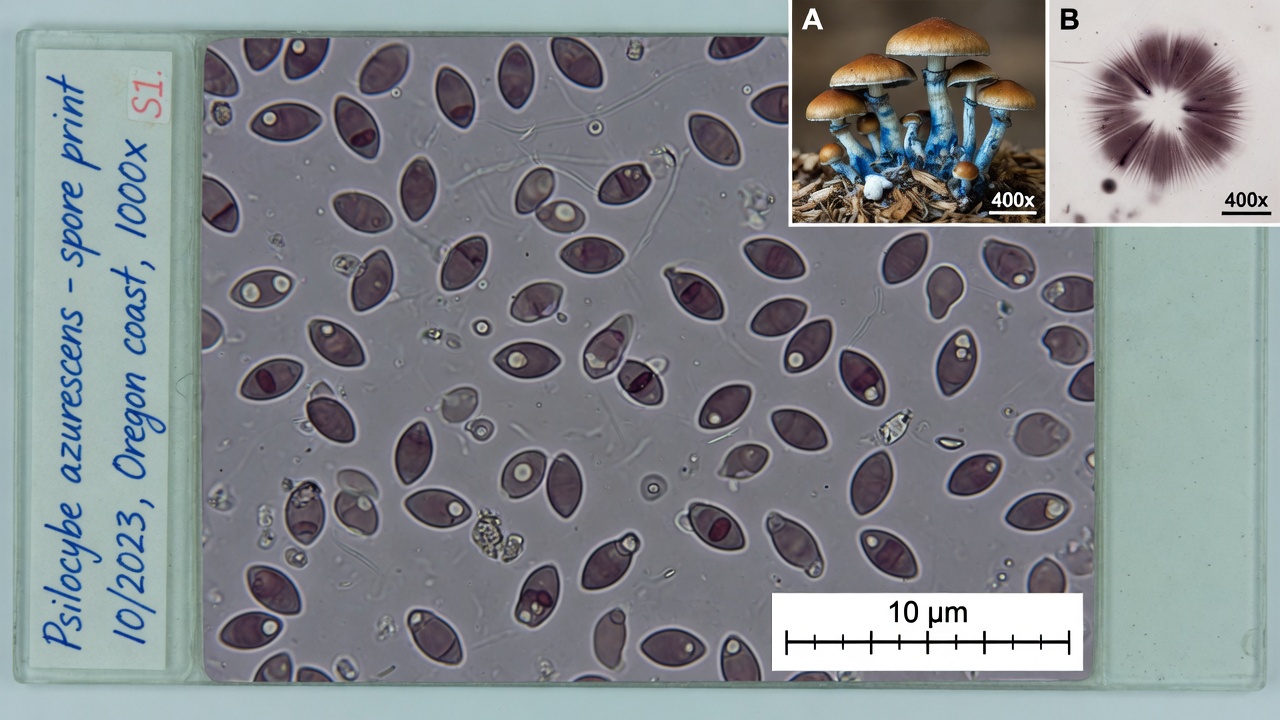
The original Stamets & Gartz description gives spores of 12–13.5 × 6.5–8.0 μm (Latin diagnosis Sporis 12-13,5 × 6,5-8.0 um). An open copy of the taxonomy paper is on the Shroomery taxonomy-paper page. A related species account is at Shroomery P. azurescens. The description notes a wall under 1 μm thick. It also notes mount colors: rich reddish brown in KOH, and light purplish wine-red in watery ammonia solutions. Treat the spores as smooth, thick-walled Psilocybe spores. Do not invent “subtle ornamentation.” Species accounts give the spore print as dark purplish brown to purplish black, or blackish-brown to purple. That is a species trait, not a trade-strain fingerprint.
Report your own calibrated length × width with sample size (n), mountant, magnification and face or side view. Length-only summaries such as “12 to 14 μm” leave out the published width range. They also drift from the original description. Shape and wall traits are useful on a slide. But similar forms evolved more than once across Psilocybe. Ramírez-Cruz et al. (2013) (also the PDF; DOI 10.1139/cjb-2013-0070) warn against reading identity from one measure alone. Mushly’s spore science and microscopy 101 covers practical baseline habits.
Look-Alikes in the Pacific Wood-Lover Complex
Do not confuse P. azurescens with Psilocybe cyanescens Wakef. (English “wavy cap,” Index Fungorum RecordID 290108). Do not confuse it with Psilocybe allenii Borov., Rockefeller & P.G. Werner 2012 (RecordID 564115). Do not confuse it with informal P. cubensis shop nicknames either (P. cubensis RecordID 290107). Borovička, Rockefeller & Werner (2012) (open PDF) treat P. azurescens, P. cyanescens and P. allenii as closely related wood-rotting lines of the Pacific Coast. Form plus ITS vouchers matter. A shop nickname in English does not merge them. Secondary primers are Wikipedia on P. cyanescens and P. allenii. For more on wood-loving and uncommon Psilocybe, see Mushly’s rare Psilocybe varieties overview. It is not a potency ranking.
P. cubensis is a dung-loving species found worldwide. It carries most trade “strain” nicknames. It is not a wood-chip stand-in for azurescens. Keep cubensis trade labels and true wood-loving species in separate notebook columns. The rare Psilocybe and diversity hubs help map that split.
What Microscopy Can—and Cannot—Show
Some notes can support species-level records of P. azurescens. These are calibrated spore measures near the Stamets & Gartz 12–13.5 × 6.5–8.0 μm range, print color, germ-pore notes and the label source. They do not prove alkaloid content. They do not rename the fungus as P. cyanescens. They do not confirm a cubensis trade nickname or merge Pacific wood-lovers into one product. For optional background on how mycologists recognize species by form, mating and gene trees, see Taylor et al. (2000) (DOI 10.1006/fgbi.2000.1228). For wider genome context on taxonomy, not chemistry shopping, see Bradshaw et al. (2024) (PDF).
Before you file an azurescens-labeled slide, separate the layers:
- Binomial: Does the label state Psilocybe azurescens Stamets & Gartz (current Index Fungorum / MycoBank usage, RecordID 446057)?
- Ecology note: Wood-loving / lignicolous habitat characters recorded as ID context—not cultivation steps.
- Spore notes: Calibrated L × W near the original range; smooth thick wall; print color in mass; mountant and n.
- Look-alike check: Clearly not P. cyanescens (wavy cap), not P. allenii and not a cubensis trade nickname.
- Limits: Microscopy records spores and labels. It does not prove potency, effects or outdoor grow claims.
Psilocybe azurescens earns a true species page. Its name, wood-loving niche and original spore measures are recorded and can be checked. The anchors for names, look-alikes and what a slide can honestly support are Index Fungorum, MycoBank and Species Fungorum. They also include the Stamets & Gartz diagnosis (via the open taxonomy-paper copy), Borovička et al. (2012) and Ramírez-Cruz et al. (2013).
Mushroom spores are sold strictly for microscopy and research purposes only. The cultivation of Psilocybin mushrooms is illegal in many jurisdictions.


What is the current scientific name of Psilocybe azurescens?