

Updated: October 4, 2026
Mushroom spores are sold strictly for microscopy and research purposes only. Cultivation of Psilocybin-containing fungi is illegal in many jurisdictions. This page is not a guide to finding, growing, or taking mushrooms.
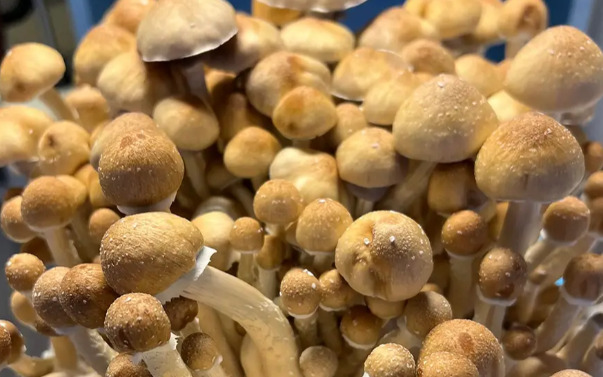
Short answer: Thai Elephant Dung, often shortened to TED, is a trade name for material sold as Psilocybe Cubensis (Earle) Singer. It is not a separate species, a published variety, or a recognised variant. Sellers say the line goes back to three wild Spore prints collected in Thailand by John Allen. The only published item we found that fits the name is a photo caption, not a description of this line. Under a microscope, a sample shows the spore characters of P. cubensis, which cannot confirm the label.
Home » Strain Encyclopedia » Psilocybe Cubensis » Thai Elephant Dung
In this guide
- What Thai Elephant Dung is
- Taxonomy
- What is documented and what is lore
- Spore and cap traits
- Origin claims, source by source
- The published photo caption
- Related names
- Identifying it, and what a microscope can't tell you
- Examining a slide
- Mushly products
- Legal note
- References
- FAQ
What Thai Elephant Dung is
Thai Elephant Dung is one of many named lines of Psilocybe cubensis. The name is a catalogue label used by spore sellers. It describes a product and not a taxon, and the substrate in the name is part of a seller's story and not a specimen record. For the difference between a species and a trade name, see our species vs strain primer and the Psilocybe cubensis species guide. For the wider set of Thai-labelled lines, see our Thai cubensis guide.
"Thai Elephant Dung (TED) is a trade name for Psilocybe cubensis, not a species or variety. Sellers credit John Allen with three wild prints; a published photo caption shows cubensis in elephant dung on Koh Samui. Claims compared."

Taxonomy
| Rank | Entry |
|---|---|
| Kingdom | Fungi |
| Phylum | Basidiomycota |
| Class | Agaricomycetes |
| Order | Agaricales |
| Family | Placement varies by source: Index Fungorum, Species Fungorum and NCBI list Agrocybaceae, while many other references use Hymenogastraceae |
| Genus | Psilocybe |
| Species | Psilocybe cubensis (Earle) Singer, Sydowia 2(1-6): 37 (1948) |
| Basionym | Stropharia cubensis Earle (1906) |
| Trade name | Thai Elephant Dung / TED (informal) |
Species records: Index Fungorum 290107, the Species Fungorum synonymy and NCBI Taxonomy 181762. None lists Thai Elephant Dung.
What is documented and what is lore
| Question | Status |
|---|---|
| Is Thai Elephant Dung a species or published variety? | No. The only formal name is Psilocybe cubensis. |
| Spore size and shape | Published for the species only, with no TED-specific measurements. |
| P. cubensis growing in elephant dung in Thailand | Shown in a published photo caption (see below). This does not identify the TED line. |
| Collected by John Allen | Seller claim, repeated by several vendors. No voucher or collection record for this line is published. |
| "Three prints" as the source of all TED genetics | Seller claim only. |
| A 2019 collection in Phuket | One seller's account. Not verified here. |
Spore and cap traits
Short answer: the published measurements describe the species, not this name.
Singer and Smith's 1958 Mycologia monograph (Mycological investigations on Teonanácatl) describes P. cubensis spores as:
- Size: 11.5-17.3 × 8-11.5 × 7-9 µm
- Surface: smooth, with a thick, complex wall
- Apex: truncate, from a distinct apical pore
- Colour in a mountant: dark yellow brown in KOH, dark olive brown in NH4OH
The KOH and NH4OH colours are mountant colours, not spore-print colours. The paper does not mention Thai Elephant Dung. Guzmán et al. (2012) give a second species-level range of (12-)13-15(-17) × 8-10(-11) × 7-9 µm.
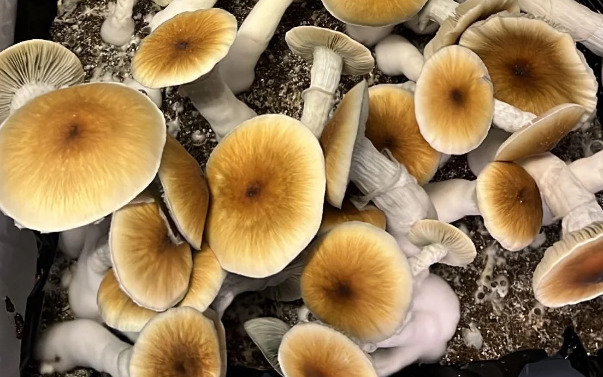
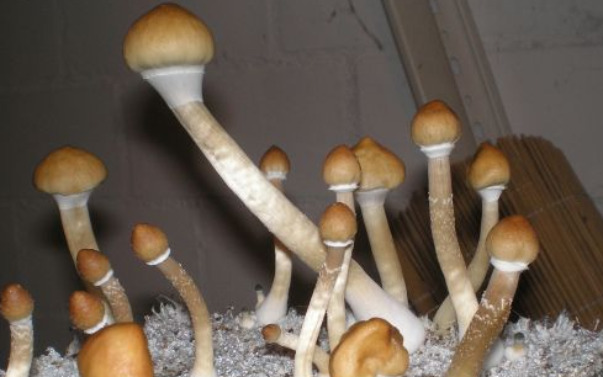
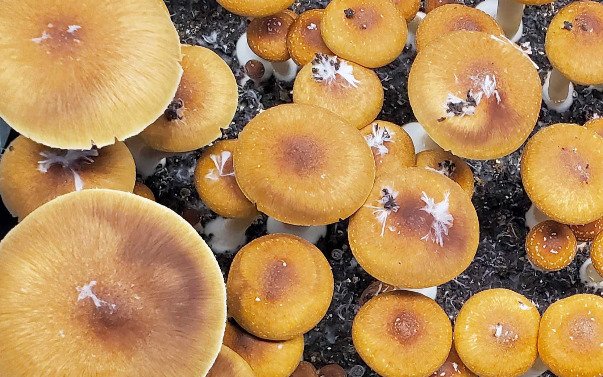
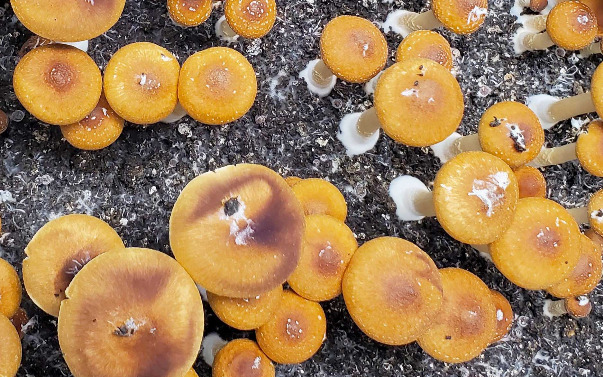
Seller descriptions are not diagnostic. Sonoran Spores says TED spores are "subellipsoid" and "dark purple," with a medium-sized fruit, a white stem with a brown hue, a thick veil and yellow caps with brown spots. Premium Spores also says "subellipsoid, dark purple." Neither gives a measured spore size. Record what you actually see on your own slide.
Origin claims
Short answer: the sellers who tell the Allen story agree with each other, but none cites a record.
| Source | What it says |
|---|---|
| Sonoran Spores | "He first spotted these spores growing outside of elephant poop, hence the name. All TED genetics that are around today stem from 3 spore prints Allen collected from the wild." |
| Only Spores | "It's said to have been identified by explorer and ethnomycologist John Allen, who collected numerous Southeast Asian cubensis specimens in the late 20th century." Names no site and no date. |
| Premium Spores | "First documented by renowned mycologist John Allen," and "All modern TED genetics can be traced back to just a small number of wild spore prints originally collected by Allen." |
| Mushroom Man | Quotes Allen as having "three prints collected from one individual and a few other prints which are on deposit at Chulalongkorn university in Bangkok." |
| Inoculate the World | A 2019 collection in Phuket by "MycoCowboy." |
The sellers agree on Allen and on a small number of wild prints, with wording that moves from "it's said" to "first documented." None gives a date, a site or a voucher number, and "three prints" is stated as fact by some and as a quote by others. A repeated story is still one story. We do not call TED a wild Thai collection, and we do not treat any person as a verified collector. The 2019 Phuket account conflicts with an Allen origin, because Allen's work is placed in the late 20th century.
The published photo caption
Allen, Sihanonth, Gartz and Stijve (2013), a self-published ethnomycological article on a different subject, includes a photograph captioned "Fig. 45. Psilocybe cubensis in elephant dung, Na Muang, Koh Samui." That is a published record of P. cubensis fruiting in elephant dung on Koh Samui. It is not a description of Thai Elephant Dung, it does not name a strain, and it does not show that any TED culture came from that find. Sellers sometimes cite it to support the name, which it cannot do on its own. No peer-reviewed paper that uses "Thai Elephant Dung" as a strain name is known.
Related names
- Elephant Gate: Inoculate the World says Elephant Gate was "first discovered by famous forager, John Allen" in elephant dung on Koh Samui, and lists Thai Elephant Dung and Koh Samui Super Strain as other products. No source that says Elephant Gate and TED are the same line is known.
- Koh Samui lines: Sellers tie these to Allen's fieldwork too. See our Thai cubensis guide, which treats them as separate labels.
- TED: a seller abbreviation for Thai Elephant Dung.
A shared collector name or island does not show that two lines are the same. Record the exact label, supplier and date on every sample.
Identifying it
Short answer: microscopy supports a species-level note, not a strain identity.
- What a match shows: smooth, thick-walled spores with a truncate apex and germ pore, within the published species range, support P. cubensis as the species to compare. Ramírez-Cruz et al. 2013 notes that spore characters overlap across Psilocybe.
- What it cannot show: that a packet is Thai Elephant Dung rather than another cubensis label, that it came from elephant dung, or that it descends from any particular collection.
- Chemistry: Mushly makes no claims about the chemical content of Thai Elephant Dung, and no published laboratory analysis under this name is known.
Examining a slide
Follow the general method in our Golden Teacher guide and the mushroom spores guide, and then:
- Measure at least 20 spores (length × width) and record the magnification and mountant.
- Note the germ pore, the wall, and the shape in face and side view.
- Record the colour in the mountant and the print colour separately.
- Write down the exact label (Thai Elephant Dung or TED), supplier and date.
- Remember the limit: a fit to P. cubensis does not prove the Thai Elephant Dung label.
Mushly products
Mushly does not currently list a syringe or print named Thai Elephant Dung. This page is a reference note and not a product page. To study related lines, browse our spore syringes for microscopy or see the Thai cubensis guide.
Legal note
Mushly offers spores for microscopy, taxonomy, and mycological research. Laws on spores, and on psilocybin-containing mushrooms, differ by country and by U.S. state, and cultivation of psilocybin- or psilocin-containing species is illegal under U.S. federal law and in many other jurisdictions. Check the law where you live before ordering.
Browse spore syringes · Thai cubensis guide · Mushroom spores for microscopy guide
References
- Index Fungorum 290107; Species Fungorum synonymy; NCBI Taxonomy 181762
- Singer, R. & Smith, A.H. (1958), Mycologia 50
- Guzmán et al. 2012, Mycotaxon 119: 65-81
- Ramírez-Cruz et al. 2013, Canadian Journal of Botany
- Allen, Sihanonth, Gartz & Stijve (2013), Fig. 45 caption, via ResearchGate (a photo caption; not a description of the TED line)
- Seller claims (not papers, not verified): Sonoran Spores; Only Spores; Premium Spores; Inoculate the World, Elephant Gate; Mushroom Man and the Phuket account




What is Thai Elephant Dung?