

About TAT Black Cap (Psilocybe cubensis): Disputed Lineage and Spore Traits Mushrooms
Updated: October 2, 2026
This page is for educational and taxonomic purposes only and is not medical or legal advice. TAT Black Cap is discussed as a trade name for Psilocybe Cubensis in microscopy study. Mushly does not support consumption or cultivation, which are illegal in many places, so check the laws where you live.
Short answer: TAT Black Cap, usually shortened to TBC, is an informal trade name for a cultivated isolate of Psilocybe cubensis (Earle) Singer. "TAT" stands for True Albino Teacher, the community line the name grew out of. TBC is not a separate species or a published variety, its lineage is community history with conflicting accounts, and no TBC-specific measurements have been published.
In this guide
- What TBC is (and isn't)
- Taxonomy
- What is documented and what is lore
- Spore and cap traits
- Ecology of the species
- Lineage and naming
- Identifying it, and what a microscope can't tell you
- Examining a slide
- Legal note
- References
- FAQ
What TBC is
TBC is one of several pale or albino-derived names you will come across within P. cubensis. The line is said to trace back to Golden Teacher, but that is community lore too. The only formal scientific name involved is Psilocybe cubensis (Earle) Singer (Index Fungorum 290107).
This page keeps two things clearly apart: what the scientific literature documents for P. cubensis as a species, and what vendors and forums say about the TBC name. For how trade names fit into the bigger picture, see our Psilocybe cubensis species guide and the species vs strain primer. For spore formats and labelling, see our guide to mushroom spores for microscopy.
"TAT Black Cap (TBC) is a Psilocybe cubensis trade isolate from the True Albino Teacher line. Disputed lineage, spore traits, and what a microscope can show."

Taxonomy
| Rank | Entry |
|---|---|
| Kingdom | Fungi |
| Phylum | Basidiomycota |
| Class | Agaricomycetes |
| Order | Agaricales |
| Family | Placement varies by source: Hymenogastraceae is widely used (Ramírez-Cruz et al. 2013), while Index Fungorum lists Agrocybaceae |
| Genus | Psilocybe |
| Species | Psilocybe cubensis (Earle) Singer 1948 (first described as Stropharia cubensis by Earle in 1906) |
| Trade name | TAT Black Cap / TBC (informal) |
Under the International Code of Nomenclature for algae, fungi, and plants, the scientific name is the binomial, and names below species level need formal publication. A label like "TAT Black Cap" records where a culture came from. It is not a taxon, and it promises nothing about the organism. Species records: Index Fungorum and MycoBank.
What is documented and what is lore
| Question | Status |
|---|---|
| Is TBC a species or published variety? | No. The only formal name is Psilocybe cubensis. |
| Spore size and shape | Published for the species only, with no TBC-specific measurements. |
| Spore print colour | No source documents it for TBC. |
| Who isolated it, and when | Community accounts conflict, with no published or herbarium record. |
| Descent from True Albino Teacher and Golden Teacher | Community lore. |
| Laboratory testing | No published analysis of TBC is known. |
Spore and cap traits
Short answer: the checkable descriptions are for the species, not for TBC.
- Cap: roughly 1.6-8 cm across, conic to convex when young and later broadly convex to flat, often with a slight umbo. Smooth and sticky when moist, brown and paler towards the margin, and it bruises blue (Singer & Smith 1958, summarised on Wikipedia).
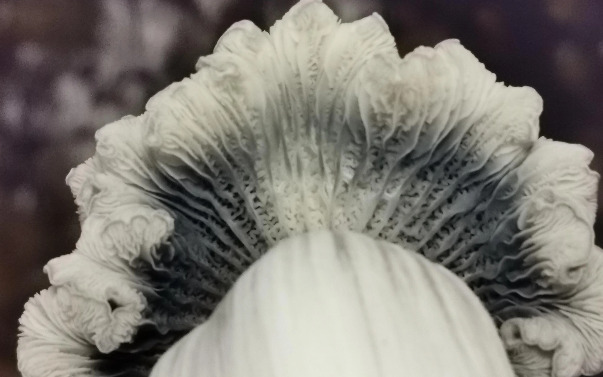
- Gills: adnate to adnexed, grey at first, darkening to purplish-black and mottled, with whitish edges.
- Stem: about 4-15 cm tall and 0.4-1.4 cm thick, white and hollow, yellowing with age, with a membranous ring that often darkens as spores fall on it.
- Spores: thick-walled, subhexagonal in face view and subellipsoid in side view. Two published ranges for the species:
- Singer & Smith (1958): 11.5-17.3 × 8-11.5 × 7-9 µm
- Guzmán et al. (2012): (12-)13-15(-17) × 8-10(-11) × 7-9 µm
- Spore print: wild-type P. cubensis prints purple-brown. No source documents a print colour for TBC. Some lore about the albino parent line mentions pale spores, so record the colour you actually see rather than assuming one.
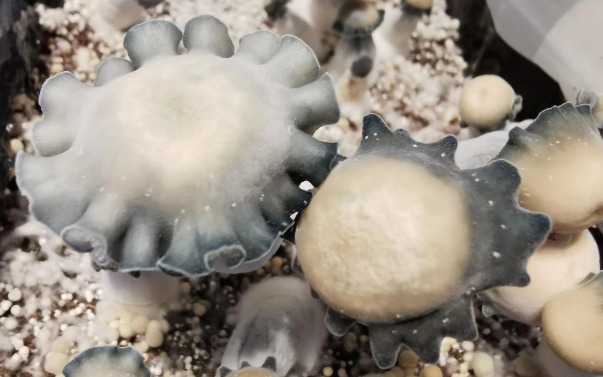
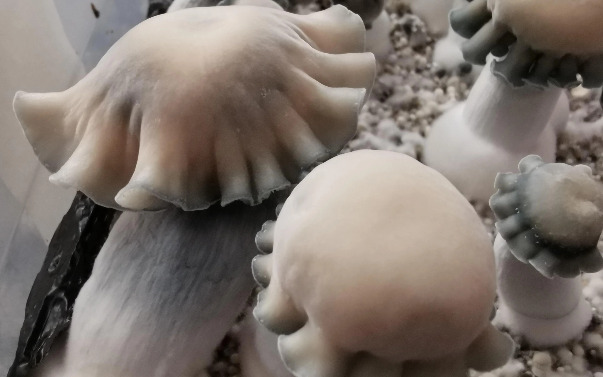
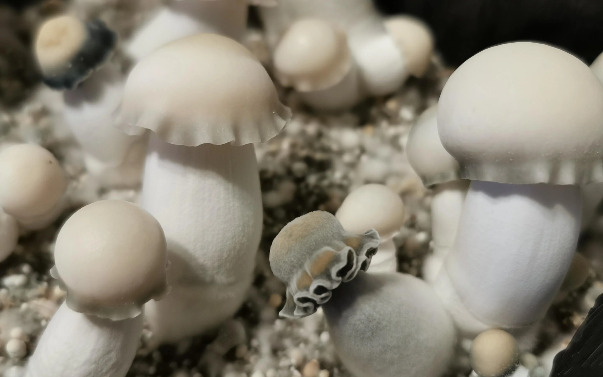
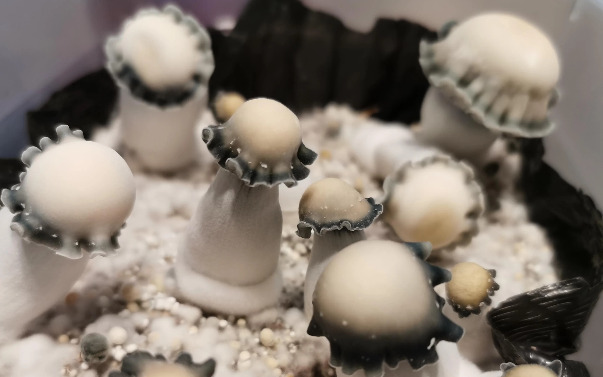
What vendors say about TBC: sellers describe small, dense fruit bodies with dark, dome-shaped or dark-centred caps, and say the line is visually unstable, varying in size and cap shape. These are informal observations. Nobody has published measurements, and nobody has explained the dark colouring.
Ecology of the species
Short answer: the species is a dung-loving saprotroph, and TBC is a cultivated isolate with no known wild population.
In the wild, P. cubensis feeds on dead organic matter rather than partnering with plant roots. Guzmán et al. (2012) describe it as common on cattle and horse dung in meadows, and it is recorded across tropical and subtropical regions worldwide. Any ecology statement applies to the species, not to the trade label.
Lineage and naming
Short answer: everything known about where TBC came from is community history, and the accounts do not agree.
- True Albino Teacher (TAT): community accounts say TAT began when albino fruits turned up among Golden Teacher material belonging to a hobbyist known online as Jik Fibs. A second hobbyist, Dave Wombat, is also credited with TAT isolates.
- TAT Black Cap: one vendor credits Jik Fibs with isolating TBC from a batch of TAT (Fungi Culture Store, vendor account). Another describes it as an isolation from TAT's "Ghost" sub-line (Humble Bruise, vendor account). A strain wiki credits Dave Wombat and Jik Fibs together and adds a later re-isolation by another hobbyist (Shroomok, community wiki).
- Earliest public post we found: a gallery post from late 2020 by Dave Wombat, describing TBC as a mutation of True Albino Teacher (r/Wombatmagic, breeder's own post).
- Related labels: cultures are also sold as "TBC Unstable" and "Wombat TBC," which vendors describe as separate lines (Fungi Culture Store, vendor account). Some strain wikis even attach the TBC name to a later descendant that looks quite different. So "TBC" can mean different cultures depending on who is selling it.
Because the sources conflict, we do not name a single isolator or a year, and we do not call TBC "stabilized." The honest summary: TBC is a named line that came out of the TAT family, with a disputed history. It is also a good example of how a trade name can spread quickly online while its origin stays fuzzy, which is worth remembering whenever you see a confident origin story attached to a strain name.
Identifying it
Short answer: microscopy supports a species-level note, not a TBC pedigree.
- Spore measurements: record length × width from a decent sample with a calibrated eyepiece, and note whether each spore is in face or side view. Compare against the species ranges above. Our spore microscopy 101 guide covers slides and measuring.
- Wall and germ pore: look for a thick, smooth wall and an apical germ pore.
- Print colour: note what you observe. For TBC, do not assume.
- Limits: spore traits can overlap across Psilocybe species (Ramírez-Cruz et al. 2013). Light microscopy cannot tell TBC apart from other P. cubensis labels, and it cannot show chemical content. For more on how much spores vary within the species, see P. cubensis spore diversity.
- Labels and records: since the name covers several cultures, write down the exact label, source and date for every sample.
- Lab testing: no published laboratory analysis of TAT Black Cap is known. Potency claims about it come from vendors and forums, and Mushly makes none.
Examining a slide
Follow the general method in our Golden Teacher guide and the mushroom spores guide, and then:
- Measure at least 20 spores (length × width) and record the magnification and mountant.
- Note the germ pore, the wall, and the spore shape in face and side view.
- Record the colour in the mountant and the print colour separately. Do not assume either.
- Write down the exact vendor label, source and date.
- Remember the limit: a fit to P. cubensis does not prove the TBC label.
Legal note
Mushly offers spores for microscopy, taxonomy, and mycological research. Laws on spores, and on psilocybin-containing mushrooms, differ by country and by U.S. state, and cultivation of psilocybin- or psilocin-containing species is illegal under U.S. federal law and in many other jurisdictions. There is no wild TBC population to protect, so the practical responsibilities are honest record-keeping and staying within the law. Check the law where you live before ordering.
Browse spore syringes for microscopy · Strain library
References
- Index Fungorum: Psilocybe cubensis (Earle) Singer, RecordID 290107
- MycoBank: Psilocybe cubensis
- Guzmán et al. 2012, Mycotaxon 119: 65-81: spore dimensions, dung habitat
- Ramírez-Cruz et al. 2013, Canadian Journal of Botany: phylogeny and trait overlap in Psilocybe
- Singer, R. & Smith, A.H. (1958). Mycologia 50.
- Wikipedia: Psilocybe cubensis: species macro-morphology summary
- International Code of Nomenclature for algae, fungi, and plants
- Community and vendor accounts (lore, not verified): Fungi Culture Store: TAT Black Cap; Fungi Culture Store: TBC Unstable; Humble Bruise; Shroomok; r/Wombatmagic




What is TAT Black Cap?