

Updated: October 10, 2026
Purple Mystics mushroom spores are sold strictly for microscopy and research purposes only. Cultivation of Psilocybin-containing fungi is illegal in many jurisdictions. This page is not a guide to finding, growing, or taking mushrooms.
Short answer: Purple Mystics (also written Purple Mystic) is a trade name for material sold as Psilocybe Cubensis (Earle) Singer. It is not a separate species, a published variety, or a recognised variant. Most sellers say it was collected from cow or horse pasture in East Plant City, Florida, by a forum user with a handle like "Blackdove," but the handle is spelled several ways, one seller says Arcadia, Florida, and none gives a date, a specimen or a real name. The name does not mean the mushroom is purple. Under a microscope, a sample shows the spore characters of P. cubensis, which cannot confirm the label or the origin.
Home » Strain Encyclopedia » Psilocybe Cubensis » Purple Mystics
In this guide
- What Purple Mystics is
- Taxonomy
- What is documented and what is lore
- Spore and cap traits
- Origin claims, source by source
- Names and spellings
- Identifying it, and what a microscope can't tell you
- Examining a slide
- Mushly products
- Legal note
- FAQ
- References
What Purple Mystics is
Purple Mystics is one of many named lines of Psilocybe cubensis in Mushly's all-strains library. The name is a catalogue label used by spore sellers. It describes a product and not a taxon, and a town in a seller's text is a claim and not a specimen record. For the difference between a species and a trade name, see our species vs strain primer and the Psilocybe cubensis species guide.
"Purple Mystics is a Psilocybe cubensis trade name. Sellers place it in Plant City, Florida and credit a forum handle, but one says Arcadia. Spore traits."




Taxonomy
| Rank | Entry |
|---|---|
| Kingdom | Fungi |
| Phylum | Basidiomycota |
| Class | Agaricomycetes |
| Order | Agaricales |
| Family | Placement varies by source: Index Fungorum, Species Fungorum and NCBI list Agrocybaceae, while Wikipedia and many other references use Hymenogastraceae. One seller page uses Strophariaceae, an older placement. |
| Genus | Psilocybe |
| Species | Psilocybe cubensis (Earle) Singer, Sydowia 2(1-6): 37 (1948) |
| Basionym | Stropharia cubensis Earle (1906), described from Cuba |
| Trade name | Purple Mystics (informal) |
Species records: Index Fungorum 290107, the Species Fungorum synonymy and NCBI Taxonomy 181762. None lists Purple Mystics.
What is documented and what is lore
| Question | Status |
|---|---|
| Is Purple Mystics a species or published variety? | No. The only formal name is Psilocybe cubensis. |
| Spore size and shape | Published for the species only, with no Purple Mystics-specific measurements. |
| Found in East Plant City, Florida | Seller claim only. Most sellers say so, one says Arcadia. No date, specimen or herbarium record is published. |
| Collected by "Blackdove" | Seller claim only. The handle is spelled several ways and no real name is given. |
| Dung or substrate | Sellers say cow, horse, or both. Unverified. |
| Does the name mean a purple cap? | A seller says no, and others describe a purple ring or tint. Seller descriptions only. |
| Published literature using the name | PubMed returned no results for either spelling with cubensis when Mushly checked, and we found none. |
Spore and cap traits
Short answer: the published measurements describe the species, not this name.
Singer and Smith's 1958 Mycologia monograph (Mycological investigations on Teonanácatl) describes P. cubensis spores as:
- Size: 11.5-17.3 × 8-11.5 × 7-9 µm
- Surface: smooth, with a thick, complex wall
- Apex: truncate, from a distinct apical pore
- Colour in a mountant: dark yellow brown in KOH, dark olive brown in NH4OH
The KOH and NH4OH colours are mountant colours, not spore-print colours. The paper does not mention Purple Mystics. Guzmán et al. (2012) give a second species-level range of (12-)13-15(-17) × 8-10(-11) × 7-9 µm.
Seller descriptions are not diagnostic, and they differ. These are descriptions, not measurements:
- Spore size: PNW Spore says "sub-ellipsoid and 10-12 by 8 micrometers." It gives no method, and the length starts below the published species range (11.5-17.3 µm), so we treat it as an unverified seller figure and not as a Purple Mystics measurement.
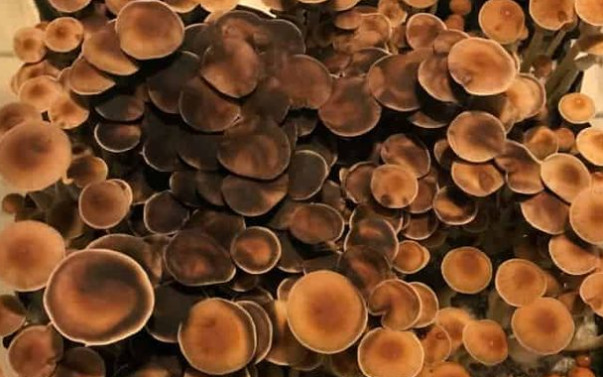
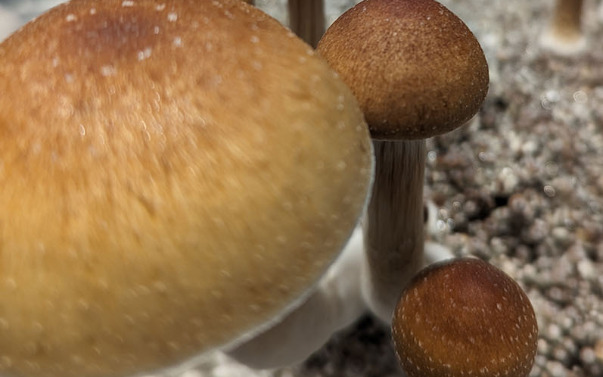
- Caps: PNW Spore describes "the purple ring that develops around the cap when found in the wild," with light brown caps shown in an image. Mushly's earlier page also cited Spore Genetics ("a unique purplish hue in the center with a darker brown perimeter"), Premium Spores ("light golden brown to a warmer caramel or chestnut shade," and a warning that the name does not mean an entirely purple cap) and Inoculate the World ("thin and light brown").
- Spore colour: PNW Spore says "deep, saturated purple pigmentation," and Mushly's earlier page cited "deep dark purple," "purplish-brown" and "dark purplish-brown" from other sellers. These are print-colour descriptions and not measurements.
- Syringe labels such as 12 cc or 12 mm are not spore sizes.
None of the pages we checked gives a measured spore size for this label that we could confirm. Record what you actually see on your own slide.
Origin claims
Short answer: most sellers agree on East Plant City, Florida and a forum handle, then disagree on the handle's spelling and on the dung. One says a different town.
| Source | What it says |
|---|---|
| PNW Spore | "Originated from cow pastures in East Plant City, FL," "found growing in pastures in East Plant City, FL from both bovine and equine dung," "collected and named by 'Blackdove,'" a "community mycologist." Gives no date. |
| Mushly hub (previous version) | "Associated with East Plant City, Florida, and linked to a cultivator known as 'Blackd0voe.'" Habitat given as horses or cattle. |
| Spore Genetics (as cited on Mushly's earlier page) | "Collected from cow pastures in East Plant City, Florida," and "originally discovered by a researcher known as Blackdove." |
| Premium Spores (as cited on Mushly's earlier page) | "Originally documented in pastureland near East Plant City, Florida," by "the original cultivator." Dung wording conflicts (bovine and equine, or equine only). |
| Inoculate the World (as cited on Mushly's earlier page) | "The original wild strain was foraged in Plant City, Florida by shroomery.org user: Blackd0ve420." |
| Mycology Now (as cited on Mushly's earlier page) | Says the material came from "a cow field in Arcadia, Florida." Names no handle. |
| Mushly syringe page (previous version) | "Sourced from the well-documented Purple Mystic strain." Names no town, collector or dung. |
The sellers agree on Florida, and most on East Plant City. They disagree on the handle (Blackdove, Blackd0voe, Blackd0ve420), on whether the dung was bovine, equine or both, and on the town (Mycology Now says Arcadia). A forum handle is not a collector's identity, and no page gives a date, a specimen or a parent strain. We do not state a town, a person, a substrate or a year as fact. A repeated claim is still one claim.
Names and spellings
- Purple Mystic and Purple Mystics are written both ways, even on one seller's site. We found no source showing they are different lines, so Mushly treats them as one catalogue name.
- The handle appears as Blackdove, Blackd0voe and Blackd0ve420. We cannot say which, if any, is correct.
- The name does not mean purple caps. Premium Spores warns against that reading, while others describe a purple ring or tint. We take no side on how common that trait is.
- Not a related line: other Florida-linked labels are separate catalogue names. See our Treasure Coast and Gulf Coast pages. A shared state is not a lineage.
Record the exact label, supplier and date on every sample.
Identifying it
Short answer: microscopy supports a species-level note, not a strain identity.
- What a match shows: smooth, thick-walled spores with a truncate apex and germ pore, within the published species range, support P. cubensis as the species to compare. Ramírez-Cruz et al. 2013 notes that spore characters overlap across Psilocybe.
- What it cannot show: that a packet is Purple Mystics rather than another cubensis label, that it came from Florida, or that it is linked to any forum user.
- Chemistry: Mushly makes no claims about the chemical content of Purple Mystics, and we found no published laboratory analysis under this name.
Examining a slide
Follow the general method in our Golden Teacher guide and the mushroom spores guide, and then:
- Measure at least 20 spores (length × width) and record the magnification and mountant.
- Note the germ pore, the wall, and the shape in face and side view.
- Record the colour in the mountant and the print colour separately.
- Write down the exact label (Purple Mystics), supplier and date.
- Remember the limit: a fit to P. cubensis does not prove the Purple Mystics label.
Mushly products
Mushly lists a Purple Mystic spore syringe (12 cc). Stock and price are shown on the product page, and it was out of stock when we last checked (October 3, 2026). The 12 cc and 12 mm figures on the label are syringe dimensions and not spore sizes. Products are sold for microscopy only, and a product listing is not evidence of the origin stories above. Browse our spore syringes for microscopy for current stock.
Legal note
Mushly offers spores for microscopy, taxonomy, and mycological research. Laws on spores, and on psilocybin-containing mushrooms, differ by country and by U.S. state, and cultivation of psilocybin- or psilocin-containing species is illegal under U.S. federal law and in many other jurisdictions. Check the law where you live before ordering.
Browse spore syringes · Strain library · Mushroom spores for microscopy guide
References
- Index Fungorum 290107; Species Fungorum synonymy; NCBI Taxonomy 181762
- Singer, R. & Smith, A.H. (1958), Mycologia 50
- Guzmán et al. 2012, Mycotaxon 119: 65-81
- Ramírez-Cruz et al. 2013, Canadian Journal of Botany
- Seller claims (not papers, not verified): PNW Spore; Spore Genetics, Premium Spores, Inoculate the World and Mycology Now (as cited on Mushly's earlier page; not re-checked)


What is Purple Mystics?