

Updated: October 12, 2026
Wollongong mushroom spores are sold strictly for microscopy and research purposes only. Cultivation of Psilocybin-containing fungi is illegal in many jurisdictions. This page is not a guide to finding, growing, or taking mushrooms.
Short answer: Wollongong is a trade name for material sold as Psilocybe Cubensis (Earle) Singer. It is not a separate species, a published variety, or a recognised variant. Sellers tie it to the city of Wollongong and the Illawarra region of New South Wales, Australia, but they word the claim differently and none names a collector, a parent or a collection site. P. cubensis itself is reported from Australia, but a species record is not a record of any packet sold under this name. Under a microscope, a sample shows the spore characters of P. cubensis, which cannot confirm the label or the origin.
Home » Strain Encyclopedia » Psilocybe Cubensis » Wollongong
In this guide
- What Wollongong is
- Taxonomy
- What is documented and what is lore
- Spore and cap traits
- Origin claims, source by source
- The species in Australia and the trade name
- Names and look-alike names
- Identifying it, and what a microscope can't tell you
- Examining a slide
- Mushly products
- Legal note
- References
- FAQ
What Wollongong is
Wollongong is one of many named lines of Psilocybe cubensis in Mushly's all-strains library. The name is a catalogue label used by spore sellers. It describes a product and not a taxon, and a place in the name is a seller's claim and not a specimen record. For the difference between a species and a trade name, see our species vs strain primer and the Psilocybe cubensis species guide.
"Wollongong mushroom is a Psilocybe cubensis trade name linked to New South Wales, Australia, but no source names a collector or specimen. Claims compared."


Taxonomy
| Rank | Entry |
|---|---|
| Kingdom | Fungi |
| Phylum | Basidiomycota |
| Class | Agaricomycetes |
| Order | Agaricales |
| Family | Placement varies by source: Index Fungorum, Species Fungorum and NCBI list Agrocybaceae, while Wikipedia and many other references use Hymenogastraceae. Neither is an error. |
| Genus | Psilocybe |
| Species | Psilocybe cubensis (Earle) Singer, Sydowia 2(1-6): 37 (1948) |
| Basionym | Stropharia cubensis Earle (1906), described from Cuba |
| Trade name | Wollongong (informal) |
Species records: Index Fungorum 290107, the Species Fungorum synonymy and NCBI Taxonomy 181762. None lists Wollongong.
What is documented and what is lore
| Question | Status |
|---|---|
| Is Wollongong a species or published variety? | No. The only formal name is Psilocybe cubensis. |
| Is the species reported from Australia? | Yes. Wikipedia gives its Australian range as northern Queensland to southern New South Wales. |
| Spore size and shape | Published for the species only, with no Wollongong-specific measurements. |
| Origin in the Illawarra or around Wollongong | A seller claim, worded differently by each seller. No collector or record is given. |
| Donated by an unnamed amateur mycologist | A claim in a pasted forum blurb. No record supports it. |
| Published literature using the name | None identified. |
Spore and cap traits
Short answer: the published measurements describe the species, not this name.
Singer and Smith's 1958 Mycologia monograph (Mycological investigations on Teonanácatl) describes P. cubensis spores as:
- Size: 11.5-17.3 × 8-11.5 × 7-9 µm
- Surface: smooth, with a thick, complex wall
- Apex: truncate, from a distinct apical pore
- Colour in a mountant: dark yellow brown in KOH, dark olive brown in NH4OH
The KOH and NH4OH colours are mountant colours, not spore-print colours. The paper does not mention Wollongong. Guzmán et al. (2012) give a second species-level range of (12-)13-15(-17) × 8-10(-11) × 7-9 µm.
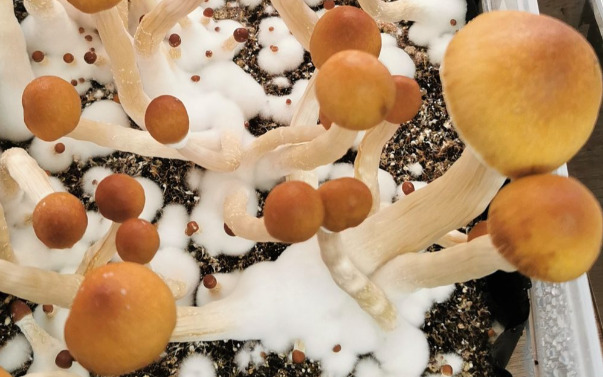
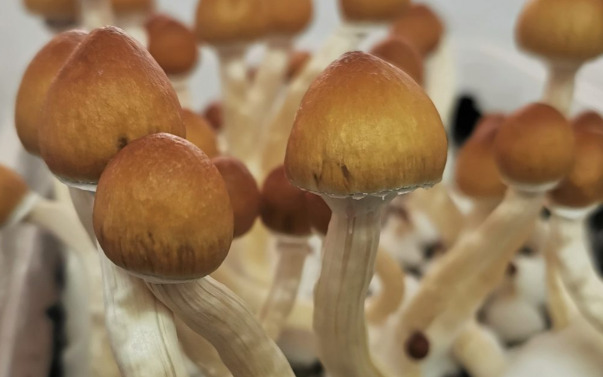
Seller descriptions of the cap and stem are not diagnostic, and they differ. These are descriptions, not measurements. Mushly's hub describes almond to golden-brown caps with stripes. Zombie Myco describes caramel to butterscotch caps with thick white stems. A forum blurb on Mycotopia describes spotted caps and completely gold stalks. Cap colour varies with age, light and moisture within the species, so none of these separates Wollongong from other cubensis labels. No source gives a measured spore size for this label. Record what you actually see on your own slide.
Origin claims
Short answer: sellers agree on the Wollongong area, then word it differently, and none names a person or a site.
| Source | What it says |
|---|---|
| Mushly hub | "Originating from the Illawarra escarpment near Wollongong, Australia." Names no collector, year or parent. |
| Zombie Myco | "Originally discovered in the coastal regions surrounding Wollongong, New South Wales, Australia." Names no person or year. |
| Mushroom Man Mycology | "Originated south of Sydney in Australia." Names no city, person or year. |
| Saltón Verde | "Originating from the Wollongong region on the east coast of Australia." Names no person or year. |
| Mycotopia (2009 forum thread) | The poster says it is "from Wollongong australia." A pasted blurb says an unnamed amateur mycologist donated it and that it comes from the Illawarra escarpment. The poster does not claim it is unique. |
| Ralphsters Spores | "An interesting strain from down under, available for several years, and now becoming more popular." Names no place. |
The sellers agree on Australia, and most agree on the Wollongong area. They differ on whether it was "discovered" in the wild, "donated," or only "from" there, and on how wide the area is: a city, the Illawarra escarpment, the coast around it, or simply south of Sydney. Wollongong is a coastal city south of Sydney, so these claims are broadly compatible, but a broad match is still not a record. No source names a collector, a parent strain, a site, a specimen number or a herbarium record, and the Mycotopia thread is a forum post and not a publication. We do not state a collector, a site or a year as fact. A repeated claim is still one claim.
The species in Australia and the trade name
Wikipedia reports P. cubensis in Australia from northern Queensland to southern New South Wales. It describes the species as growing on cow dung and occasionally horse dung, and says it is thought to have colonised Australia with the introduction of cattle. So a P. cubensis record near Wollongong is plausible, but a species record is not a record of a particular culture. Nothing links the packets sold as Wollongong to a documented specimen, a collector, or a place in the Illawarra.
Names and look-alike names
- Wollongong: one catalogue label. No source shows a different line behind it.
- The city and the label: a label named after a place is not a record from that place. The Illawarra claim is one of the seller stories above.
- Other labels that carry a place name: Cuba, Panama, Ecuador and Fiji are separate catalogue names, and a shared style of name is not a lineage.
Record the exact label, supplier and date on every sample.
Identifying it
Short answer: microscopy supports a species-level note, not a strain identity.
- What a match shows: smooth, thick-walled spores with a truncate apex and germ pore, within the published species range, support P. cubensis as the species to compare. Ramírez-Cruz et al. 2013 notes that spore characters overlap across Psilocybe.
- What it cannot show: that a packet is Wollongong rather than another cubensis label, that it came from the Wollongong area, or that it was collected or donated by any named person.
- Chemistry: Mushly makes no claims about the chemical content of Wollongong, and no published laboratory analysis under this name is known.
Examining a slide
Follow the general method in our Golden Teacher guide and the mushroom spores guide, and then:
- Measure at least 20 spores (length × width) and record the magnification and mountant.
- Note the germ pore, the wall, and the shape in face and side view.
- Record the colour in the mountant and the print colour separately.
- Write down the exact label (Wollongong), supplier and date.
- Remember the limit: a fit to P. cubensis does not prove the Wollongong label.
Mushly products
Mushly does not currently list a syringe, print or multi-pack named Wollongong. This page is a reference note and not a product page. To study related lines, browse our spore syringes for microscopy or see the Psilocybe cubensis strain list.
Legal note
Mushly offers spores for microscopy, taxonomy, and mycological research. Laws on spores, and on psilocybin-containing mushrooms, differ by country and by U.S. state, and cultivation of psilocybin- or psilocin-containing species is illegal under U.S. federal law and in many other jurisdictions. Check the law where you live before ordering.
Browse spore syringes · Strain library · Mushroom spores for microscopy guide
References
- Index Fungorum 290107; Species Fungorum synonymy; NCBI Taxonomy 181762
- Singer, R. & Smith, A.H. (1958), Mycologia 50
- Guzmán et al. 2012, Mycotaxon 119: 65-81
- Ramírez-Cruz et al. 2013, Canadian Journal of Botany
- Wikipedia: Psilocybe cubensis (distribution, habitat)
- Seller claims (not papers, not verified): Zombie Myco; Mushroom Man Mycology; Saltón Verde; Ralphsters Spores; Mycotopia forum thread (2009)


Where does Wollongong come from?