

Updated: October 6, 2026
African Transkei mushroom spores are sold strictly for microscopy and research purposes only. Cultivation of Psilocybin-containing fungi is illegal in many jurisdictions. This page is not a guide to finding, growing, or taking mushrooms.
Short answer: African Transkei, also sold as South African Transkei or simply Transkei, is a trade name for material sold as Psilocybe Cubensis (Earle) Singer. It is not a separate species, a published variety, or a recognised variant. Sellers say it comes from the Transkei region of South Africa's Eastern Cape, but their details conflict, none names a collector, and no published record documents it. Under a microscope, a sample shows the spore characters of P. cubensis, which cannot confirm the label or the origin.
Home » Strain Encyclopedia » Psilocybe Cubensis » African Transkei
In this guide
- What African Transkei is
- Taxonomy
- What is documented and what is lore
- Spore and cap traits
- Origin claims, source by source
- Names and spellings
- Identifying it, and what a microscope can't tell you
- Examining a slide
- Mushly products
- Legal note
- References
- FAQ
What African Transkei is
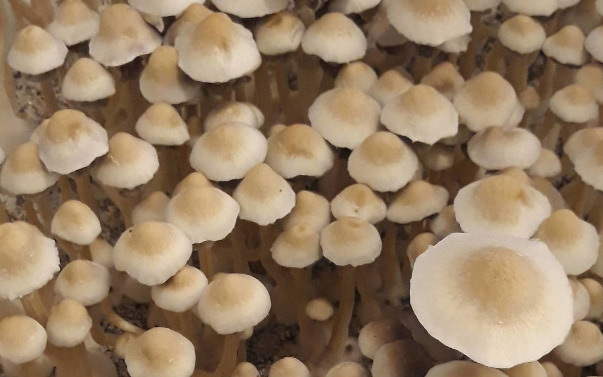
African Transkei is one of many named lines of Psilocybe cubensis in Mushly's all-strains library. The name is a catalogue label used by spore sellers. It describes a product and not a taxon, and a region in the name is a seller's claim and not a specimen record. For the difference between a species and a trade name, see our species vs strain primer and the Psilocybe cubensis species guide.
"African Transkei mushroom is a Psilocybe cubensis trade name, not a species. Sellers cite the Eastern Cape, but details conflict. Claims and spore traits."

Taxonomy
| Rank | Entry |
|---|---|
| Kingdom | Fungi |
| Phylum | Basidiomycota |
| Class | Agaricomycetes |
| Order | Agaricales |
| Family | Placement varies by source: Index Fungorum, Species Fungorum and NCBI list Agrocybaceae, while Wikipedia, Zombie Myco and many other references use Hymenogastraceae |
| Genus | Psilocybe |
| Species | Psilocybe cubensis (Earle) Singer, Sydowia 2(1-6): 37 (1948) |
| Basionym | Stropharia cubensis Earle (1906), described from Cuba |
| Trade name | African Transkei / South African Transkei / Transkei (informal) |
Species records: Index Fungorum 290107, the Species Fungorum synonymy and NCBI Taxonomy 181762. None lists Transkei.
What is documented and what is lore
| Question | Status |
|---|---|
| Is Transkei a species or published variety? | No. The only formal name is Psilocybe cubensis. |
| Spore size and shape | Published for the species only, with no Transkei-specific measurements. |
| From South Africa's Eastern Cape | Seller claim only. No collector, voucher or herbarium record is published. |
| Collected in 2002 | One seller's claim. No other source gives a date. |
| "First African" or "one of the very few wild African varieties" | Seller claims. No source supports them. |
| Published literature using the name | None is known. |
Spore and cap traits
Short answer: the published measurements describe the species, not this name.
Singer and Smith's 1958 Mycologia monograph (Mycological investigations on Teonanácatl) describes P. cubensis spores as:
- Size: 11.5-17.3 × 8-11.5 × 7-9 µm
- Surface: smooth, with a thick, complex wall
- Apex: truncate, from a distinct apical pore
- Colour in a mountant: dark yellow brown in KOH, dark olive brown in NH4OH
The KOH and NH4OH colours are mountant colours, not spore-print colours. The paper does not mention Transkei. Guzmán et al. (2012) give a second species-level range of (12-)13-15(-17) × 8-10(-11) × 7-9 µm.
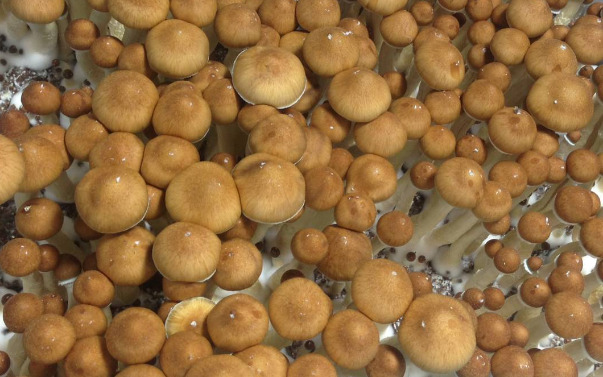
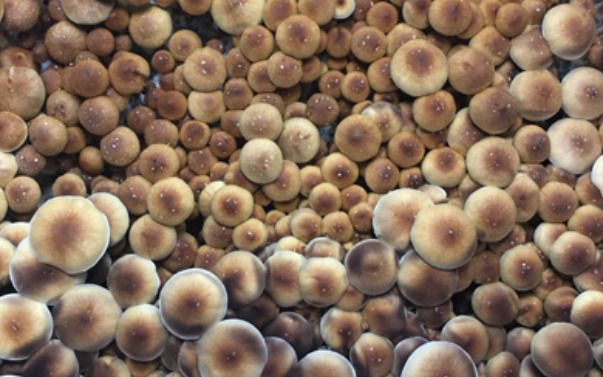
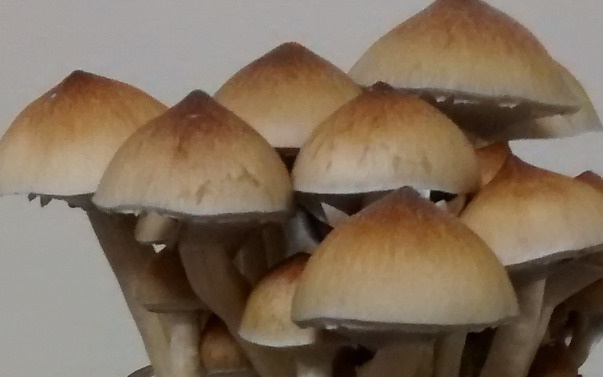
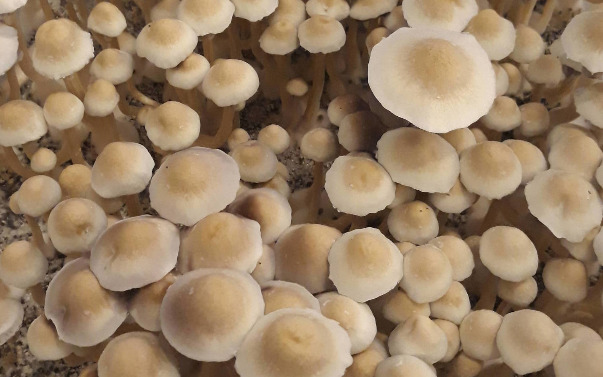
Seller descriptions are not diagnostic, and they differ. Caps are described as "golden to caramel" (Zombie Myco), "golden-brown caps that darken with age" (Spore Genetics), "classic browns and tans" with "purple-colored spores" (Basidium Equilibrium) and "pale white and golden hue" (MyShrooms). Those are descriptions and not measurements, and caps change with age and conditions. None of the pages we checked gives a measured spore size for this label. Record what you actually see on your own slide.
Origin claims
Short answer: the sellers agree on South Africa and disagree on the details.
| Source | What it says |
|---|---|
| Spore Genetics | "South Africa's Eastern Cape, originally collected in 2002 near Durban on the Wild Coast"; "one of the very few wild cubensis varieties ever confirmed in Africa." Names no collector. |
| Zombie Myco | "Wild landscapes of the Transkei region, located in the Eastern Cape," "found growing in the wild, reportedly near the coast and within pastures and wooded grasslands." Gives no date or collector. |
| Basidium Equilibrium | "Discovered in the coastal grasslands of South Africa's Eastern Cape, near the Transkei region." Gives no date or collector. |
| MyShrooms | "Originates from the Transkei region in the Eastern Cape," and "the first African psilocybin mushroom to enter the global research community." Gives no date or collector. |
The sources agree on the Eastern Cape and, mostly, on a coastal setting. They differ on the rest, and one claim contains an inconsistency: Durban is in KwaZulu-Natal, not the Eastern Cape, and the Wild Coast and the former Transkei lie further south in the Eastern Cape. We do not state a place, a year or a collector as fact. "First African" and "very few confirmed" are marketing superlatives, and none cites a record. A repeated claim is still one claim.
Names and spellings
Sellers use African Transkei, South African Transkei and Transkei for what appear to be the same product. Mushly's hub page used "Transkei" while its product listings use "African Transkei." Spore Genetics and Sporeworks also sell it as an "isolate," which would mean a selection step that none of them documents. Don't confuse it with Natal Super Strength, a separate catalogue name for a KwaZulu-Natal line (see our NSS page). A shared country is not a shared lineage. Record the exact label, supplier and date on every sample.
Identifying it
Short answer: microscopy supports a species-level note, not a strain identity.
- What a match shows: smooth, thick-walled spores with a truncate apex and germ pore, within the published species range, support P. cubensis as the species to compare. Ramírez-Cruz et al. 2013 notes that spore characters overlap across Psilocybe.
- What it cannot show: that a packet is Transkei rather than another cubensis label, that it came from the Eastern Cape, or that it is not a close African relative. Recent work on African Psilocybe species is discussed on our NSS page, and its relevance to this label is not established.
- Chemistry: Mushly makes no claims about the chemical content of Transkei, and no published laboratory analysis under this name is known.
Examining a slide
Follow the general method in our Golden Teacher guide and the mushroom spores guide, and then:
- Measure at least 20 spores (length × width) and record the magnification and mountant.
- Note the germ pore, the wall, and the shape in face and side view.
- Record the colour in the mountant and the print colour separately.
- Write down the exact label (African Transkei), supplier and date.
- Remember the limit: a fit to P. cubensis does not prove the Transkei label.
Mushly products
Mushly offers African Transkei as a spore syringe and as a spore print, for microscopy and taxonomic study. Check availability and price on each product page. Browse them through our spore syringes and spore prints categories.
Legal note
Mushly offers spores for microscopy, taxonomy, and mycological research. Laws on spores, and on psilocybin-containing mushrooms, differ by country and by U.S. state, and cultivation of psilocybin- or psilocin-containing species is illegal under U.S. federal law and in many other jurisdictions. Check the law where you live before ordering.
Spore syringes · Spore prints · Mushroom spores for microscopy guide
References
- Index Fungorum 290107; Species Fungorum synonymy; NCBI Taxonomy 181762
- Singer, R. & Smith, A.H. (1958), Mycologia 50
- Guzmán et al. 2012, Mycotaxon 119: 65-81
- Ramírez-Cruz et al. 2013, Canadian Journal of Botany
- Seller claims (not papers, not verified): Spore Genetics; Zombie Myco; Basidium Equilibrium; MyShrooms; Sporeworks


What is African Transkei?