

Updated: October 11, 2026
spores of Cuba mushrooms are sold strictly for microscopy and research purposes only. Cultivation of Psilocybin-containing fungi is illegal in many jurisdictions. This page is not a guide to finding, growing, or taking mushrooms.
Short answer: Cuba (also sold as Cuban) is a trade name for material sold as Psilocybe Cubensis (Earle) Singer. It is not a separate species, a published variety, or a recognised variant. The species itself is named for Cuba, because the American botanist Franklin Sumner Earle first described it there, and that is easy to confuse with a "Cuban strain." Sellers say the line "traces its lineage" to Cuba, but no source names a collector, a place or a date for the trade line, and the species' Cuban type specimen is a different thing from any packet sold under this name. Under a microscope, a sample shows the spore characters of P. cubensis, which cannot confirm the label or the origin.
Home » Strain Encyclopedia » Psilocybe Cubensis » Cuba
In this guide
- What Cuba is
- Taxonomy
- What is documented and what is lore
- Spore and cap traits
- The species, the island and the trade name
- Origin claims, source by source
- Names and look-alike names
- Identifying it, and what a microscope can't tell you
- Examining a slide
- Mushly products
- Legal note
- References
- FAQ
What Cuba is
Cuba is one of many named lines of Psilocybe cubensis in Mushly's all-strains library. The name is a catalogue label used by spore sellers. It describes a product and not a taxon, and a country in the name is a seller's claim and not a specimen record. For the difference between a species and a trade name, see our species vs strain primer and the Psilocybe cubensis species guide.
"Cuba mushrooms are a Psilocybe cubensis trade name. The species was first described from Cuba, but no source documents a Cuban strain. Claims compared."


Taxonomy
| Rank | Entry |
|---|---|
| Kingdom | Fungi |
| Phylum | Basidiomycota |
| Class | Agaricomycetes |
| Order | Agaricales |
| Family | Placement varies by source: Index Fungorum, Species Fungorum and NCBI list Agrocybaceae, while Wikipedia and many other references use Hymenogastraceae |
| Genus | Psilocybe |
| Species | Psilocybe cubensis (Earle) Singer, Sydowia 2(1-6): 37 (1948) |
| Basionym | Stropharia cubensis Earle (1906), described from Cuba |
| Trade name | Cuba, Cuban (informal) |
Species records: Index Fungorum 290107, the Species Fungorum synonymy and NCBI Taxonomy 181762. None lists a Cuba or Cuban cultivar. Some references, including Wikipedia, date Singer's transfer to Psilocybe to 1949 and not 1948.
What is documented and what is lore
| Question | Status |
|---|---|
| Is Cuba a species or published variety? | No. The only formal name is Psilocybe cubensis. |
| Was the species first described from Cuba? | Yes. Earle described Stropharia cubensis from Cuba, published in 1906. |
| Is there a documented Cuban strain behind the trade name? | No documented Cuban strain is known. A product named Cuba is not the same as the species' type material. |
| Spore size and shape | Published for the species only, with no Cuba-specific measurements. |
| "Traces its lineage directly to Cuba" | Seller claim only. No collector, date or herbarium record is given for the trade line. |
| Published literature using the name as a cultivar | None identified. |
Spore and cap traits
Short answer: the published measurements describe the species, not this name.
Singer and Smith's 1958 Mycologia monograph (Mycological investigations on Teonanácatl) describes P. cubensis spores as:
- Size: 11.5-17.3 × 8-11.5 × 7-9 µm
- Surface: smooth, with a thick, complex wall
- Apex: truncate, from a distinct apical pore
- Colour in a mountant: dark yellow brown in KOH, dark olive brown in NH4OH
The KOH and NH4OH colours are mountant colours, not spore-print colours. The paper does not mention a Cuba cultivar. Guzmán et al. (2012) give a second species-level range of (12-)13-15(-17) × 8-10(-11) × 7-9 µm.
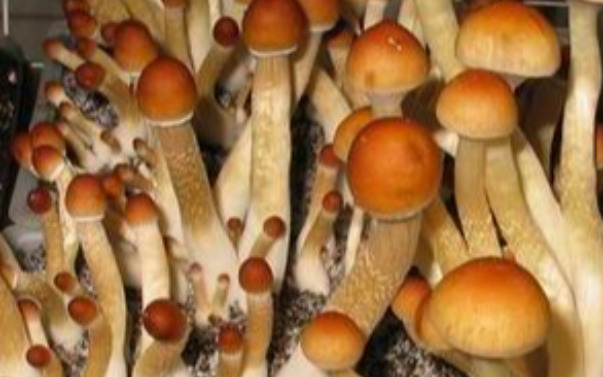
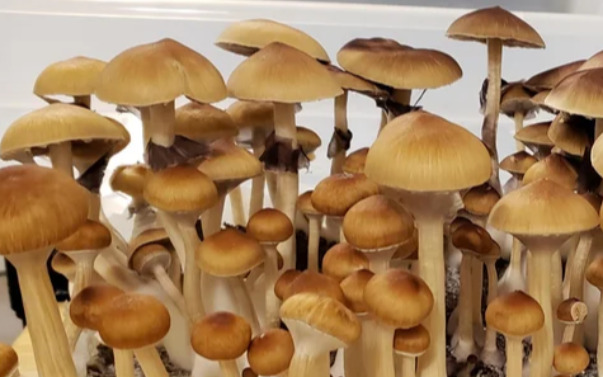
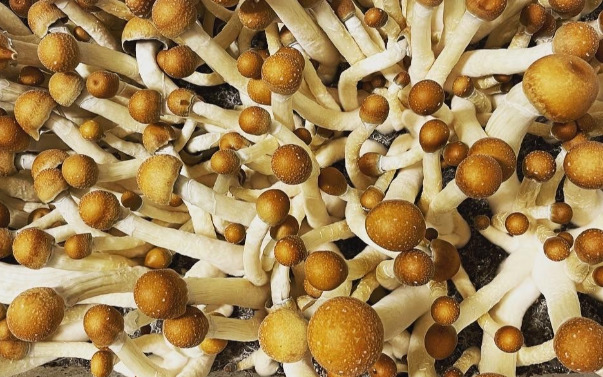
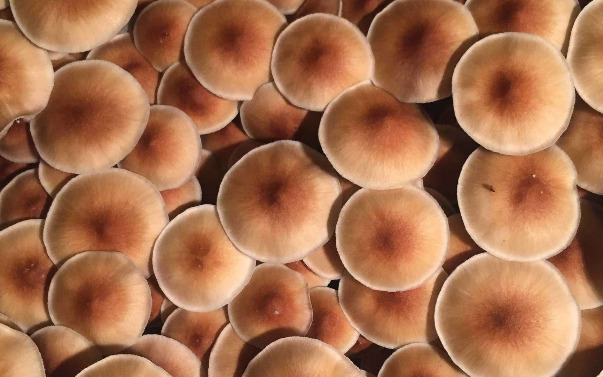
Seller descriptions are not diagnostic. These are descriptions, not measurements. Zombie Myco describes a "light golden-brown cap that is convex in younger specimens and flattens with age," 2 to 8 cm across, on a stem that "tends to be long and thick," and gives no spore colour, size or shape. No source gives a measured spore size for a Cuba-labelled product. Record what you actually see on your own slide.
The species, the island and the trade name
Cubensis means "coming from Cuba." Earle, who then directed the Estación Central Agronómica in Cuba, collected and described the species there, and it was published in 1906 as Stropharia cubensis. A New York Botanical Garden herbarium record (NY 761564) lists an Earle collection from Santiago de las Vegas, La Habana, dated 8 September 1904, and the record does not state a type status. That may explain why some sellers and writers say the species was found in 1904 and others say 1906: one is the apparent collection date, the other the publication date.
None of that makes a packet sold as "Cuba" a descendant of Earle's specimen. The type material is a dried herbarium specimen from the early 1900s, and a modern culture sold under a country's name is a separate thing. Sellers who merge the two are making a marketing claim, not a documented one.
A June 2026 article in The Microdose (The poster child for psychedelic mushrooms is named after a country that doesn't use it) quotes Cuban researchers saying the species is present in Cuba but largely unknown there as a psychedelic, is "not integrated into Cuban traditions or medicine," and has little documented history of Indigenous use on the island. That is one article's account, but it points the same way: the name records where the species was first described and does not mean there is a long-known local line.
Origin claims
Short answer: sellers claim a Cuban origin for the trade line, and the sources they rest on describe the species and not a strain.
| Source | What it says |
|---|---|
| Zombie Myco | The strain "traces its lineage directly to Cuba, where it was first reported growing in the wild," and the "Cuban variant was formally described growing wild on bovine dung in Cuba." Says it spread with cattle farming to the Caribbean, South and Central America, the southern U.S. and Southeast Asia. Names no collector and gives no collection date. |
| The Stain Blue Museum | "Discovered by F.S. Earle in Cuba in 1904 (as Stropharia cubensis)." Describes the species and makes no "Cuban strain" claim. |
| Mushly hub | "They originate from Cuba." Names no collector, place or date. |
The sellers agree that Cuba is the origin of the name. What they describe, a formal description in Cuba, is the history of the species and not of a trade line. A repeated claim is still one claim, and we do not state a collector, a place or a year for the trade line as fact.
Names and look-alike names
- Cuba, Cuban and cubensis: cubensis is the species name, and Cuba or Cuban is a catalogue label for a product. A page or a packet that says "Cuban cubensis" gives no more information than "cubensis."
- Gold Cap and similar common names: these name the whole species and not a Cuban line. See our Gold Cap page.
- Other countries' labels: Ecuador, Panama and other place-name labels are separate catalogue names. A shared country-style name is not a lineage.
- The Cuban type specimen: a herbarium specimen is not a culture, and no source links one to any product on the market.
Record the exact label, supplier and date on every sample.
Identifying it
Short answer: microscopy supports a species-level note, not a strain identity.
- What a match shows: smooth, thick-walled spores with a truncate apex and germ pore, within the published species range, support P. cubensis as the species to compare. Ramírez-Cruz et al. 2013 notes that spore characters overlap across Psilocybe.
- What it cannot show: that a packet is Cuba rather than another cubensis label, that it came from Cuba, or that it descends from Earle's material.
- Chemistry: Mushly makes no claims about the chemical content of Cuba, and no published laboratory analysis under this name is known.
Examining a slide
Follow the general method in our Golden Teacher guide and the mushroom spores guide, and then:
- Measure at least 20 spores (length × width) and record the magnification and mountant.
- Note the germ pore, the wall, and the shape in face and side view.
- Record the colour in the mountant and the print colour separately.
- Write down the exact label (Cuba or Cuban), supplier and date.
- Remember the limit: a fit to P. cubensis does not prove the Cuba label.
Mushly products
Mushly does not currently list a syringe, print or multi-pack named Cuba or Cuban. This page is a reference note and not a product page. To study related lines, browse our spore syringes for microscopy or see the Psilocybe cubensis strain list.
Legal note
Mushly offers spores for microscopy, taxonomy, and mycological research. Laws on spores, and on psilocybin-containing mushrooms, differ by country and by U.S. state, and cultivation of psilocybin- or psilocin-containing species is illegal under U.S. federal law and in many other jurisdictions. Check the law where you live before ordering.
Browse spore syringes · Strain library · Mushroom spores for microscopy guide
References
- Index Fungorum 290107; Species Fungorum synonymy; NCBI Taxonomy 181762
- Singer, R. & Smith, A.H. (1958), Mycologia 50
- Guzmán et al. 2012, Mycotaxon 119: 65-81
- Ramírez-Cruz et al. 2013, Canadian Journal of Botany
- Wikipedia: Psilocybe cubensis
- New York Botanical Garden herbarium record, NY 761564
- The Microdose, June 15, 2026
- Seller and museum claims (not papers, not verified): Zombie Myco; The Stain Blue Museum


What is Cuba?