

About Reishi (Ganoderma lucidum and relatives): Name, Family, Spore Data and Look-alikes Mushrooms
Updated: October 10, 2026
This page is a taxonomy and microscopy reference. It is not medical advice, a foraging guide, or a growing guide, and it makes no health claims.
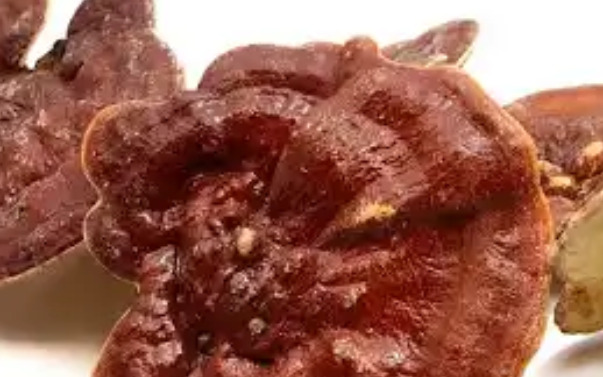
Short answer: "Reishi" is a common name, not a species. On the Mushly hub it is paired with Ganoderma lucidum (Curtis) P. Karst., the name Index Fungorum currently accepts, but the same word is also used for Ganoderma sichuanense (also sold as G. lingzhi) and for other laccate (glossy-capped) Ganoderma. Recent work treats G. lucidum and G. sichuanense as different species, so a product labelled "reishi" may not be G. lucidum. Sources also disagree on the family (Polyporaceae or Ganodermataceae) and on spore size, and part of that disagreement is because they describe different species.
Home » Strain Encyclopedia » Reishi
In this guide
- What Reishi is
- Taxonomy
- Where the sources agree and differ
- Spore data
- Ecology and range
- Look-alikes and look-alike names
- Examining a slide
- Mushly products
- Legal and safety note
- References
- FAQ
What Reishi is
Reishi (from Japanese) and lingzhi (from Chinese) are common names applied to glossy, red-to-black bracket fungi in the genus Ganoderma. Neither is a scientific name. On Mushly, Reishi is listed in the all-strains library next to other non-cubensis species such as Lion's Mane, Turkey Tail and Cordyceps. It is not a Psilocybe Cubensis strain, and it does not follow the trade-name pattern of the cubensis pages.
"Reishi is a common name used for several Ganoderma species, not one species. Ganoderma lucidum, G. sichuanense (lingzhi) and relatives are often confused. Taxonomy, spore data and look-alikes compared."

Taxonomy
| Rank | Entry |
|---|---|
| Kingdom | Fungi |
| Phylum | Basidiomycota |
| Class | Agaricomycetes |
| Order | Polyporales |
| Family | Placement varies by source: Index Fungorum lists Polyporaceae, while Wikipedia and many modern references use Ganodermataceae |
| Genus | Ganoderma P. Karst. (1881) |
| Species (hub name) | Ganoderma lucidum (Curtis) P. Karst., Rev. Mycol., Toulouse 3(9): 17 (1881) |
| Basionym | Boletus lucidus Curtis (1781), from European material |
| Common names | Reishi, lingzhi, lacquered bracket, varnished conk |
Species record: Index Fungorum 148413. Index Fungorum calls G. lucidum the "current name" but lists its position in the family as uncertain, which is one reason sources differ.
The name problem. Wikipedia says G. lucidum "is not a synonym for G. sichuanense (nor G. lingzhi) and is not in the same clade," and describes Ganoderma taxonomy as "chaotic." The lingzhi article says G. sichuanense (Zhao & Zhang, 1983) is the accepted name and G. lingzhi (Wu, Cao & Dai, 2012) is treated as a later synonym, citing Du et al. (2023). It adds that Asian populations were later "established" as distinct from European ones, both morphologically and phylogenetically.
Where the sources agree and differ
| Question | What the sources say |
|---|---|
| Is "reishi" one species? | No. The word is applied to G. lucidum, G. sichuanense (lingzhi) and other laccate species. |
| Family | Polyporaceae (Index Fungorum). Ganodermataceae (Wikipedia and many modern references). Neither is an error on this page's part. |
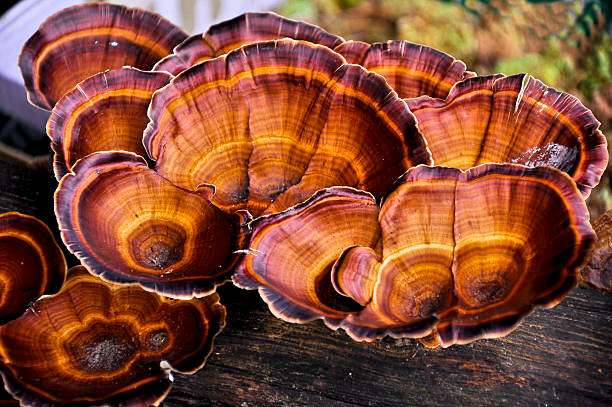
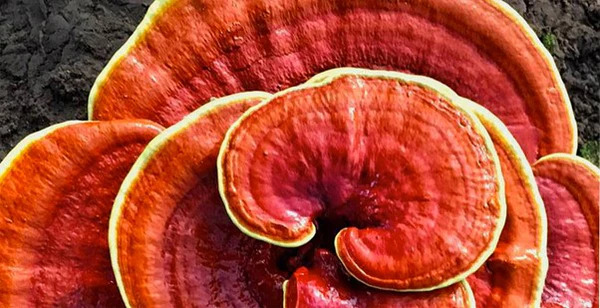
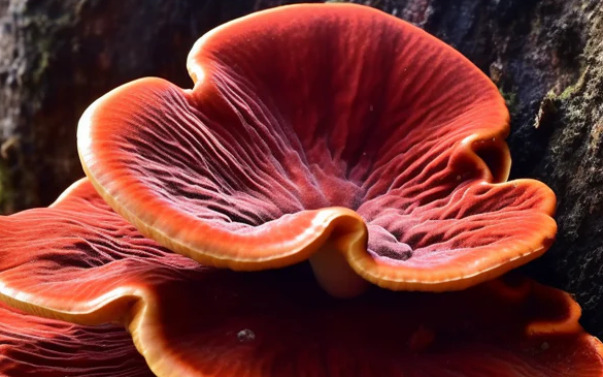
| Cap colour | "orange-red to almost black" (NatureSpot), concentric yellow, orange, red and purplish zones turning purple-brown then black (First Nature), and "purple-brown" and "red-coloured" (Wikipedia, on one page). Colour varies with age and species. |
| Spore print | Reddish-brown (First Nature; MushroomExpert for G. sessile). |
| Native range | Sources give different ranges (see Ecology and range). |
| Whether Asian "lingzhi" is the same species as European G. lucidum | Recent summaries say no. |
Spore data
Short answer: the figures below are secondary sources and describe different species, so none of them is a measurement of a Mushly product.
Ganoderma spores are unusual under the microscope. They are ellipsoid with a truncated end, double-walled with a pigmented inner wall that carries fine ornamentation, and many descriptions add a clear outer layer (a myxosporium or "appendix"). Whether that layer is included changes the measurement, so compare figures only when the method matches.
| Species | Spore size | Source and notes |
|---|---|---|
| G. lucidum (hub name) | 8.2-12.1 × 4.8-8.9 µm (averages 10.7 × 7.1) | Wikipedia. Secondary summary. |
| G. lucidum | 7-12 × 6-8 µm | First Nature. Secondary field-guide figure. |
| G. sessile (a different species, once folded into G. lucidum in North America) | 8.5-14 × 5.5-8 µm, including the clear appendix | MushroomExpert. |
| G. sichuanense (Thai material) | 8.3-9.8 × 5.7-6.8 µm with the outer layer; 6.2-7.5 × 4.2-5.3 µm without | Faces of Fungi entry (uncredited). |
| G. sichuanense (original separation) | 7.4-9.2 × 5-6.6 µm | Cao et al. 2012, as reported on the Faces of Fungi page. |
We give no Mushly-specific measurement. Record what you actually see on your own slide, and note whether you included the outer layer.
Ecology and range
- Hosts: First Nature says it is parasitic mainly at or near the bases of old oak and maple, and sometimes grows on stumps of recently felled broadleaf trees. Wikipedia says decaying hardwood stumps, mainly plum or oak. MushroomExpert says G. sessile grows on hardwoods.
- Range: First Nature says it is uncommon in Britain and Ireland and "occurs throughout mainland Europe as well as in many parts of Asia and North America." Wikipedia gives several different range statements on one page. MushroomExpert says G. lucidum is a non-native species found in only two North American places (Utah and northern California), possibly introduced by cultivators, citing Loyd and colleagues (2017, 2018). Index Fungorum and NCBI state no range.
- Substrate: Wikipedia reports softwoods as poor substrates, with newer work reporting G. lucidum degrading Scots pine wood. These are secondary statements.
Treat range statements with care. Because the name is applied to several species, a record of "reishi" in a place does not show it was G. lucidum.
Look-alikes
This is a taxonomy note, not an identification guide. Do not eat or use a wild fungus on the strength of a web page.
- G. sichuanense (lingzhi): the East Asian species sold as "lingzhi," treated as distinct from G. lucidum in recent summaries.
- G. tsugae and G. oregonense: named on Wikipedia as closer relatives of G. lucidum than G. sichuanense is.
- G. sessile: the species North American records of G. lucidum usually refer to, per MushroomExpert.
- G. curtisii and G. ravenelii: named on Wikipedia as sister taxa of G. sichuanense.
- G. resinaceum and G. applanatum (artist's conk): named by First Nature, with G. resinaceum having larger spores and smaller pores, and G. applanatum ochre-brown and broadly attached.
- Product labels: Wikipedia reports a DNA study in which most grow-your-own kits and half of the dried products labelled G. lucidum contained G. sichuanense, and only one kit contained G. lucidum. The University of Florida's summary of the study (UF/IFAS, 2018) says it tested 37 products (20 manufactured and 17 kits) and found "none of the manufactured products and only one of the kits actually contained Ganoderma lucidum." The study is Loyd et al. 2018, Frontiers in Microbiology 9: 1557.
Examining a slide
Follow the general method in our mushroom spores guide, and then:
- Prepare the spores in water or a weak KOH mountant and record which.
- Measure at least 20 spores, and record the magnification and whether the outer layer is included.
- Note the truncated end, the double wall and the surface ornamentation.
- Record the print colour and the mountant colour separately.
- Write down the exact label, supplier and date.
- Remember the limit: spore characters can separate Ganoderma from other bracket fungi, but they cannot reliably separate G. lucidum from G. sichuanense or from other laccate species.
Mushly products
Mushly lists a Reishi Mushroom Culture. It is a culture syringe holding a liquid culture of mycelium, and it is not a spore syringe. It was out of stock when we last checked (October 3, 2026). The culture product states no spore size and no species determination beyond the label, so this page does not treat it as G. lucidum. See the spore syringes for microscopy for current stock of spore products.
Legal and safety note
Mushly offers mushroom specimens for microscopy, taxonomy and mycological research. Reishi is not a psilocybin-containing species, but rules on importing or shipping live cultures vary by country, so check your local rules. This page makes no health or treatment claims, and nothing here is medical advice.
Browse spore syringes · Strain library · Mushroom spores for microscopy guide
References
- Index Fungorum 148413
- Wikipedia, Ganoderma lucidum; Wikipedia, Lingzhi mushroom
- First Nature, Ganoderma lucidum
- MushroomExpert, Ganoderma sessile
- Faces of Fungi entry for Ganoderma sichuanense
- UF/IFAS (2018), summary of Loyd et al. 2018, Frontiers in Microbiology 9: 1557
- Species Fungorum synonymy 148413, NCBI Taxonomy 5315, GBIF, iNaturalist, NatureSpot, Wild Food UK and North Spore




Is Reishi a Psilocybe cubensis strain?