

About Lions Mane (Hericium erinaceus): Taxonomy, Spore Traits and Look-alikes Mushrooms
Updated: October 4, 2026
spores and cultures are sold for microscopy and research purposes. This page is a reference for observing a species. It is not a foraging guide and not medical advice. Never eat a wild mushroom on the strength of an online description.
Short answer: Lion's Mane is the common name of Hericium erinaceus (Bull.) Pers., a real, formally named species and not a Psilocybe Cubensis strain or trade name. It is a wood-decay fungus that forms a cluster of long, soft spines rather than a cap and gills. Its spores are white, smooth to finely roughened, and amyloid. "Lion's mane" is also used loosely for other toothed fungi, so a common name alone doesn't identify a species. Mushly does not currently list a dedicated Lion's Mane product.
Home » Strain Encyclopedia » Edible and Medicinal Species » Lion's Mane
In this guide
- What Lion's Mane is
- Taxonomy
- What sources agree on and where they differ
- Fruiting body and spore traits
- Ecology and distribution
- Common names and related species
- Examining a slide
- Mushly products
- Legal note
- References
- FAQ
What Lion's Mane is
"Lion's Mane" is a common name for one species, Hericium erinaceus, named for its mass of hanging spines. It is unrelated to the Psilocybe cubensis lines Mushly lists, and a common name is not a catalogue strain. In English it also goes by bearded tooth, bear's head and, in Japanese, yamabushitake, although field guides don't share one common-name list and some of those names are applied to other Hericium species as well.
"Lions Mane is the common name of Hericium erinaceus, a toothed wood-decay fungus with white amyloid spores. Taxonomy, published spore data, related species, and what microscopy can and cannot show."


Taxonomy
| Rank | Entry |
|---|---|
| Kingdom | Fungi |
| Phylum | Basidiomycota |
| Class | Agaricomycetes |
| Order | Russulales |
| Family | Hericiaceae |
| Genus | Hericium |
| Species | Hericium erinaceus (Bull.) Pers. (1797) |
| Basionym | Hydnum erinaceus Bull. (1781) |
| Synonyms (Wikipedia) | Clavaria erinaceus; Dryodon erinaceus |
| Common names | Lion's mane, bearded tooth, yamabushitake |
Please check the record pages if you need the exact citation, because the NCBI current-name line omits the year that Index Fungorum gives. Family placement (Hericiaceae, order Russulales) is consistent across the sources checked.
What sources agree on and where they differ
| Question | Status |
|---|---|
| Is Lion's Mane a formal species? | Yes. Hericium erinaceus has a published name and authority. |
| Spore size | Published in field guides with different ranges. See below. |
| Spore print and amyloid reaction | White print, amyloid spores, in all sources checked. |
| Where it grows | Europe, North America and Asia. Sources word the range differently. |
| One species or several? | A preliminary DNA study suggests multiple phylogenetic species may be involved. |
| Health benefits | Mushly makes no cognitive, nutritional or medicinal claims for this species. |
Fruiting body and spore traits
Short answer: soft spines instead of gills, and small white amyloid spores.
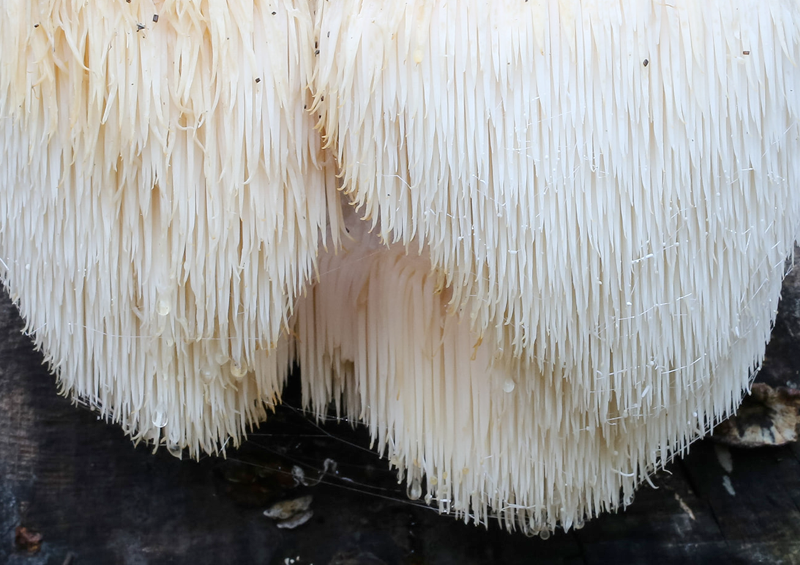
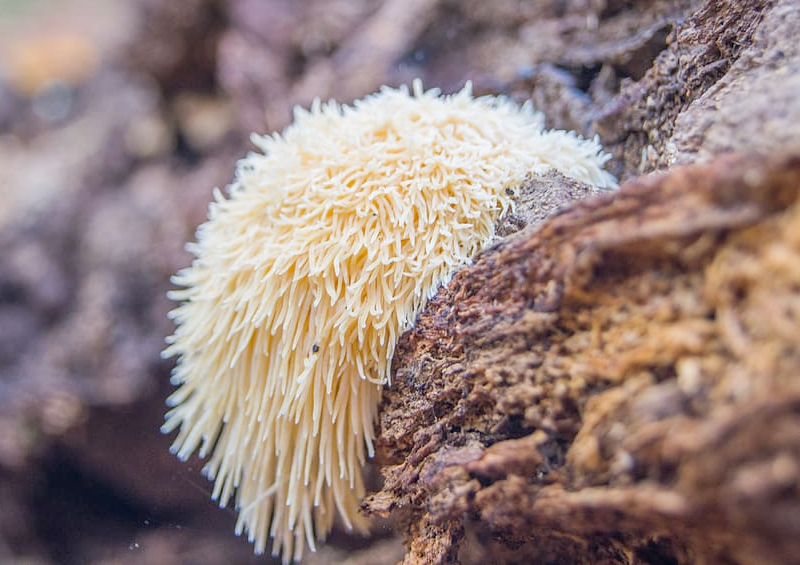
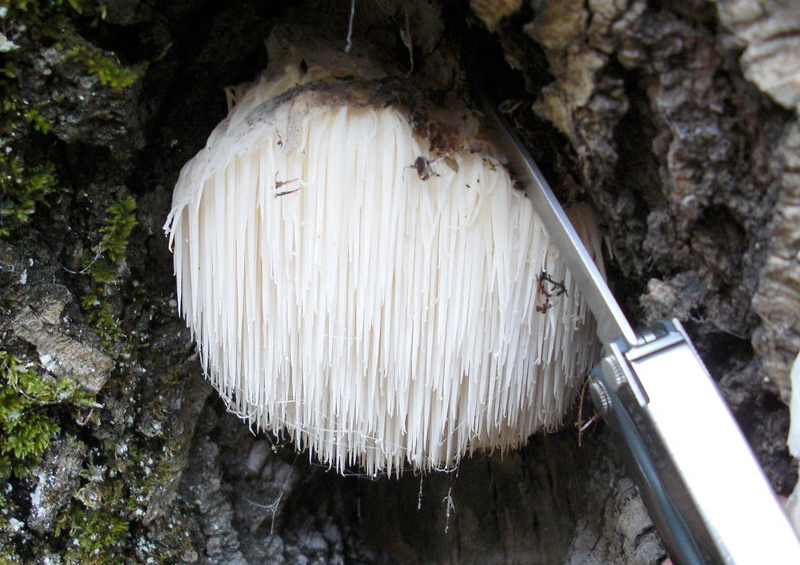
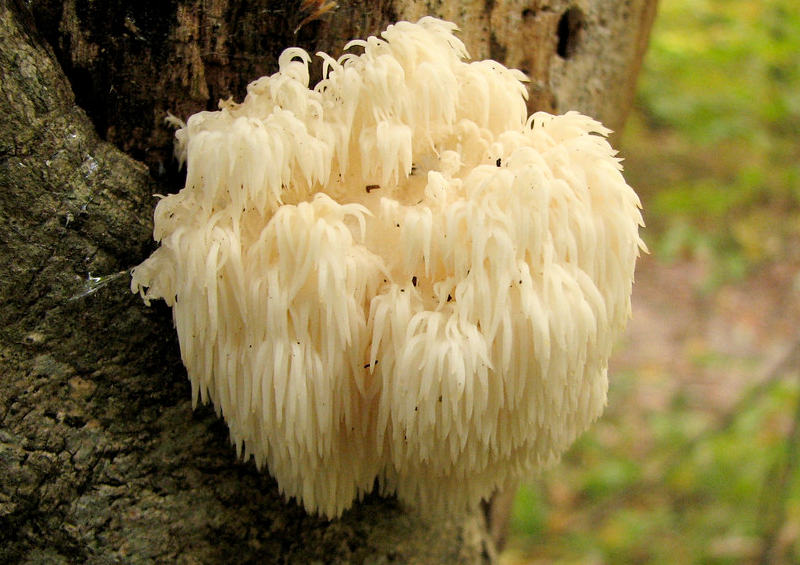
- Fruiting body: a single mass of long, soft, hanging spines, white when fresh, with no cap and gills in the usual sense.
- Spore print: white.
- Spore shape and wall: subglobose to short ellipsoid, smooth to finely roughened, colourless, amyloid (they stain blue-grey to blue-black in Melzer's reagent).
| Source | Spore size |
|---|---|
| Wikipedia | about 5-7 × 4-5 µm |
| MushroomExpert.com | 5-6 × 5.5-6 µm |
Both are secondary sources and the two ranges differ slightly, with the second listing a width equal to or above the length, which fits "globose to subglobose." Neither is a primary taxonomic treatment, so measure your own sample and record the mountant. Spores this small and round are hard to tell from those of related Hericium species by size alone.
Ecology and distribution
H. erinaceus grows on dead or wounded hardwoods, often beech, maple or oak, and causes a white rot. Sources describe it as saprobic and sometimes parasitic, fruiting singly or in pairs in late summer and autumn, and over winter and spring in warmer regions. Wikipedia describes it as native to North America and Eurasia, and MushroomExpert gives a wider list including Central America. It is red-listed in several European countries according to Wikipedia, so wild collection is restricted or discouraged in some places. Check local rules before collecting anything.
Common names and related species
- Hericium americanum and H. coralloides: branched relatives in eastern North America. Young specimens of branched Hericium species can resemble Lion's Mane before they develop their branching.
- Names for the same group: "pom-pom," "bearded tooth," "bear's head" and "coral tooth" are applied to different Hericium species by different guides.
- Other toothed or spiny fungi: Wikipedia lists Donkia pulcherrima, Radulomyces copelandii and some Sarcodontia species as superficially similar.
Treat these as a reason to check the scientific name on any label, culture or product, not as an identification key. Identification of wild fungi should never rest on one feature.
Examining a slide
- Mount a small piece of spine tissue or a spore deposit in water, then in Melzer's reagent, and record both.
- Measure at least 20 spores (length × width) and note the magnification.
- Note the shape (subglobose to short ellipsoid), the wall (smooth to finely roughened) and the amyloid reaction.
- Record print colour separately from the mountant colour.
- Remember the limit: matching the published description supports Hericium, but spores alone do not separate the species.
Mushly products
Mushly lists edible and medicinal cultures in its edible cultures category. No dedicated Lion's Mane product page is known, so check the category for what is listed and its scientific name before buying.
Legal note
Lion's Mane is not a psilocybin-containing species and is legal to possess in most places, but laws on spores and cultures differ by country and region, and some regions restrict wild collection. Check the rules where you live. Mushly's microscopy products are sold for research and study.
Edible cultures · Mushroom spores for microscopy guide
References
- Index Fungorum 356812 and NCBI Taxonomy 91752 (check the record pages for the exact citation)
- Wikipedia: Hericium erinaceus (synonyms, spore data, habitat, distribution, look-alikes, conservation status)
- MushroomExpert.com: Hericium erinaceus (spore data, authority note, DNA note citing Hallenberg et al. 2013)




What is Lion's Mane?