

About Turkey Tail (Trametes versicolor): Taxonomy, Spores and Look-alikes Mushrooms
Updated: October 2, 2026
This article is for educational and microscopy purposes only and is not medical or legal advice. Turkey tail is discussed for scientific study and cultural context. Nothing here is a health claim or a recommendation to consume any fungus. Always follow local laws.
Short answer: Turkey tail is Trametes versicolor (L.) Lloyd, a common, worldwide bracket fungus (Polyporaceae) that rots dead hardwood. Its smooth, slightly curved, cylindrical spores are tiny, about 4-6 × 1.5-2.5 µm, and print white. It is also widely known by an older name, Coriolus versicolor, which is the name most of the medical literature still uses.
In this guide
- What turkey tail is
- Taxonomy
- Name history: Coriolus versicolor and other synonyms
- Fruit body and spore traits
- Ecology and distribution
- Look-alikes
- Examining a slide
- Cultural context and a note on health research
- Legal note
- References
- FAQ
What turkey tail is
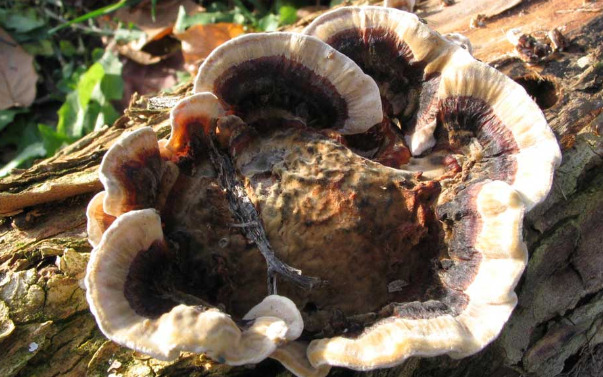
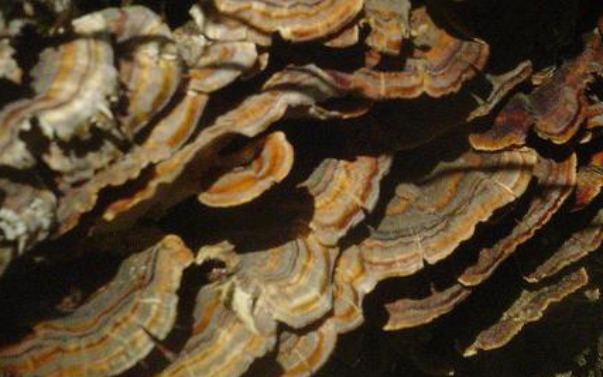
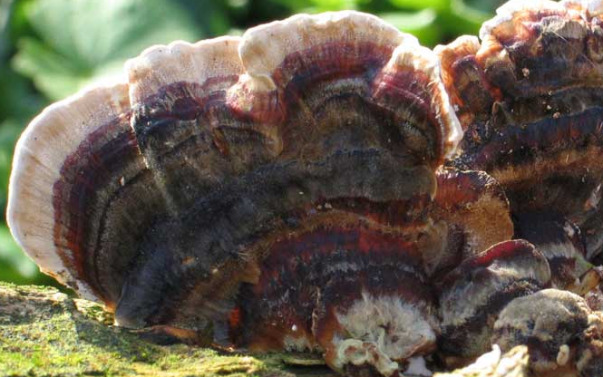
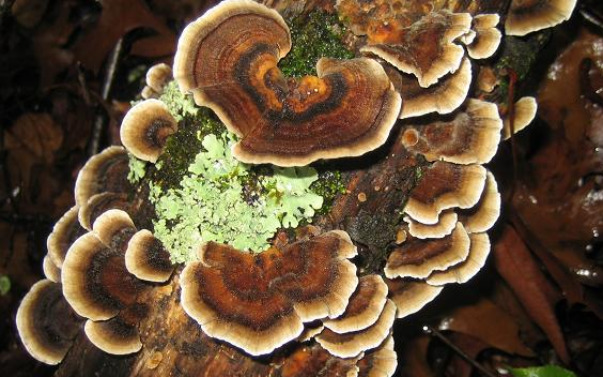
The common name comes from the fan-shaped, multicoloured brackets, which resemble a wild turkey's tail feathers. The epithet versicolor means "of several colours," and the fungus is one of the most variable and easily recognised polypores. It is a useful subject for mycology students because its wood decay, microscopic anatomy and spores are all easy to study.
"Turkey tail is Trametes versicolor, a common bracket fungus. Spore size, look-alikes, why it is also called Coriolus versicolor, and a note on health research."


Taxonomy
| Rank | Entry |
|---|---|
| Kingdom | Fungi |
| Phylum | Basidiomycota |
| Class | Agaricomycetes |
| Order | Polyporales |
| Family | Polyporaceae |
| Genus | Trametes |
| Species | Trametes versicolor (L.) Lloyd (1921) |
Authorities give the Lloyd combination as 1920 or 1921 depending on the source. Older literature often cites a 1936-1939 combination by Pilát, which is why you may see "(L.) Pilát" on some pages. Check Index Fungorum for the current record.
Name history
Short answer: it was described by Linnaeus in 1753 and has moved between genera several times, so the same fungus appears under different names.
- Boletus versicolor L. (1753): the original name, and the basionym.
- Polyporus versicolor (L.) Fr. (1821): moved into the large genus Polyporus.
- Coriolus versicolor (L.) Quél. (1886): the name used for a century in medical and supplement literature.
- Trametes versicolor (L.) Lloyd (1921): the current accepted name.
Other synonyms include Polystictus versicolor and Trametes azurea (Biota of New Zealand; First Nature). Because most medical studies were published under Coriolus versicolor, searches for research need both names (Habtemariam 2020). The Chinese name is yún zhī.
Fruit body and spore traits
Short answer: thin, leathery, multi-zoned brackets with a white, pored underside, and very small smooth spores.
- Fruit body: a bracket or shelf, up to about 10 cm across, fan-shaped and attached along one side. The upper surface is velvety to finely hairy with concentric zones of colour (brown, tan, grey, blue, green, orange or white). Colours are highly variable (MykoWeb).
- Underside: a white to pale yellowish surface with very small pores, not gills.
- Texture: tough and leathery, too tough to eat.
- Hyphal system: trimitic, meaning the flesh contains three hyphal types (generative, skeletal and binding hyphae). This is a key microscopic character of polypores, and the flesh is white and about 1-2 mm thick (Biota of New Zealand).
- Spore print: white.
- Spores: smooth, thin-walled and hyaline (colourless), slightly curved-cylindrical, often compared to a sausage or hot dog. Published ranges:
- MykoWeb and First Nature: 4-6 × 1.5-2.5 µm, white to pale yellow in a deposit, and inamyloid (First Nature)
- Biota of New Zealand: 4-6 × 1-2 µm
These spores are much smaller and narrower than those of the species Mushly's other pages cover, so they need high magnification (see below).
Ecology and distribution
Short answer: a wood-decay fungus found on dead hardwood in almost every region of the world.
Trametes versicolor is a saprotroph that decays the wood of dead hardwoods, growing in tiled layers, rows or overlapping groups on logs, stumps, standing dead trees and fallen branches. It is common throughout the world (Wikipedia).
- Season: fruit bodies can be found almost all year but are most obvious in autumn and winter, when deciduous trees are bare (First Nature; MykoWeb gives fall to spring in California).
- Ecological role: by breaking down wood, including its tough lignin, it returns nutrients to the soil.
- Spread: spores are dispersed by wind.
Look-alikes
Short answer: several other bracket fungi resemble it, and the underside tells them apart.
- Stereum ostrea (false turkey tail): a similar zoned bracket, but its underside is smooth, with no pores.
- Trametes hirsuta (hairy bracket): a close relative with a hairier surface and less distinct zoning (Wikipedia).
- Trametes betulina and other Trametes species: listed as similar species in references, and best separated with a field guide.
Use a pored underside, the zoning and a white spore print together, and use proper keys and experienced mycologists. Do not identify wild fungi from a photo or from one character alone.
Examining a slide
Spores of this species are small and colourless, so they are low-contrast under plain brightfield. Follow the general method in our Golden Teacher guide and the mushroom spores guide, and then:
- Use 1000x with oil immersion, since 400x is rarely enough for spores about 1.5-2.5 µm wide.
- Close the condenser diaphragm slightly, or use phase-contrast, to make the thin walls visible.
- Take the print on dark paper or a clean slide, since it is white.
- Measure at least 20 spores and compare the range with 4-6 × 1.5-2.5 µm.
- For the hyphal system, you need a thin section of the fruit body, not spores, to see the generative, skeletal and binding hyphae.
- Record the substrate (host tree), location and date.
Cultural context and a note on health research
Short answer: this page makes no health claims, and the research is specific to extracts, not to the whole fungus.
- Cultural context: in China the fungus is known as yún zhī and has a history in traditional herbal practice. We cite this as cultural history only.
- Research context: most published work concerns polysaccharide preparations such as PSK and PSP, which were isolated from cultures of Coriolus versicolor (Habtemariam 2020 reviews this literature). PSK is approved in Japan as an adjuvant therapy in cancer treatment, but it is not approved in the United States for treating cancer or any clinical condition (Wikipedia).
- What that does not mean: research on an extract does not show that eating or handling the mushroom has any effect. Anyone with a health question should talk to a healthcare professional.
Legal note
Mushly offers cultures and spores for microscopy, taxonomy and mycological research. Trametes versicolor is not a psychoactive species and is not controlled like psilocybin-containing fungi, but rules on importing biological material and on selling products vary by country. Check the rules where you live.
Shop edible and medicinal cultures
References
- MykoWeb, California Fungi: Trametes versicolor: description, spores, habitat
- First Nature: Trametes versicolor, Turkeytail fungus: spores, season, taxonomic history
- Biota of New Zealand: Trametes versicolor (L.) Lloyd 1921: nomenclature, synonyms, hyphal system, spores
- Wikipedia: Trametes versicolor and Trametes hirsuta: overview, look-alikes
- Habtemariam S. (2020), Biomedicines 8(5): 135: review of PSP and PSK research; notes the literature is mostly under Coriolus versicolor
- Index Fungorum: current name record (check the record before publishing)




What is turkey tail?