

Puerto Rican cubensis is a catchy trade and community name for a line of Psilocybe Cubensis. It names where a line is said to come from. It is not a separate species on Index Fungorum. For microscopy readers, the useful skill is reading labels. The two-part name gives the species. “Puerto Rican” is the source label on a print or syringe. What you can actually check on a slide are the spore traits recorded for P. cubensis: size, thick wall, germ pore at the tip and purple-brown print. Pair this page with Mushly’s primer on species vs strain and the mushroom spores hub. The goal here is taxonomy and records. It gives no cultivation instructions and makes no effects claims.
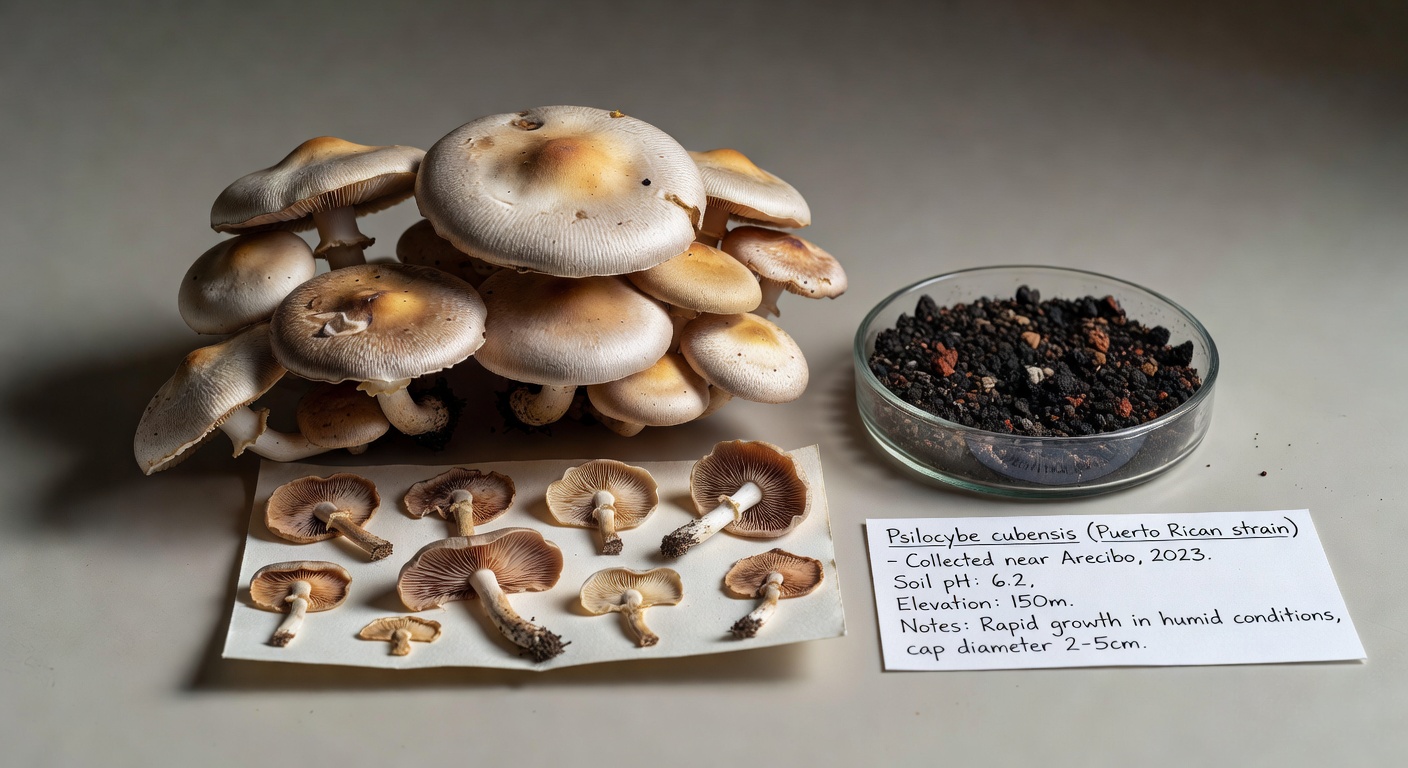
Puerto Rican Inside P. cubensis—Not a Separate Taxon
Under the International Code of Nomenclature for algae, fungi, and plants (ICN), the scientific name is the two-part name. Article 23 governs species names. Related rank rules are in Article 2 and Article 4. Article 24 covers names below species. A readable overview is on the ICN Wikipedia page.
You can check the current use of this species name in several places. Index Fungorum has a Psilocybe cubensis current-name search and NamesRecord 290107. That record is Psilocybe cubensis (Earle) Singer, 1948, with the original name Stropharia cubensis Earle 1906. There is also Species Fungorum’s GSD species page and NCBI Taxonomy TaxId 181762. Searching Index Fungorum for “Puerto Rican” finds no formal published taxon by that name. That is just what you expect for a shop or community source label.
In biology and commerce, a strain is an informal label for a named line or product inside a species. Puerto Rican fits that layer. It is a useful source label for microscopy notes. It is not a rival species name or a grow recipe. Treating every place nickname as a new species mixes up catalogs and formal naming. The species history of Psilocybe cubensis rests on Earle’s 1906 description and Singer’s 1948 combination. Do not read “Puerto Rican” back into that first description. Do not invent a Puerto Rico type locality for the species itself.
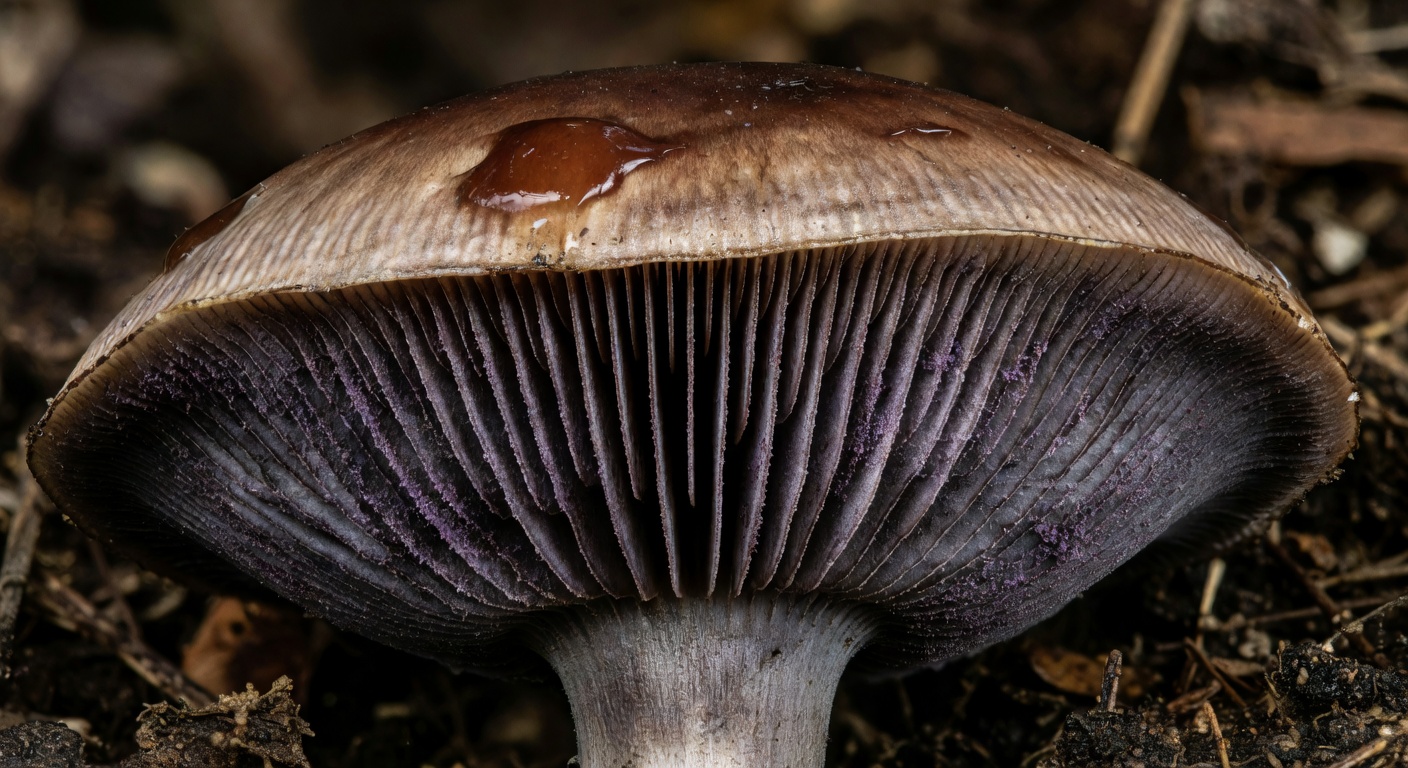
Provenance Lore, Not Ethnobotany
Vendor and community notes often tie the Puerto Rican trade line to a collection story near Canóvanas, in northeastern Puerto Rico. Keep that as source lore in your notebook. It is not a published herbarium type or a plant-use study. It does not prove unique island spore measures. A place nickname on a syringe or print is a source label. It is not proof of a separate species, chemical type or peer-reviewed local variety.
At the species level, P. cubensis lives on dung in tropical and subtropical areas. It is widely spread, often in places linked to people. Cite that as species ecology (see notes in Guzmán et al. 2012). It does not prove that a Puerto Rican product has hurricane-proof mycelium, volcanic-soil tuning or other island-only traits. Place-name products such as Mazatapec or Transkei are also separate trade labels inside the same species. They are useful for label literacy. Do not merge every Caribbean or tropical nickname into one taxon.
Spore Characters to Document (Species Level)
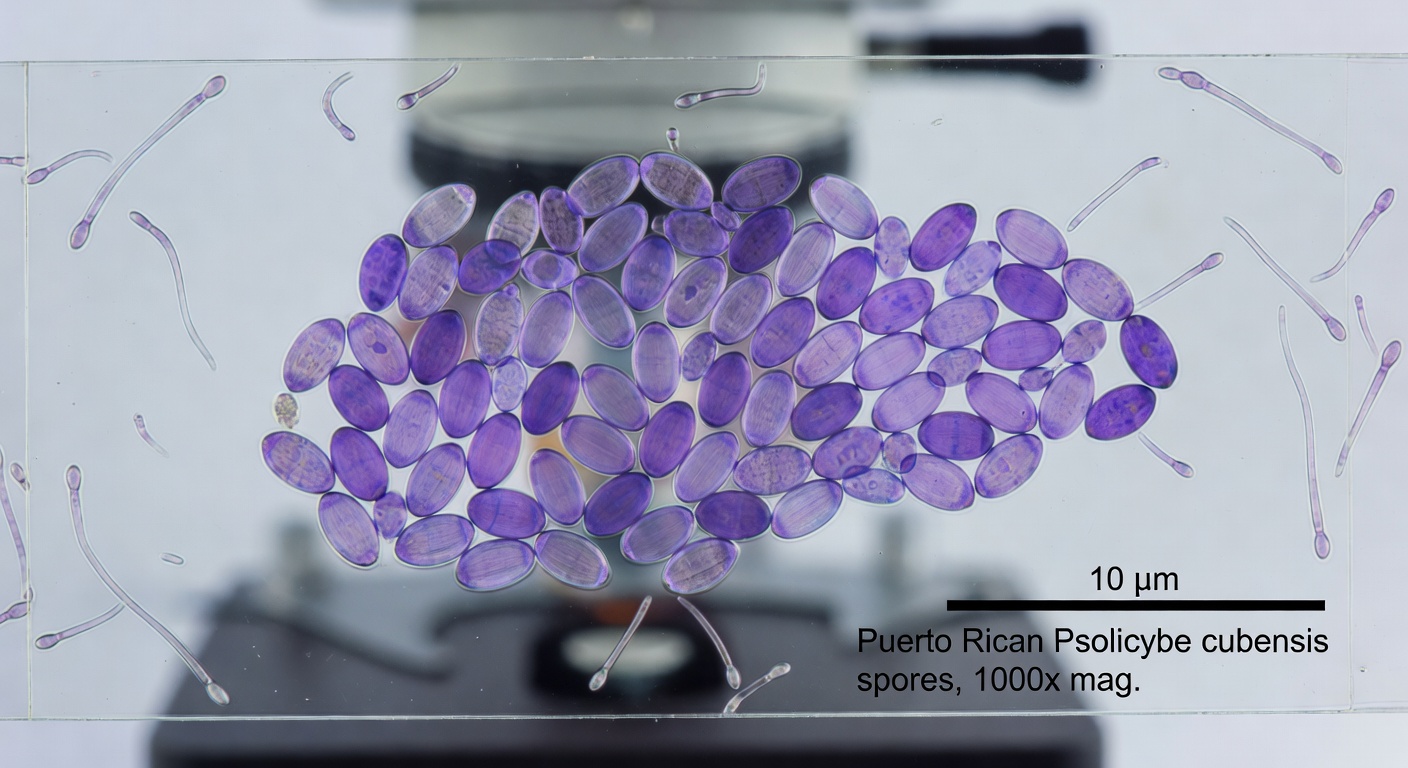
On the slide, record P. cubensis traits and keep the “Puerto Rican” label as the source. Light microscopy does not prove island pedigree. Published ranges for P. cubensis spores are usually about 11.5–17 × 8–11 μm, often summed up as about 11–17 × 7–12 μm. They are nearly oval. Secondary summaries are on the P. cubensis Wikipedia page. Guzmán et al. (2012) give (12–)13–15(–17) × 8–10(–11) × 7–9 μm, with notes on face and side views. That is a reminder to record which way the spore faces. Do not invent Puerto Rican-only “larger” ranges, denser prints or thicker island walls. The literature does not support those as separate measures.
Spores of the species are usually smooth and thick-walled, with a germ pore at the tip. Ruch & Motta (1987) in Mycologia describe the spore wall layers and germ pore of P. cubensis. See the Mycologia landing, JSTOR or DOI 10.1080/00275514.1987.12025395. Primers on the germ pore and basidiospore help newcomers name what they see. The spore print of the species is usually purple-brown to purple in mass. Again, that is a species trait. It is not a fingerprint unique to Puerto Rican.
Shape and wall thickness are useful on a slide. But similar forms evolved more than once across Psilocybe. Ramírez-Cruz et al. (2013) (also the PDF) warn against reading section or “strain” identity from one measure alone. For a Puerto Rican-labeled mount, keep good notes. Record calibrated length × width, mountant, magnification, view direction and the exact product label. Mushly’s spore science and microscopy 101 is a practical baseline before you compare labeled cubensis samples.
What Microscopy Can—and Cannot—Show
Calibrated spore measures, print color in mass, wall thickness and a germ pore at the tip can support species-level records of P. cubensis. They help you check that the same product looks consistent in your notebook over time. They do not prove a Puerto Rican pedigree, island-only traits or effects. They do not create a new Index Fungorum name.
For optional background on how mycologists recognize species by form, mating and DNA, see Taylor et al. (2000) (also DOI 10.1006/fgbi.2000.1228). The criteria can disagree. That is one more reason a place nickname is not an Index Fungorum taxon. For genus context, see the genus Wikipedia overview of Psilocybe. For wider cubensis label practice, see Mushly’s cubensis spore diversity post and spore-print techniques.
Where This Label Fits in a Notebook
Puerto Rican gets attention because the place nickname is memorable. It is widely listed as a P. cubensis line with a Caribbean island origin story. Use it to practice “same species, place-name source” notes. Write the species name. Record the trade name exactly as printed. File your measures against published species ranges. Related place-name cubensis labels, such as Mazatapec, are separate trade names inside the same species. See Mushly’s Mazatapec hub for another place-name example. Neither nickname is a new taxon.
When you are ready to work with a matching research product, Mushly carries a Puerto Rican spore syringe. Browse the all strains catalog and the Psilocybe cubensis strains hub to see how many informal names sit under one species name. Put the learning first. Order formats only when you are ready to work.
A Microscopy Checklist for Puerto Rican–Labeled Slides
Before you file a Puerto Rican–labeled mount, separate the layers:
- Binomial: Does the label state Psilocybe cubensis (or the current Index Fungorum / Species Fungorum usage)?
- Trade / source name: Is “Puerto Rican” recorded exactly as printed on the product? Do not invent a formal variety from the nickname.
- Spore notes: Record calibrated L × W, shape, wall, germ pore and print color in mass. Cite species ranges. Do not invent Puerto Rican-only measures.
- Same-SKU consistency: Date received, mountant, magnification, and matched photos so you can compare sessions over time.
- Limits: Microscopy records spores and labels. It does not prove mating pedigree, Canóvanas collection lore, island traits, potency or trip type.
Puerto Rican gets attention because the name is memorable. But the safe frame for microscopy stays simple. There is one species name, one informal source label, recorded cubensis spore traits and honest limits on what a slide can show. Index Fungorum RecordID 290107, Guzmán et al., Ruch & Motta, Ramírez-Cruz and Taylor et al. are the anchors for names and spores.
Mushroom spores are sold strictly for microscopy and research purposes only. The cultivation of Psilocybin mushrooms is illegal in many jurisdictions.


