

About Mazatapec (Psilocybe cubensis): Name, Mazatec Context and Spore Traits Mushrooms
Updated: October 2, 2026
This article is for educational and taxonomic purposes only and is not medical or legal advice. Mazatapec is discussed as a trade name for Psilocybe Cubensis in microscopy study. Mushly does not support consumption or cultivation, which are illegal in many jurisdictions.
Short answer: Mazatapec (often shortened to "Maz") is one of the oldest names in the Psilocybe cubensis spore trade. It is an informal collector name, not a separate species or a published variety. The name points to the Mazatec people of Oaxaca, Mexico, but no record connects today's spore line to mushrooms documented there. Under a microscope a sample shows ordinary P. cubensis spores.
In this guide
- What Mazatapec is (and isn't)
- Taxonomy
- What is documented and what is lore
- Spore and cap traits
- Ecology of the species
- The Mazatec context
- Name and lineage
- Does "Mazatapec" mean one consistent line?
- Identifying it, and what a microscope can't tell you
- Examining a slide
- Mushly products
- Legal note
- References
- FAQ
What Mazatapec is
Mazatapec is one of many named lines of Psilocybe cubensis in Mushly's all-strains library. The species is recorded in Index Fungorum as RecordID 290107 and in NCBI Taxonomy 181762. This page separates documented history from trade lore and focuses on what you can check under a microscope. For the difference between a species and a trade name, see our species vs strain primer and the Psilocybe cubensis species guide.
"Mazatapec is a Psilocybe cubensis collector line named for the Mazatec people of Oaxaca. What the record shows, what is lore, and species spore traits."


Taxonomy
| Rank | Entry |
|---|---|
| Kingdom | Fungi |
| Phylum | Basidiomycota |
| Class | Agaricomycetes |
| Order | Agaricales |
| Family | Placement varies by source: long placed in Hymenogastraceae (Ramírez-Cruz et al. 2013), while Index Fungorum and NCBI list Agrocybaceae |
| Genus | Psilocybe |
| Species | Psilocybe cubensis (Earle) Singer 1948 |
| Basionym | Stropharia cubensis Earle 1906, described from Cuba |
| Trade name | Mazatapec ("Maz") |
Mazatapec is a collector name, not a taxon. Under the botanical code (ICN), a name below species rank needs formal publication, and Mazatapec has no species, variety or form publication in Index Fungorum, MycoBank or Species Fungorum. Cross-reference: Wikidata Q690450.
What is documented and what is lore
| Question | Status |
|---|---|
| Is Mazatapec a species or published variety? | No. The only formal name is Psilocybe cubensis. |
| Mazatec use of sacred mushrooms in Oaxaca | Well documented, including P. cubensis among the species recorded there. |
| Spore size and shape | Published for the species only, with no Mazatapec-specific measurements. |
| Link between the modern spore line and mushrooms collected in Oaxaca | Not documented. Some vendors say it was collected near Huautla. |
| Collector, date and exact location of the line | Not recorded in any source we found. |
| Is it one consistent line across suppliers? | Not necessarily. |
Spore and cap traits
Short answer: the published figures describe the species, and no study has published Mazatapec-specific measurements.
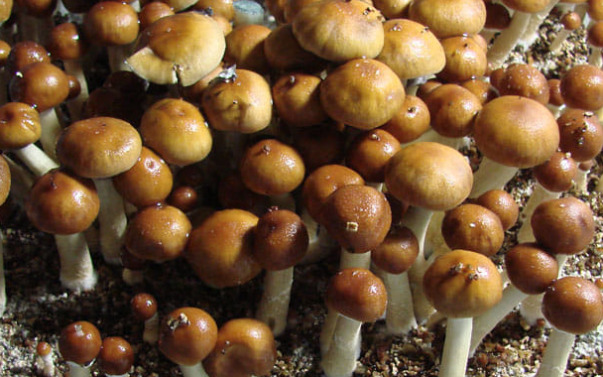
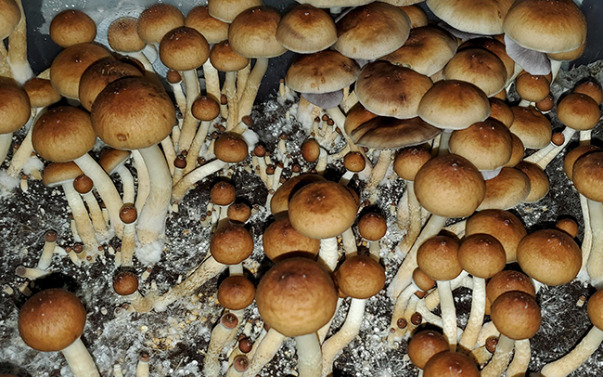
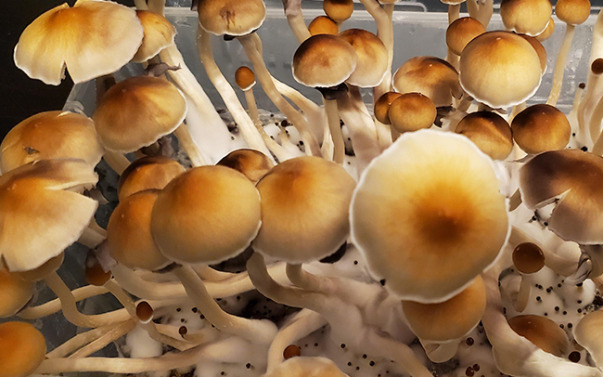
- Cap: about 1.6-8 cm across, conic to convex with a small papilla when young, then broadly convex to plane. Brown fading to golden, and bruising blue (Singer & Smith 1958, Mycologia 50; summarised on Wikipedia).
- Gills: adnate to adnexed, grey, darkening to purplish-black and mottled, with whitish edges.
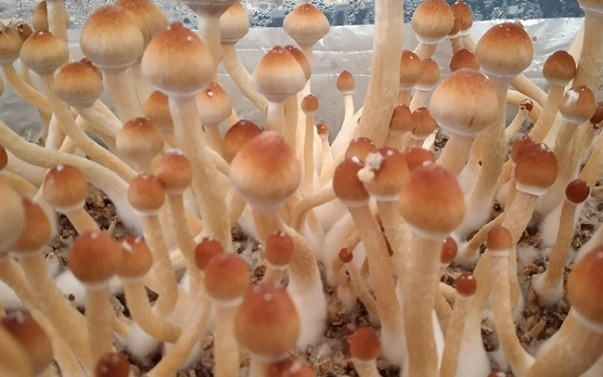
- Stem: about 4-15 × 0.4-1.4 cm, white, hollow, yellowing with age, with a persistent membranous ring that darkens with spores.
- Spore print (species): dark purple-brown to purplish-black.
- Spores: thick-walled, subhexagonal in face view and subellipsoid in side view, with a smooth wall and an apical germ pore (Ruch & Motta 1987). Two published ranges for the species:
- Singer & Smith (1958): 11.5-17.3 × 8-11.5 × 7-9 µm
- Guzmán et al. (2012): (12-)13-15(-17) × 8-10(-11) × 7-9 µm
What collectors say: Mazatapec is described as a classic-looking cubensis, with golden-brown to caramel caps and fairly slender pale stems. That is reputation, not a published measurement.
Ecology of the species
Short answer: a dung-loving saprotroph, and Mazatapec itself is a collection line with no known wild population.
In the wild, P. cubensis is a saprotroph and a coprophilous (dung-associated) fungus, common on cattle and horse dung in meadows, with a pantropical distribution (Guzmán et al. 2012). Singer (1958) recorded that in the Huautla region it grows mostly on cattle dung. These statements apply to the species, not to the trade name.
The Mazatec context
Short answer: the Mazatec mushroom tradition is well documented, but it is a living culture, not a product origin story.
The Mazatec are an Indigenous people of the Sierra Mazateca in northern Oaxaca, with some communities in Puebla and Veracruz. Huautla de Jiménez is the largest town of the region. A Mazatec-region anthropologist writes that mushrooms are, first, rainy-season food, and that certain kinds are held in deep respect and considered sacred (Rodríguez Venegas 2023, MAPS Bulletin). They are used in healing ceremonies called veladas, led by ritual specialists, the best known of whom was María Sabina (c. 1894-1985), a Mazatec sabia and poet from Huautla de Jiménez.
The outside record:
- In the mid-1950s R. Gordon Wasson and Valentina Pavlovna Wasson collected mushrooms in Huautla, and the French mycologist Roger Heim identified Psilocybe mexicana, P. caerulescens and Stropharia (now Psilocybe) cubensis among them (Heim 1956; summarised by García de Teresa 2021).
- In June 1955 Wasson took part in a velada led by María Sabina. On May 13, 1957 Life magazine published his account, "Seeking the Magic Mushroom," with Heim's paintings of the species, including Stropharia cubensis "on cow dung in pastures" (Life 42(19)).
- Singer and Smith (1958) list a P. cubensis collection from Huautla by Wasson among the material they studied (Singer & Smith 1958).
- Sabina's veladas are most associated with P. caerulescens, and the species Heim cultured in his lab was P. mexicana.
A peer-reviewed history describes at least four kinds of sacred mushroom in the Sierra Mazateca, including "San Isidro" (P. cubensis) and "landslide" (P. caerulescens) (García de Teresa 2022). The attention that followed the Life article brought outsiders to Huautla and serious hardship to María Sabina, who never sought it. Other Oaxacan peoples, such as the Zapotec, also have documented Psilocybe traditions (IMA Fungus 2025).
Name and lineage
Short answer: the name is commonly said to be a misspelling of "Mazatec," and no record ties the cultivated line to the Oaxaca collections.
- No record connects the modern line to those collections. Vendor accounts say it was collected near Huautla (Inoculate the World), but that is a seller's claim.
- The name. It is commonly said to be a misspelling of "Mazatec" that stuck. No place in Oaxaca called Mazatapec is known. The similar name Mazatepec is a town in Morelos with no link to the strain.
- Honest vendor pages say the same thing: the cultivated line's exact location, date and collector are not recorded (Mondo, Maverick Mushroom).
- The wider point. A population-genomics study says pedigrees of named cultivars are passed on as lore and have not been verified (McTaggart et al. 2023).
- Parent claims. Vendor lore names Mazatapec as a parent of Z-Strain, which is likewise undocumented.
Treat the origin stories as trade history, not taxonomy. Our Huautla page covers a separately named line.
One consistent line
Short answer: "Mazatapec" from different suppliers is not necessarily the same line.
In a commercial whole-genome registry (not peer-reviewed), two Mazatapec-labelled samples from different suppliers group together, while a third sits nearer Gulf Coast and Golden Teacher samples (PSP10006, PSP10068, PSP10093). A Mazatapec sample was also among the genomes in a peer-reviewed Psilocybe genome atlas (McKernan et al. 2021). That is one more reason to record the supplier, format and date on every slide.
Identifying it
Short answer: a slide supports a species-level note, not a strain identity.
- Spore traits are species-level: spore characters can be homoplastic across Psilocybe (Ramírez-Cruz et al. 2013). Mazatapec, Golden Teacher and Mexican Dutch King show the same slide characters.
- DNA barcodes: in a 2026 study of 14 cubensis trade strains, the ITS2 barcode was identical in 13 of them. Mazatapec was not one of the 14 (Sharchaton et al. 2026).
- Look-alikes: Psilocybe subcubensis is closest in appearance but has smaller spores, and P. cubensis is sometimes compared with Panaeolus semiovatus, which does not bruise blue.
- Chemistry: Mushly does not publish potency figures for Mazatapec, and no published laboratory analysis of Mazatapec-labelled material is known. P. cubensis strains, and even individual mushrooms of the same strain, vary widely under identical lab conditions, so a trade name is not a reliable guide, and potency is not something spores or a microscope can show.
Examining a slide
Follow the general method in our Golden Teacher guide and the mushroom spores guide, and then:
- Measure at least 20 spores (length × width) and record the magnification and mountant.
- Note the view orientation (face or side), the germ pore, and the wall.
- Record the colour in the mountant and the print colour separately.
- Write down the exact label, supplier and date as provenance.
- Remember the limit: a fit to P. cubensis does not prove the Mazatapec label.
Mushly products
Mushly lists the Mazatapec spore syringe 12cc and the Mazatapec spore print for microscopy and research only. See also the Psilocybe cubensis strain list.
Legal note
Mushly offers spores for microscopy, taxonomy, and mycological research. Laws on spores, and on psilocybin-containing mushrooms, differ by country and by U.S. state, and cultivation of psilocybin- or psilocin-containing species is illegal under U.S. federal law and in many other jurisdictions. Check the law where you live before ordering.
Mazatapec spore syringe · Spore print · All spore syringes
References
- Index Fungorum 290107; NCBI Taxonomy 181762; Species Fungorum; MycoBank
- Singer & Smith (1958), Mycologia 50
- Guzmán et al. 2012, Mycotaxon 119: 65-81; Ruch & Motta 1987; Ramírez-Cruz et al. 2013
- History: Heim 1956; García de Teresa 2021 and 2022; Rodríguez Venegas 2023; Life 42(19), 1957; IMA Fungus 2025
- Genomics: McKernan et al. 2021; McTaggart et al. 2023; Sharchaton et al. 2026; registry entries PSP10006, PSP10068, PSP10093 (commercial, not peer-reviewed)
- Vendor accounts (not papers): Inoculate the World; Mondo; Maverick Mushroom




What is Mazatapec?