
This page covers Psilocybin mushrooms history, from colonial accounts to modern trials. The story sits where several fields meet. These include the study of plant use by people, chemistry, media history and modern clinical research. The timeline is well documented. It runs from colonial accounts of teonanácatl, to mid-century fieldwork and lab work, to a famous 1957 magazine essay, to trials in this century. You can follow it without turning history into a session guide. This piece stays with the history of science. It names papers, people and institutions. For microscopy shoppers, it points to Mushly’s mushroom spores guide and the labeled specimens in the strain catalog. It is not medical advice, cultivation instruction or ceremony tourism.
From Teonanácatl to Named Ethnobotany
Spanish colonial writers recorded Indigenous use of sacred mushrooms. They used names such as teonanácatl. But for centuries, Western botany was unsure which fungi these accounts meant. Harvard ethnobotanist Richard Evans Schultes helped reopen the question. He did fieldwork in Oaxaca in the late 1930s. In his 1939 Botanical Museum Leaflets paper, “Plantae mexicanae II: The Identification of Teonanácatl…,” he linked the colonial accounts to living mushroom practice. He also deposited early herbarium material. Later mycologists refined the taxonomy. Early Panaeolus assignments were complicated by Psilocybe and related taxa. So the paper is best read as a founding milestone, not a final species list. Britannica’s overview of psilocybin and Wikipedia’s summary of psilocybin both build on that field tradition.
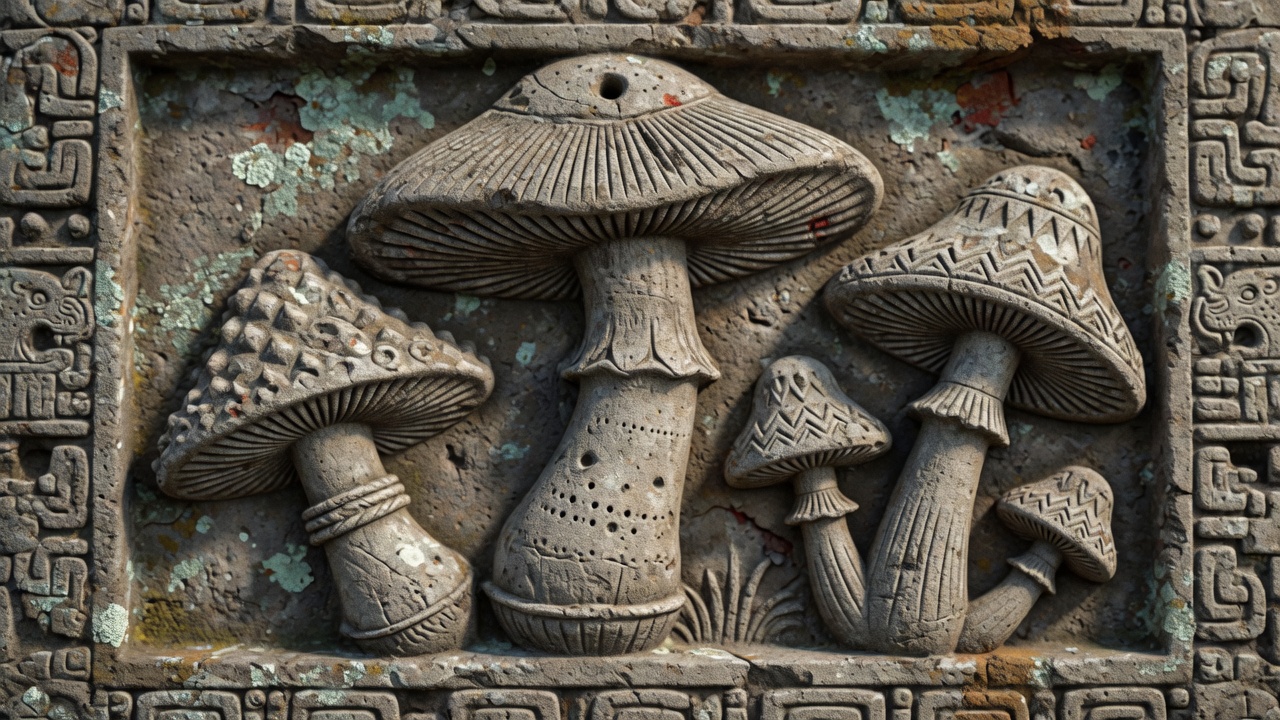
Some old objects are cited as “ancient mushroom art.” The evidence here is more mixed. Researchers have interpreted some Mesoamerican objects and paintings as fungal images. Other readings are still debated. Sticking to named milestones in history and science, such as Schultes, Wasson and Hofmann, keeps the timeline honest. It avoids overclaiming certainty about the distant past.
Huautla, María Sabina, and Wasson’s 1957 Life Essay
What brought Mazatec mushroom veladas to a global English-speaking audience was a magazine feature, not a journal article. In 1955, ethnomycologist R. Gordon Wasson and photographer Allan Richardson took part in a night vigil. It was held in Huautla de Jiménez, Oaxaca, and led by Mazatec curandera María Sabina. Wasson’s photo-essay “Seeking the Magic Mushroom” ran in Life on 13 May 1957. It made the phrase “magic mushroom” known to millions of readers. The paper trail survives in Wikipedia’s overview of Seeking the Magic Mushroom, the Psychedelic Library’s Life cover index, and its essay text pages.
María Sabina was a real person and a ritual specialist, not a brand mascot. Later scholars show how media attention and outside tourism brought stigma and commercial use to Huautla. They also describe debates about loss of sacred meaning and appropriation. Good, respectful starting points include Gerber and colleagues on ethics and Indigenous context in the psychedelic field (PMC8033603). There is also CulAnth Fieldsights on re-territorializing María Sabina, and Dawson on media harm in Fieldwork in Religion. Mushly’s profile of María Sabina stays with her life and cultural context. It gives no ceremony how-tos or travel tips.
Hofmann, 1958: Molecules Have Names
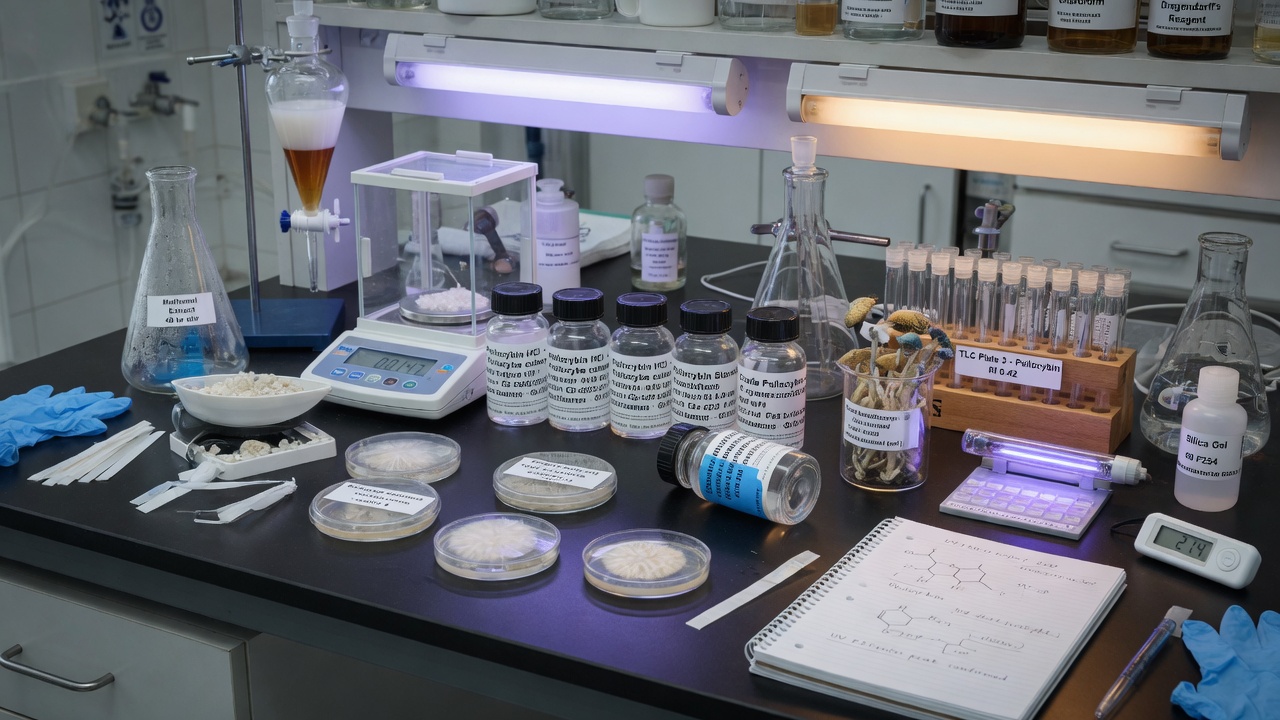
A magazine story alone does not make a research program. Specimens from the Wasson–Heim collecting work reached Sandoz chemist Albert Hofmann. They used material from Psilocybe mexicana. Hofmann, Heim, Brack & Kobel reported isolating crystals of psilocybin (and trace psilocin) in Experientia 14:107–109 (1958). This landmark paper is recorded at Springer as 10.1007/BF02159243. Britannica’s biography of Albert Hofmann places that chemistry in his wider career. The isolation was a lab achievement. It was not a folk “discovery” of the fungi themselves.
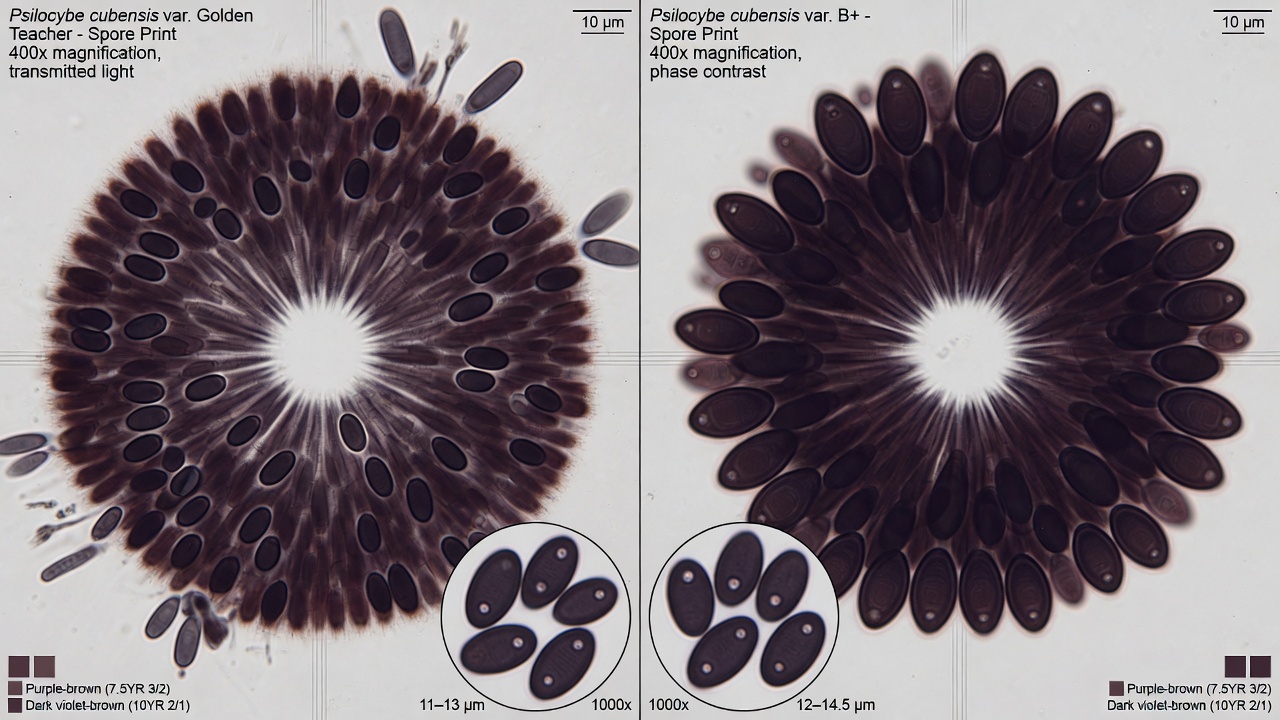
Once the structures were known, labs could make reference standards. They could map serotonin 5-HT2A pathways and compare extracts with pure compounds. That shift, from old names to molecules you can test, helps modern mycology and pharmacology talk past each other less often. A microscope slide of dark purple-brown Psilocybe spores and a chromatogram of psilocybin are different tools. But they are aimed at related organisms.
Public Controversy, Then a Research Gap
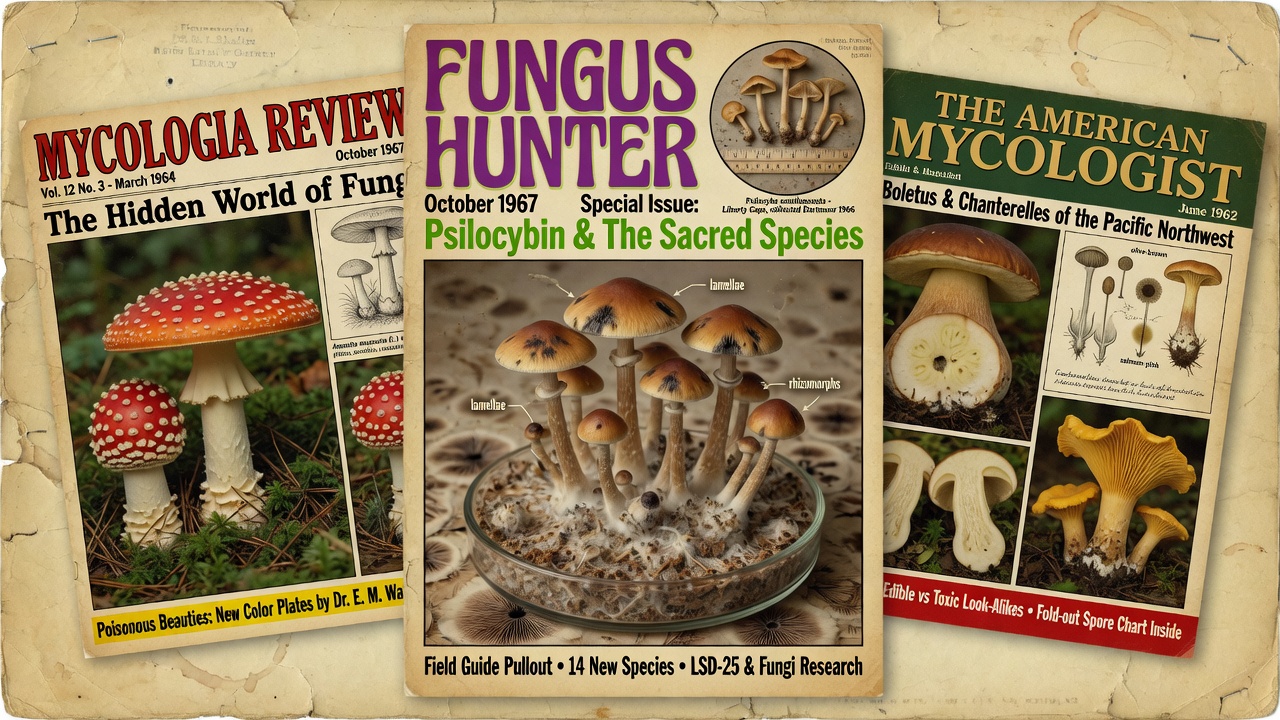
By the early 1960s, psilocybin had moved from Oaxaca and Basel into university psychology labs and public controversy. Timothy Leary and colleagues made the compound a household word in the United States. They insisted that expectation and environment shape what people report. Mushly traces that idea in a companion essay on why set and setting matter. Legal scheduling under the Controlled Substances Act largely paused U.S. clinical work for decades. Cultural memory did not pause. Music, journalism and amateur mycology kept the fungi in view. But the link between institutions broke. When regulated research came back strongly in the 2000s, it inherited three things at once: Hofmann’s molecules, Wasson’s public myth and a contested mid-century vocabulary.
Species, Strains, and What Microscopy Actually Sees
Popular writing often folds every “magic mushroom” into one story. Taxonomy does not. The genus Psilocybe includes many species, each with its own habitat and spore traits. Psilocybe Cubensis is just the most widely discussed cultivable species in commerce and hobby microscopy. Informal “strain” names, such as Golden Teacher, Penis Envy and dozens of others, usually label selected lines within one species. They are not separate species. These labels help collectors and microscopy buyers keep lines and notes in order. They do not reliably map onto promised “effects,” and this page does not treat them that way.
For readers who study research specimens, these words matter. Mushly’s mushroom spores overview explains how prints and syringes support taxonomy and microscopy. The all-strains catalog shows how trade names map onto documented P. cubensis lines. Spore syringes and prints are research formats. They are tools for slides and records. They are not an invitation to grow controlled species where that is still illegal.
Modern Research Milestones (History of Science, Not Therapy Claims)
The new wave of research in this century rebuilt careful methods around molecules Hofmann had already described. Griffiths and colleagues ran a double-blind study at Johns Hopkins in 2006. It was published in Psychopharmacology (Springer record; open MAPS-archived PDF). It helped restart visible U.S. human research in supportive lab conditions. The center at hopkinspsychedelic.org sets out that history in public.
Brain-science landmarks followed. Carhart-Harris and colleagues did fMRI work in 2012 (PMC3277566). This team is linked to what is now Imperial College’s Centre for Psychedelic Research. The work linked the acute psilocybin state to changes in brain blood flow and network links, including default-mode hubs. In 2016 the team ran an open-label feasibility study of psilocybin with psychological support in treatment-resistant depression (Lancet Psychiatry author PDF). It is an early marker on the clinical timeline with a small n. It is not proof that the treatment works. Davis and colleagues ran a randomized trial with a waiting-list control for major depressive disorder. It was published in JAMA Psychiatry (publisher page; open PMC7643046) and is another often-cited modern anchor. Report these as trial publications. They are not proven consumer treatments or shop claims.
Steps in the regulatory process also belong on a history timeline. In October 2018, COMPASS Pathways received FDA Breakthrough Therapy designation for a psilocybin therapy program aimed at treatment-resistant depression. In November 2019, the Usona Institute announced Breakthrough Therapy designation for its psilocybin program in major depressive disorder. Breakthrough Therapy designation is a faster FDA development path based on early evidence. It is not marketing approval. Later imaging work, such as Daws et al. 2022 in Nature Medicine (s41591-022-01744-z), continues the science story. It does not permit product claims.
Reading the Timeline Without Overclaiming
Here is a simple map of the history. Colonial teonanácatl accounts → Schultes 1939 → María Sabina’s veladas and Wasson’s 13 May 1957 Life essay (with later work on media harm) → Hofmann et al. 1958 isolation → mid-century psychology and cultural flashpoint → decades of legal chill → Griffiths 2006, Carhart-Harris 2012/2016, Davis et al., and FDA Breakthrough designations as process steps. Each stage answers a different question. Ethnobotany asks who knew which fungi, and why. Chemistry asks what the active compounds are. Clinical research asks what happens under controlled protocols. Microscopy asks how spores and fruiting bodies can be recorded as biological specimens.
Mixing these questions creates the haze this site tries to avoid. Strain names end up standing in for pharmacology, or clinical headlines stand in for taxonomy. Keeping them apart makes the history easier to read and the shopping side cleaner. If you are curious about strain names, go to the strain hubs and the spores guide. For life stories, read about María Sabina and Timothy Leary.
The public story of psilocybin runs from Schultes’s leaflet, through Hofmann’s structures and the 1957 Life spreads, to today’s named trials and designations. It is a history of science and media. It is not a DIY therapy guide. Careful readers can follow the citations above and weigh popular summaries against primary sources. Treat species labels as biological descriptions, not scripts for what will happen.
Mushroom spores are sold strictly for microscopy and research purposes only. Growing psilocybin-containing mushrooms is illegal under U.S. federal law and in many places worldwide. Check local rules before you buy research specimens.


