

About Portobello Mushroom (Agaricus bisporus): Taxonomy, Spore Traits and Look-alikes Mushrooms
Updated: October 10, 2026
spores and cultures are sold for microscopy and research purposes. This page is a reference for observing a species. It is not a foraging guide, a growing guide or medical advice.
Short answer: "Portobello" (also spelled portabella or portobella) is a common name for the mature, brown form of Agaricus bisporus (J.E. Lange) Imbach. The same species is sold as a button mushroom when young and white, and as cremini when young and brown, so these are stages and colour forms of one species and not separate species. It is a formally named species and not a Psilocybe Cubensis strain. Its spores print dark brown and measure about 4.5-5.5 × 5-7.5 µm in one general reference, much smaller than those of P. cubensis.
Home » Strain Encyclopedia » Edible and Medicinal Species » Portobello
In this guide
- What the name covers
- Taxonomy
- What sources agree on and where they differ
- Spore traits
- Ecology and distribution
- Look-alikes
- Examining a slide
- Mushly products
- Legal note
- References
- FAQ
What the name covers
According to Wikipedia, A. bisporus goes by different names depending on colour and age:
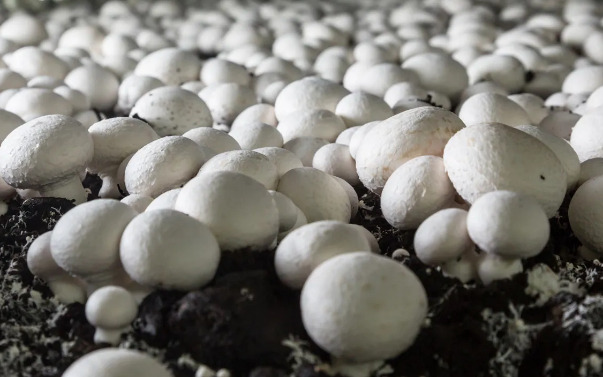
- Immature, white: button mushroom, white mushroom, champignon de Paris, table mushroom, cultivated mushroom.
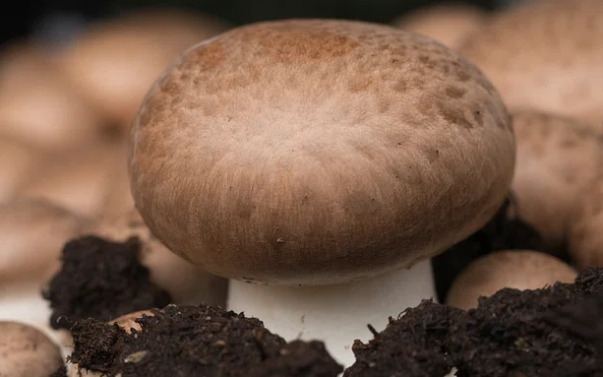
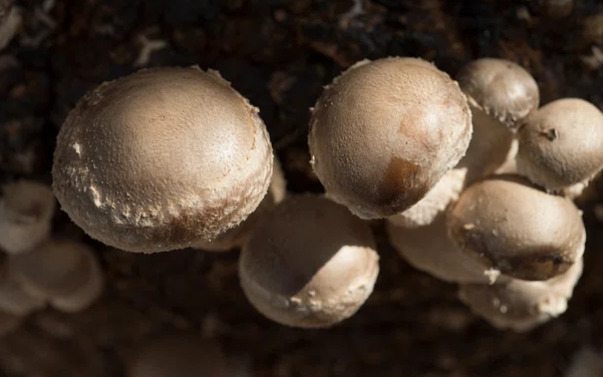
- Immature, brown: cremini (or crimini), Swiss, Roman or Italian brown, baby bella, and "chestnut mushroom," a name also used for the unrelated Pholiota adiposa (see our Chestnut page).
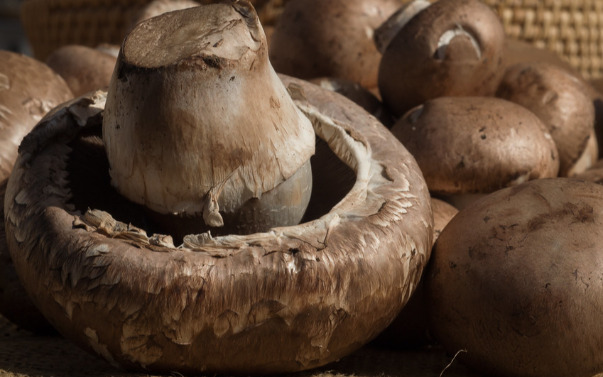
- Mature, brown: portobello, portabella or portobella. Wikipedia gives the cap as 10-15 cm across, against 5-10 cm for the pale grey-brown wild form. It says the origin of the word "portobello" is disputed.
These names describe age and colour, not different species. See our Button Mushroom page for the same species under its other name.
"Portobello is a common name for the mature brown stage of Agaricus bisporus, the same species sold as button and cremini mushrooms. Taxonomy, published spore data, ecology, look-alikes and what microscopy can show."


Taxonomy
| Rank | Entry |
|---|---|
| Kingdom | Fungi |
| Phylum | Basidiomycota |
| Class | Agaricomycetes |
| Order | Agaricales |
| Family | Agaricaceae |
| Genus | Agaricus |
| Species | Agaricus bisporus (J.E. Lange) Imbach, Mitt. naturf. Ges. Luzern 15: 15 (1946) |
| Basionym | Psalliota hortensis f. bispora J.E. Lange (1926) |
| Common names | Portobello, portabella, cremini, button mushroom, champignon de Paris |
Index Fungorum (531546), the Species Fungorum synonymy and NCBI Taxonomy (5341) agree on the name and authority. "Portobello" is a market name and does not appear as a name in any of them. The species name refers to the usual two-spored basidia, and Wikipedia notes that two four-spored varieties have been described.
What sources agree on and where they differ
| Question | Status |
|---|---|
| Are portobello, cremini and button different species? | No. They are the same species at different stages and colours. |
| Is it a Psilocybe cubensis strain? | No. It is a different genus and family, and it is not psychoactive. |
| Family | Agaricaceae in the records and references above. |
| Where the word "portobello" comes from | Disputed. Wikipedia gives no single origin. |
| Native range | Wikipedia gives grasslands in Eurasia and North America. |
| Health and nutrition | Mushly makes no nutritional or wellness claims. |
Spore traits
Short answer: small, oval to round spores in a dark brown print, usually two per basidium.
Wikipedia describes the spores as "oval to round," about 4.5-5.5 × 5-7.5 µm, with a dark brown spore print, and says the basidia are usually two-spored. That is a general-reference description and not a primary taxonomic treatment, so check a monograph before citing sizes.
For comparison, P. cubensis spores are measured at 11.5-17.3 × 8-11.5 × 7-9 µm in Singer and Smith (1958), with a truncate apex and germ pore. A portobello slide should look clearly different. Measure your own sample and record the mountant.
Ecology and distribution
Wikipedia describes A. bisporus as native to grasslands in Eurasia and North America. It grows in rich soil and compost, often with manure, and fruits from autumn to winter, especially near cypress. It is cultivated in more than 70 countries.
The white commercial form traces to a natural mutation found in 1925 on a farm in Coatesville, Pennsylvania, according to Wikipedia. Pure-culture spawn was first produced at the Pasteur Institute in 1893, replacing field-collected spawn that could carry pathogens.
Look-alikes
Wikipedia warns that A. bisporus can be confused with:
- Destroying angels (Amanita species), which have a volva or cup at the base and pure white gills. These are deadly.
- Agaricus xanthodermus, which has a phenol-like odour and yellows when bruised.
- Entoloma sinuatum, which has yellowish gills turning pink and lacks a ring.
This list comes from a general reference and is not an identification key. A mushroom in a field is not a portobello because it looks like one. Identification of wild fungi should never rest on one feature, and nobody should eat a wild fungus on the strength of an online description.
Examining a slide
- Mount a spore deposit in water first, then in KOH, and record both. A dark brown print on white paper is the usual starting point.
- Measure at least 20 spores (length × width) and record the magnification.
- Note the shape (oval to round) and the wall, and count the spores per basidium if you can see basidia. Two is typical for this species.
- Record the print colour separately from the mountant colour.
- Remember the limit: matching a published range supports a comparison, but it does not separate A. bisporus from other Agaricus species on its own.
Mushly products
Mushly does not list a product named Portobello. To browse what Mushly does list, see the edible cultures category and the mushroom spores guide.
Legal note
Agaricus bisporus is not a psilocybin-containing species and is legal to possess in most places, but laws on spores and cultures differ by country and region. Check the rules where you live. Mushly's microscopy products are sold for research and study and not for consumption or cultivation.
Edible cultures · Strain library · Mushroom spores for microscopy guide
References
- Wikipedia: Agaricus bisporus (authority, basionym, common names, spores, basidia, ecology, history, look-alikes)
- Index Fungorum 531546; Species Fungorum synonymy 531546; NCBI Taxonomy 5341
- Singer, R. & Smith, A.H. (1958), Mycologia 50 (P. cubensis spore range, for comparison only)




Are portobello, cremini and button mushrooms different species?