

Updated: October 3, 2026
spores of PESA mushrooms are sold strictly for microscopy and research purposes only. Cultivation of Psilocybin-containing fungi is illegal in many jurisdictions. This page is not a guide to finding, growing, or taking mushrooms.
Short answer: PESA is a collector name for a line of Psilocybe Cubensis (Earle) Singer. It is not a published species, variety or form. Vendors also expand the same letters as "PES Amazonian," after Pacifica Exotica Spora, a Hawaiian spore company that is no longer in business. Its origin story is vendor lore, and the accounts disagree. Under a microscope a sample shows ordinary P. cubensis spores.
Home » Strain Encyclopedia » Psilocybe Cubensis » PESA
In this guide
- What PESA is (and isn't)
- Taxonomy
- What is documented and what is lore
- Spore and cap traits
- Ecology of the species
- Name and provenance
- PESA and PES Amazonian
- Identifying it, and what a microscope can't tell you
- Examining a slide
- Mushly products
- Legal note
- References
- FAQ
What PESA is
PESA is one of many named lines of Psilocybe cubensis in Mushly's all-strains library. The species is recorded in Index Fungorum as RecordID 290107 and in NCBI Taxonomy 181762. This page keeps the trade-name story apart from what you can check under a microscope. For the difference between a species and a trade name, see our species vs strain primer and the Psilocybe cubensis species guide.
"PESA mushrooms are a Psilocybe cubensis trade name, tied in vendor lore to Pacifica Exotica Spora and an Amazon collection. Origin stories and spores."


Taxonomy
| Rank | Entry |
|---|---|
| Kingdom | Fungi |
| Phylum | Basidiomycota |
| Class | Agaricomycetes |
| Order | Agaricales |
| Family | Placement varies by source: Hymenogastraceae in most modern treatments (Ramírez-Cruz et al. 2013), while Index Fungorum lists Agrocybaceae |
| Genus | Psilocybe |
| Species | Psilocybe cubensis (Earle) Singer, Sydowia 2: 37 (1948) |
| Basionym | Stropharia cubensis Earle 1906 |
| Trade name | PESA (informal) |
PESA is a collector name, not a taxon. Under the botanical code (ICN), a name below species rank needs formal publication, and PESA has no such record in Index Fungorum, Species Fungorum or MycoBank. Cross-reference: Wikidata Q690450.
What is documented and what is lore
| Question | Status |
|---|---|
| Is PESA a species or published variety? | No. The only formal name is Psilocybe cubensis. |
| Spore size and shape | Published for the species only, with no PESA-specific measurements. |
| What the letters stand for | Vendor lore: Pacifica Exotica Spora (PES) plus an A, usually read as Amazonian. |
| Where it was collected | Vendors say Colombia or Peru. No collector, checkable date or herbarium number is published. |
| Is it an azurescens hybrid? | No. That claim is sales copy, not a published cross. |
| Is it the same isolate as PES Amazonian? | Many shops use the names interchangeably. No sequenced pedigree confirms it. |
Spore and cap traits
Short answer: the published figures describe the species, and no study has published PESA-specific measurements.
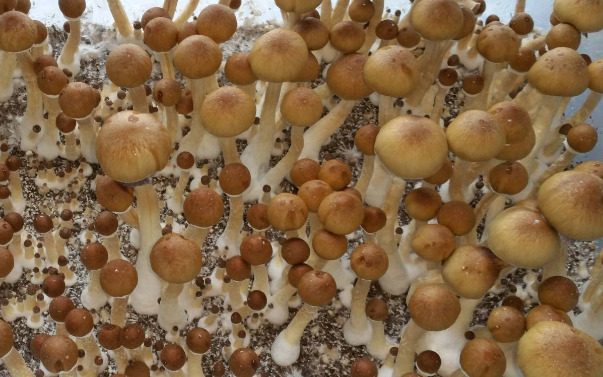
- Cap: about 1.6-8 cm across, conic to convex, becoming plane, often with a small umbo. Smooth and sticky when moist, brown and paler towards the margin, fading to golden with age (Singer & Smith 1958, Mycologia 50; summarised on Wikipedia).
- Gills: grey, adnate to adnexed, darkening to purplish-black, with paler edges.
- Stem: about 4-15 × 0.4-1.4 cm, white, hollow, yellowish with age, with a persistent membranous ring.
- Bruising: blue where the flesh is handled.
- Spores: thick-walled, subhexagonal in face view and subellipsoid in side view. Two published ranges for the species:
- Singer & Smith (1958): 11.5-17.3 × 8-11.5 × 7-9 µm
- Guzmán et al. (2012): (12-)13-15(-17) × 8-10(-11) × 7-9 µm
- Other features: the fruit body has a well-developed ring and hyaline pleurocystidia (Guzmán et al. 2012).
Ecology of the species
Short answer: a dung-loving saprotroph, and PESA itself is a collection line with no herbarium population of its own.
In the wild, P. cubensis is a coprophilous (dung-associated) fungus of tropical and subtropical pastures. Guzmán et al. (2012) call it pantropical and "common on cattle and horse dung in meadows." Those statements belong to the species, not to the trade name. Vendor stories that place a founding collection in the Amazon are lore, covered below, and are not a range map.
Name and provenance
Short answer: the letters point to a defunct Hawaiian vendor, and the two origin stories we found disagree.
PES stands for Pacifica Exotica Spora, a Hawaiian spore company that is no longer in business. Vendors then add an A. Two readings circulate:
- Michigan Myco says PESA is P. cubensis from that company, "supposedly discovered" in the Colombian region of the Amazon, and that the A was meant as Amazonian (Michigan Myco).
- Maverick Mushroom says the usual story is a wild collection from dung in the Amazon basin, most commonly placed in Peru, sold by the same company in the early 2000s (Maverick Mushroom).
Neither account names a collector's specimen, a date that can be checked, or a herbarium number, and Colombia and Peru are different countries. Treat both as grower lore. A population-genomics paper makes the same general point about named cultivars: pedigrees are passed along as lore and have not been verified (McTaggart et al. 2023).
Not an azurescens hybrid. The same Michigan Myco page says PESA was at times falsely marketed as a hybrid of P. cubensis and Psilocybe azurescens, which led some people to read the final A as azurescens. That is sales copy, not a published cross. P. azurescens is a different species with its own guide.
PESA and PES Amazonian
Short answer: many shops use the two names for one catalogue line, but nothing documented makes them the same isolate.
Mushly's PES Amazonian page covers the longer name. This page covers the shorter one, and we do not claim a sequenced pedigree that would prove they are the same culture. Mushly also lists a separately named PES Hawaiian spore print. Treat it as its own label, since nothing here connects it to PESA.
Identifying it
Short answer: microscopy supports a species-level note, not a strain identity.
Record calibrated length, width and thickness, which view you used, and the mountant. The printed name is provenance, not a character you can see.
- Look-alikes: Psilocybe subcubensis is the look-alike with smaller spores. Panaeolus semiovatus can look similar and does not bruise blue.
- Not a field guide: this page is not instructions for searching pastures or identifying a mushroom you found outdoors.
- Chemistry: Mushly does not publish potency figures for PESA, and no published laboratory analysis of PESA-labelled material is known. Potency is not something a spore or a microscope shows.
Examining a slide
Follow the general method in our Golden Teacher guide and the mushroom spores guide, and then:
- Measure at least 20 spores (length × width) and record the magnification and mountant.
- Note the view orientation (face or side), the germ pore, and the wall.
- Record the colour in the mountant and the print colour separately.
- Write down the exact label, supplier and date as provenance.
- Remember the limit: a fit to P. cubensis does not prove the PESA label.
Mushly products
Mushly does not currently sell a syringe or print named PESA. Amazonian-labelled items are a different label and are not PESA. To study related lines, browse our spore syringes for microscopy or see the Psilocybe cubensis strain list.
Legal note
Mushly offers spores for microscopy, taxonomy, and mycological research. Laws on spores, and on psilocybin-containing mushrooms, differ by country and by U.S. state, and cultivation of psilocybin- or psilocin-containing species is illegal under U.S. federal law and in many other jurisdictions. Check the law where you live before ordering.
Browse spore syringes · Strain library
References
- Index Fungorum 290107; NCBI Taxonomy 181762; Species Fungorum; MycoBank; Wikidata Q690450
- Singer & Smith (1958), Mycologia 50: 262-303
- Guzmán et al. 2012, Mycotaxon 119: 65-81; Ramírez-Cruz et al. 2013
- McTaggart et al. 2023, Current Biology
- Vendor lore (not papers): Michigan Myco; Maverick Mushroom
- Wikipedia: Psilocybe cubensis (species primer only)


What is PESA?