

About Cambodian (Psilocybe cubensis): Angkor Field Report and Spore Traits Mushrooms
Updated: October 2, 2026
This article is for educational, historical and taxonomic purposes only and is not medical or legal advice. Cambodian is discussed as a trade name for Psilocybe Cubensis in microscopy study. Mushly does not support consumption or cultivation, which are illegal in many jurisdictions.
Short answer: Cambodian is a trade name for a line of Psilocybe cubensis (Earle) Singer. It is not a separate species or a published variety. Wild P. cubensis around the Angkor temples is documented in a field report by the ethnomycologist John W. Allen, but the claim that the trade line descends from his prints comes from vendors, not from a published strain record. Under a microscope a sample shows ordinary P. cubensis spores.
In this guide
- What Cambodian is (and isn't)
- Taxonomy
- What is documented and what is lore
- Spore and cap traits
- Ecology of the species
- The Angkor field report
- Vendor lore and related labels
- Identifying it, and what a microscope can't tell you
- Examining a slide
- Mushly products
- Legal note
- References
- FAQ
What Cambodian is
Cambodian is one of many named lines of Psilocybe cubensis in Mushly's all-strains library. The species is recorded in Index Fungorum as RecordID 290107 and in NCBI Taxonomy 181762. This page keeps the documented Angkor field report apart from the trade-line story and focuses on what you can check under a microscope. For the difference between a species and a trade name, see our species vs strain primer and the Psilocybe cubensis species guide.
"Cambodian is a Psilocybe cubensis trade line. John W. Allen documented wild cubensis at Angkor in 1999-2000; the line's descent from his prints is vendor lore."


Taxonomy
| Rank | Entry |
|---|---|
| Kingdom | Fungi |
| Phylum | Basidiomycota |
| Class | Agaricomycetes |
| Order | Agaricales |
| Family | Placement varies by source: Hymenogastraceae in most modern treatments (Ramírez-Cruz et al. 2013), while Index Fungorum lists Agrocybaceae |
| Genus | Psilocybe |
| Species | Psilocybe cubensis (Earle) Singer 1948 |
| Basionym | Stropharia cubensis Earle 1906 |
| Trade name | Cambodian (informal) |
Cambodian is a collector name, not a taxon. Under the botanical code (ICN), a name below species rank needs formal publication, and Cambodian has no such record in Index Fungorum, MycoBank or Species Fungorum. Cross-reference: Wikidata Q690450.
What is documented and what is lore
| Question | Status |
|---|---|
| Is Cambodian a species or published variety? | No. The only formal name is Psilocybe cubensis. |
| Wild P. cubensis at Angkor | Documented in Allen's 1999-2000 field report, with identification confirmed by Gastón Guzmán. |
| Spore size and shape | Published for the species only, with no Cambodian-specific measurements. |
| Descent of the trade line from Allen's prints | Vendor lore, not a published strain record. |
| Ancient ritual use in the region | Not supported. Allen's report says Heim and Hofmann found no use by ancient local cultures. |
Spore and cap traits
Short answer: the published figures describe the species, and no study has published Cambodian-specific measurements.
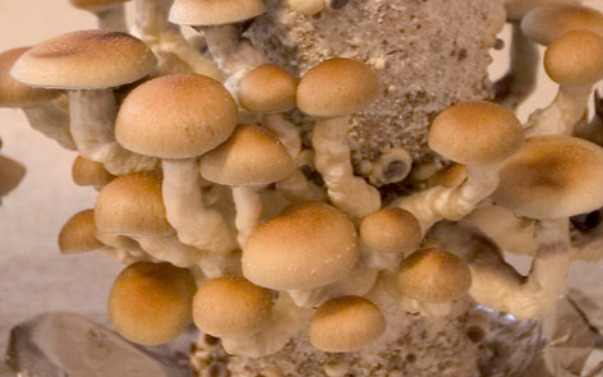
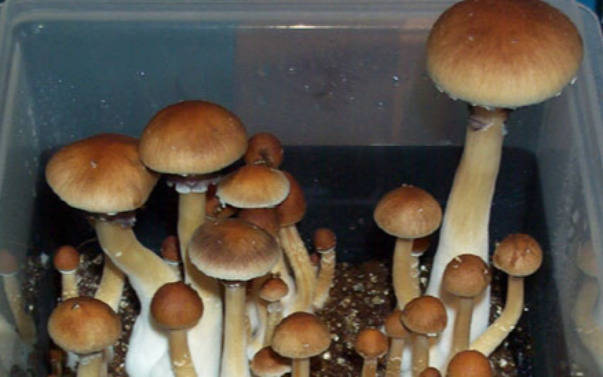
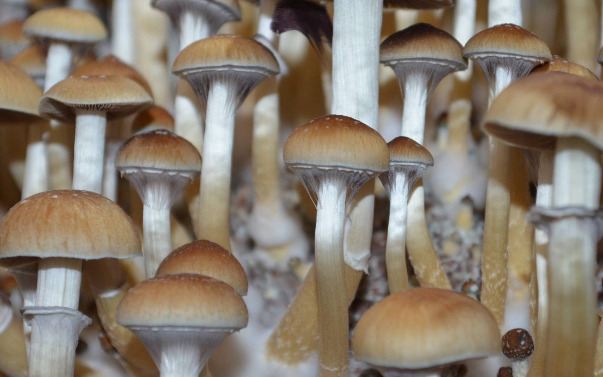
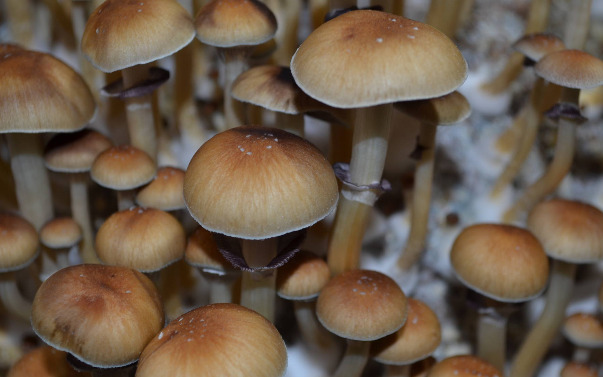
- Cap: about 1.6-8 cm across, conic to convex, becoming plane (Singer & Smith 1958, Mycologia 50; summarised on Wikipedia).
- Gills: grey, darkening to purplish-black.
- Stem: about 4-15 × 0.4-1.4 cm, white, hollow, with a membranous ring, bruising blue when handled.
- Spore print: dark purple-brown to purplish-black.
- Spores: thick-walled, subhexagonal in face view and subellipsoid in side view, with a smooth wall and an apical germ pore (Ruch & Motta 1987). Two published ranges for the species:
- Singer & Smith (1958): 11.5-17.3 × 8-11.5 × 7-9 µm
- Guzmán et al. (2012): (12-)13-15(-17) × 8-10(-11) × 7-9 µm
Ecology of the species
Short answer: a dung-loving saprotroph, and Cambodian itself is a collection line with no documented wild population.
In the wild, P. cubensis is a saprotrophic, dung-associated fungus of tropical and subtropical pastures, "common on cattle and horse dung in meadows," with a pantropical distribution (Guzmán et al. 2012). Ecological statements apply to the species, not the trade name. Around Angkor, the documented habitat is cattle dung on the grazed temple plateau, where water buffalo are also common (Allen et al., Ethnomycological Journals Vol. IX, MAPS bibliography PDF).
The Angkor field report
Short answer: a self-published field report documents wild P. cubensis at Angkor, with the identification confirmed by a professional mycologist.
- The visits. Allen visited Angkor Wat, Angkor Thom and the Bayon on 3 October 1999 and again in September-October 2000.
- The specimens. P. cubensis was photographed, collected and preserved, then passed to the mycologist Gastón Guzmán, who confirmed the identification.
- The source. This comes from Allen's own report, which is a self-published field report, not a peer-reviewed paper.
- Earlier records. The same report notes the species had been reported from Cambodia decades earlier, by Heim and Hofmann in 1958.
- No ancient ritual use. The report states that Heim and Hofmann found no use of these mushrooms by the ancient cultures of the region, so we make no claim of ritual history.
Other species at Angkor. Allen's collections also included Panaeolus (Copelandia) cyanescens and Psilocybe samuiensis. Those are separate species, not the Cambodian cubensis line, and P. samuiensis is not a cubensis.
Vendor lore and related labels
Short answer: the link between Allen's prints and the modern trade line is a vendor claim.
Spore vendors trace the Cambodian trade line to prints from Allen's collections. That link comes from the trade, not from a published strain record. A population-genomics study makes the same general point about named cultivars: their pedigrees are passed on as lore and have not been verified (McTaggart et al. 2023).
Mushly also lists a separately named John Allen spore print. Treat it as its own label. Nothing on this page connects it to Cambodian.
Identifying it
Short answer: microscopy supports a species-level note, not a strain identity.
- Spore traits are species-level: spore characters can be homoplastic across Psilocybe (Ramírez-Cruz et al. 2013).
- DNA barcodes: in a 2026 study of 14 cubensis strains, the ITS2 barcode was identical in 13. Cambodian was not one of the 14 (Sharchaton et al. 2026).
- Look-alikes: P. cubensis is closest in appearance to Psilocybe subcubensis, which has smaller spores, and is sometimes compared with Panaeolus semiovatus, which does not bruise blue.
- Chemistry: Mushly does not publish potency figures for Cambodian, and no published laboratory analysis of Cambodian-labelled material is known. Potency is not something spores or a microscope can show.
Examining a slide
Follow the general method in our Golden Teacher guide and the mushroom spores guide, and then:
- Measure at least 20 spores (length × width) and record the magnification and mountant.
- Note the view orientation (face or side), the germ pore, and the wall.
- Record the colour in the mountant and the print colour separately.
- Write down the exact label, supplier and date as provenance.
- Remember the limit: a fit to P. cubensis does not prove the Cambodian label.
Mushly products
Mushly lists the Cambodian spore syringe and the Cambodian spore print for microscopy and research only. See also the Psilocybe cubensis strain list.
Legal note
Mushly offers spores for microscopy, taxonomy, and mycological research. Laws on spores, and on psilocybin-containing mushrooms, differ by country and by U.S. state, and cultivation of psilocybin- or psilocin-containing species is illegal under U.S. federal law and in many other jurisdictions. Check the law where you live before ordering.
Cambodian spore syringe · Spore print · All spore syringes
References
- Index Fungorum 290107; NCBI Taxonomy 181762; Species Fungorum; MycoBank; Wikidata Q690450
- Singer & Smith (1958), Mycologia 50
- Guzmán et al. 2012, Mycotaxon 119: 65-81; Ruch & Motta 1987; Ramírez-Cruz et al. 2013
- McTaggart et al. 2023; Sharchaton et al. 2026
- Field report (self-published, not peer-reviewed): Allen et al., Ethnomycological Journals Vol. IX, MAPS bibliography PDF
- Wikipedia: Psilocybe cubensis (species primer only)




What is Cambodian?