

Updated: October 2, 2026
This article is for educational and taxonomic purposes only and is not medical or legal advice. Penis Envy is discussed as a trade name for Psilocybe Cubensis in microscopy study. Mushly does not support consumption or cultivation, which are illegal in many jurisdictions.
Short answer: Penis Envy is a trade and community name for a selected lineage of Psilocybe cubensis (Earle) Singer. It is not a separate species. Under a microscope, a Penis Envy sample shows the spore characters of P. cubensis, and the label records where the sample came from, not a separate identity.
In this guide
- What Penis Envy is (and isn't)
- Taxonomy
- Spore and cap traits
- Ecology of the species
- PE, APE and PE6: how the labels get confused
- Where the name came from
- Identifying it, and what a microscope can't tell you
- Preparing a slide
- Legal note
- References
- FAQ
What Penis Envy is
Penis Envy is a trade name. Index Fungorum lists no "Penis Envy" taxon, and the species record is RecordID 290107. On a slide, a Penis Envy sample is studied as P. cubensis.
This page separates what is documented about Penis Envy, what is community lore, and what you can actually check under a microscope. For the general difference between a species and a trade strain, see our species vs strain primer and the Psilocybe cubensis species guide.
"Penis Envy is a trade name for Psilocybe cubensis, not a species. Spore traits, PE vs PE6 vs APE labels, and what is documented versus community lore."

Taxonomy
| Rank | Entry |
|---|---|
| Kingdom | Fungi |
| Phylum | Basidiomycota |
| Class | Agaricomycetes |
| Order | Agaricales |
| Family | Placement varies by source: Index Fungorum lists Agrocybaceae, and most modern treatments use Hymenogastraceae |
| Genus | Psilocybe |
| Species | Psilocybe cubensis (Earle) Singer 1948 (basionym Stropharia cubensis Earle 1906) |
| Trade name | Penis Envy (often shortened to PE) |
Names below species rank only count under the botanical code when they are validly published as a subspecies, variety or form (ICN Art. 24). Penis Envy has no such record in Index Fungorum or MycoBank. Cross-references: Wikidata Q690450 and NCBI Taxonomy 181762.
Spore and cap traits
Short answer: the published figures describe the species P. cubensis. No study has published measurements specific to Penis Envy.
- Cap: about 1.6-8 cm across, conic to convex, becoming plane. Brown, paling towards golden or whitish at the margin, smooth and sticky when moist (Singer & Smith 1958, as summarised on Wikipedia).
- Gills: grey, adnate to adnexed, darkening to purplish-black and mottled, with whitish edges.
- Stem: about 4-15 cm tall and 0.4-1.4 cm thick, hollow, white, yellowing with age, with a persistent membranous ring.
- Spore print: purple-brown to purplish-black in mass.
- Spores: thick-walled, subhexagonal in face view and subellipsoid in side view, with a smooth wall and an apical germ pore (Ruch & Motta 1987). Two published ranges for the species:
- Singer & Smith (1958): 11.5-17.3 × 8-11.5 × 7-9 µm
- Guzmán et al. (2012): (12-)13-15(-17) × 8-10(-11) × 7-9 µm
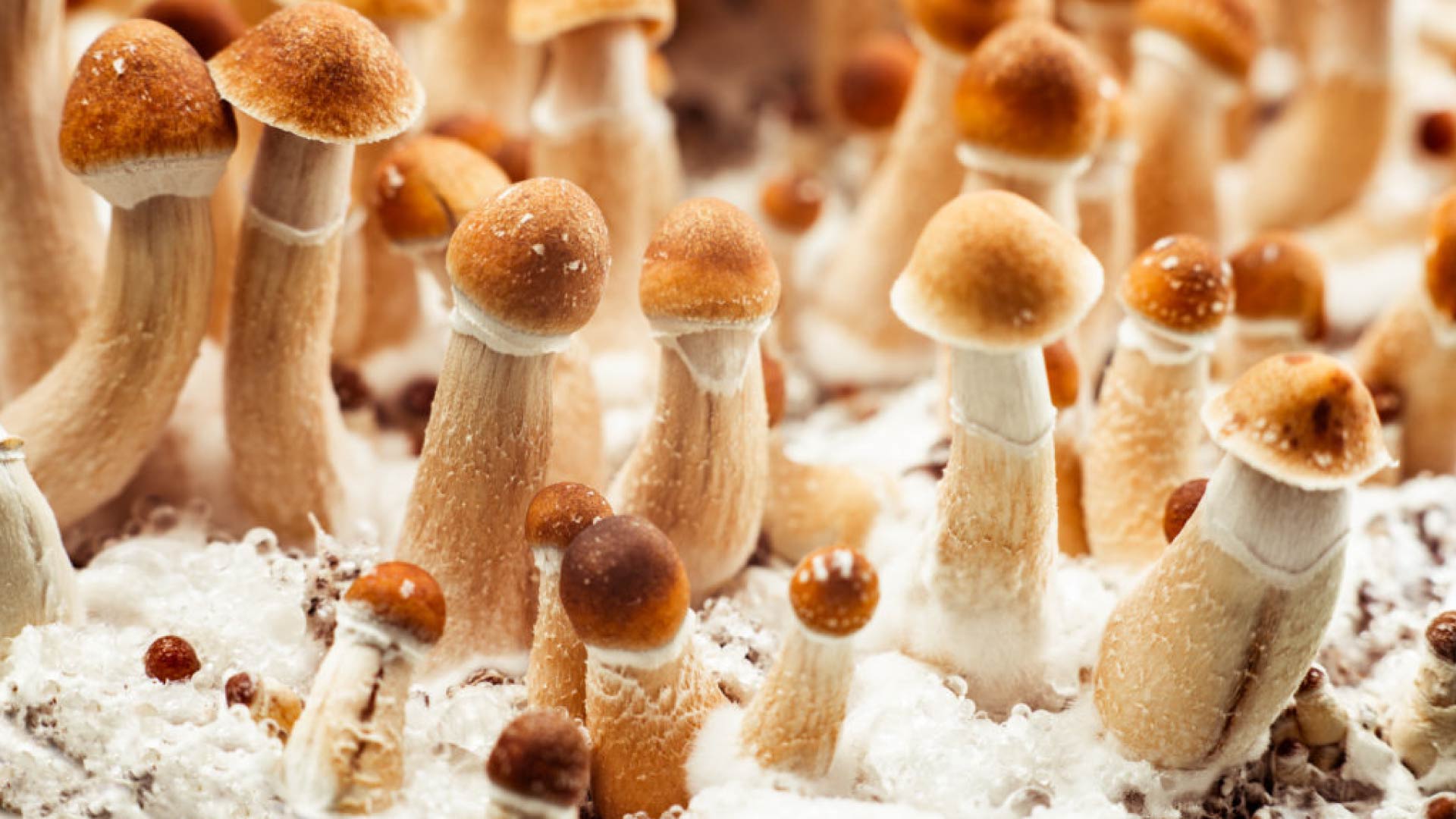
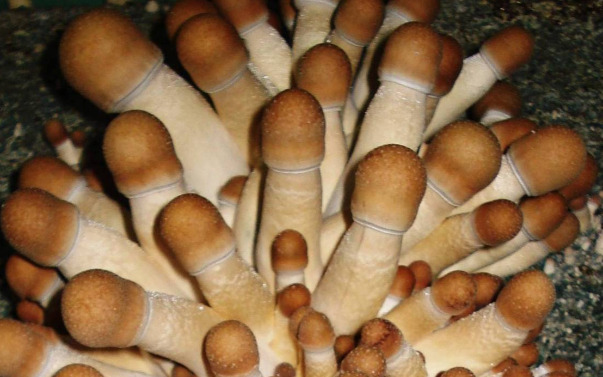
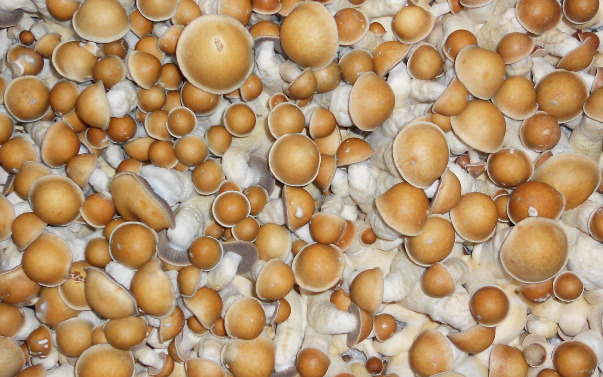
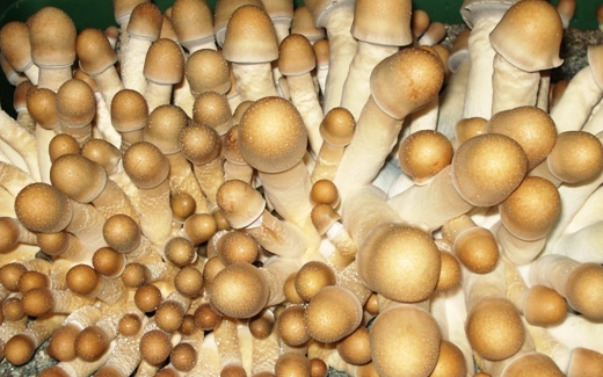
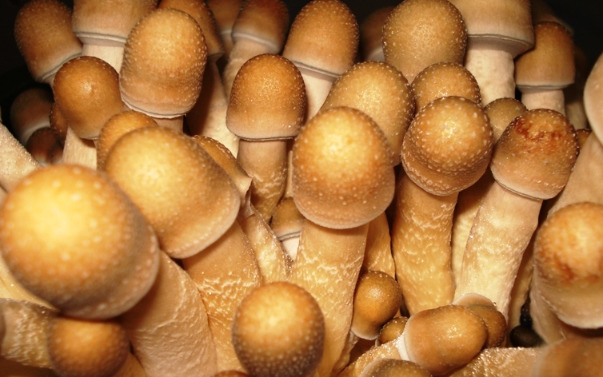
What collectors say about Penis Envy: trade sources commonly describe a thick, dense stem, a small cap that often stays closed, a reduced partial veil, and low spore output. These are community descriptions, not published measurements, and we know of no study that quantifies Penis Envy spore output.
Ecology of the species
Short answer: the species is a dung-loving saprotroph, but Penis Envy itself is a cultivated line with no documented wild populations.
As a species, P. cubensis grows on herbivore dung, "common on cattle and horse dung in meadows" (Guzmán et al. 2012). It also occurs on water-buffalo dung and rich pasture soil. Its range is pantropical to subtropical: the Gulf Coast and south-eastern USA, Mexico, Central and South America, the Caribbean, South-East Asia, India and Australia. Those statements apply to the species, not to the label.
How the labels get confused
Short answer: PE, APE and PE6 are different labels, and a light microscope cannot confirm which one you have.
Classic Penis Envy is commonly described as a poor spore producer, so related lines circulate under similar names:
- Penis Envy (PE): the classic lineage this page is about.
- **Albino Penis Envy (APE):** a separately labelled line.
- Penis Envy Uncut: another separately labelled line.
- Penis Envy 6 (PE6): a related hybrid, not classic Penis Envy.
Record the exact vendor label on every slide. Mushly's related item is Penis Envy 6 (PE6) spores, and our full range is on the spore syringes page.
Where the name came from
Short answer: the best-known origin story has been revised by the person who popularised it, so treat it as lore.
- The popular version. Hamilton Morris's 2009 Vice feature told a story in which Terence McKenna collected Amazonian P. cubensis spores, which reached the Texas mycologist Steven Pollock, who grew out an unusually thick form.
- The revision. Morris later said earlier accounts were apocryphal, and in a 2022 podcast interview he credited the selection to the cultivator Rich Gee (see also Leafly's summary).
- The evidence. No herbarium collection or peer-reviewed lineage study exists. The name itself is folk etymology from the fruit-body shape.
- What the literature says. A sample labelled "P.envy" was used for a P. cubensis genome assembly, and the authors themselves note that the strain name is anecdotal (McKernan et al. 2021). A 2025 review adds that strain descriptions, Penis Envy included, come mainly from community reports rather than academic work (Kurzbaum et al. 2025).
Identifying it
Short answer: microscopy supports a species-level note, not a trade-line pedigree.
- Spore print: purple-brown to purplish-black, as for any P. cubensis.
- Spores: calibrated measurements near the published ranges, in face and side view, with the germ pore, support a species-level note.
- Look-alike: Psilocybe subcubensis is macroscopically very similar but has smaller spores.
- Limits: microscopy cannot separate Penis Envy from Golden Teacher or other cubensis labels, and it says nothing about chemistry. Peer-reviewed work shows tryptamine content varies widely between and within P. cubensis strains grown under identical conditions, so a trade name is not a chemical specification (Sharchaton et al. 2026).
For a side-by-side view, see Golden Teacher and Penis Envy genetic comparisons, our Golden Teacher page, and Strain vs Strain.
Preparing a slide
Because PE-type lines are described as poor spore producers, expect sparse slides. Follow the same method as for any cubensis sample, which is covered step by step in our Golden Teacher guide and the mushroom spores guide. Then note:
- The exact vendor label and the date.
- How many spores you could measure, and a size range from as many as you can find.
- Spore shape, whether the apex looks truncate, and whether a germ pore is visible.
- Color in the mountant, recorded separately from print color.
- The limit: a fit to P. cubensis does not prove the Penis Envy label.
Legal note
Mushly offers spores for microscopy, taxonomy, and mycological research. Laws on spores, and on psilocybin-containing mushrooms, differ by country and by U.S. state, and cultivation of psilocybin- or psilocin-containing species is illegal under U.S. federal law and in many other jurisdictions. Check the law where you live before ordering.
Shop Penis Envy 6 spore syringes · All spore syringes
References
- Index Fungorum: Psilocybe cubensis, RecordID 290107
- MycoBank: Psilocybe cubensis
- NCBI Taxonomy 181762; Wikidata Q690450
- Singer, R. & Smith, A.H. (1958). Mycologia 50.
- Guzmán et al. 2012, Mycotaxon 119: 65-81
- Ruch & Motta 1987, Mycologia
- McKernan et al. 2021, F1000Research 10: 281
- Kurzbaum et al. 2025, Journal of Fungi 11: 99
- Sharchaton et al. 2026, Journal of Fungi 12: 486
- Origin lore: Vice (2009); Hamilton Morris Podcast (2022); Leafly summary




What is Penis Envy?