

Microscopy and research framing only ? not legal advice. Mushly sells mushroom spore syringes and Spore prints for educational study. We do not sell grow kits or provide cultivation instructions.
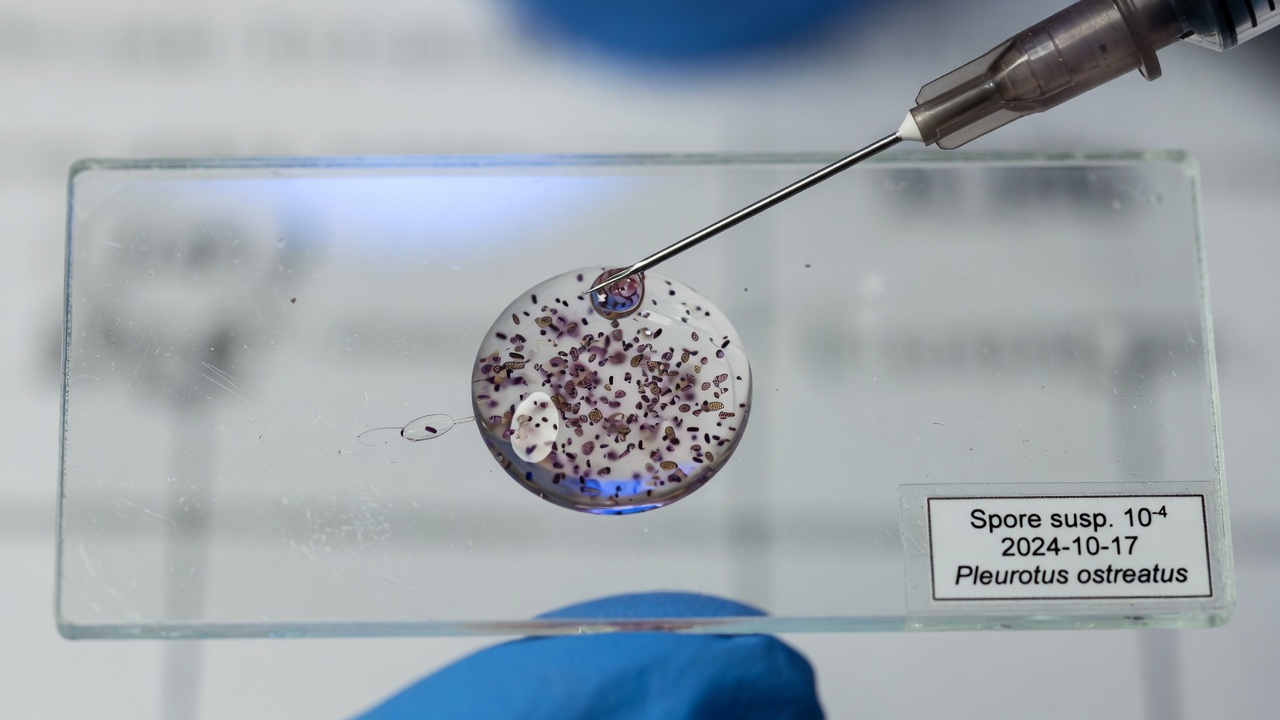
A mushroom spore syringe is a simple research tool: a sterile syringe filled with sterile water and a suspension of spores. That is the whole idea. The water lets you put a small, even drop on a glass slide so you can look at the spores under a microscope, one at a time, instead of in a dry pile.
People often arrive on this page looking for a recipe to make their own. Mushly does not publish those instructions. The old article that used to live at this address was a cultivation how-to, and it has been retired. What follows is the research version of the same question: what a syringe actually is, why a prepared one is the practical starting point for microscopy, and how to get a clean drop onto a slide.
What is in a spore syringe
Two things: sterile water, and spores. There is no nutrient in the water, so the spores stay as spores. They do not grow in the barrel.
The ?12 cc? on a Mushly label is the volume of the barrel, about 12 millilitres. It says nothing about how many spores are inside. A syringe can look like plain water and still hold plenty of spores, because a single Psilocybe Cubensis spore is only about 11.5?17 micrometres long and 8?11.5 micrometres wide ? far smaller than anything the eye can resolve. Our guide to why a syringe can look clear explains the physics; the short version is that you cannot judge a syringe by eye. The microscope has the final say.
If the liquid is murky in a way that looks off, or you see unusual colours or films, stop and read what a cloudy syringe can mean before you put a drop on a slide. Cloudiness is not automatically ?more spores,? and it is not automatically contamination either. It is a reason to look carefully.
Why a prepared research syringe is the practical choice
For microscopy, the job is a clean, label-accurate drop of spores in water. A prepared syringe from a vendor that sells for research is built for that: a known trade name on the barrel, spores already suspended, and a tip you can use to place one drop on a slide.
Making a syringe yourself from a print is a different task, with a different set of risks ? especially contamination that then sits in the liquid and confuses whatever you later see under the lens. We are not going to walk through that process. If your aim is to study spores, the straightforward path is to use a prepared spore syringe and spend your attention on the slide, the notes, and the comparison, not on improvised lab ware.
A spore print is a different format, and a useful one. It is a dry deposit of spores, usually on foil. Prints keep well and give you a dense sample, but they go onto the slide as a scrape or a pinch, which can clump. A syringe is the easier wet mount. Liquid culture is something else again: it is living mycelium in a nutrient broth, not a spore sample, and it will not answer a question about spore shape or size. Mushly?s Psilocybe range is syringes and prints; we do not sell Psilocybe liquid culture.
How to use a syringe on a slide
The full, step-by-step slide method is in our beginners? guide to preparing slides from spore syringes. The outline is short:
- Confirm that the label matches the strain or trade name you intend to document.
- Work on a clean, flat surface. Have a clean slide, a coverslip, and a notebook ready.
- Gently invert or roll the syringe so the spores are mixed through the water. Avoid shaking it like a bottle; you want an even suspension, not a foam of bubbles.
- Place one small drop in the centre of the slide. A thin drop is easier to read than a flood.
- Lower the coverslip at a slight angle so it touches the drop first, then settles. That motion pushes air bubbles aside.
- Start at low power to find the drop, then move to about 400? to see shape and colour. For measurements and wall detail, mycologists go to oil immersion at about 1,000?, with a calibrated eyepiece scale.
Plain water is enough for this work. The liquid in the syringe already is a water mount. P. cubensis spores carry their own brown pigment, so you do not need a stain to see them. Other reagents (KOH, Melzer?s, Congo red) have specific uses in mycology; they are not required for a first look at a cubensis syringe, and Melzer?s is restricted in some places.
Write down the trade name, the species binomial if you know it, the date, the mount, and the magnification. That boring consistency is what makes later comparisons worthwhile. For equipment, measuring, and what to look for, continue with Spore Microscopy 101.
What you are looking at
Under a compound microscope, Psilocybe cubensis spores are thick-walled and smooth, ellipsoid (oval from the side, a little angular face-on), with a germ pore at one end. In mass, as a print, they look dark purple-brown. In a thin water mount, with light shining through them, they look paler ? yellowish brown to brown. Published size ranges are about 11.5?17 ? 8?11.5 micrometres.
Trade names ? Golden Teacher, Penis Envy, and the rest ? are labels inside that species, not separate species of their own. Two named cubensis lines will often look alike under the lens. The value of a syringe is a clean, labeled sample you can document, not a promise that every trade name will show a dramatic spore difference. Our species versus strain primer covers that distinction.
A note on the law
Mushly sells mushroom spores strictly for microscopy and research. Ungerminated spores do not contain Psilocybin or psilocin, and many jurisdictions do not control them, but that is not universal. Some places restrict spores directly, or treat them differently when they are intended for cultivation. Growing psilocybin mushrooms is illegal under US federal law and in many other countries.
This is general information, not legal advice. Check the current rules where you live before you order or possess spores. Start with our overviews of legal status and mushroom spores in the USA and Canada.
References
- Psilocybe cubensis (species summary, including the commonly cited spore-size range)
- Index Fungorum: Psilocybe cubensis (Earle) Singer, record 290107
- Michael Kuo, ?Using a Microscope to Study Mushrooms,? MushroomExpert.Com
- Mushly, Mushroom Spore Microscopy 101
- Mushly, Preparing Microscopy Slides from Spore Syringes
- Mushly, Legal status of psilocybin mushrooms


Can you show me how to make a spore syringe at home?