

Opening a new spore syringe and finding what looks like plain water is one of the most common surprises in amateur microscopy. It is also one of the most common reasons people assume a syringe is empty. Often it is not, and there is a simple physical reason why. Occasionally, though, a syringe really does contain very few spores, and the only way to tell the two apart is to look under a microscope. This clear spore syringe guide explains both sides and how to check.
Spores Are Smaller Than the Eye Can Resolve
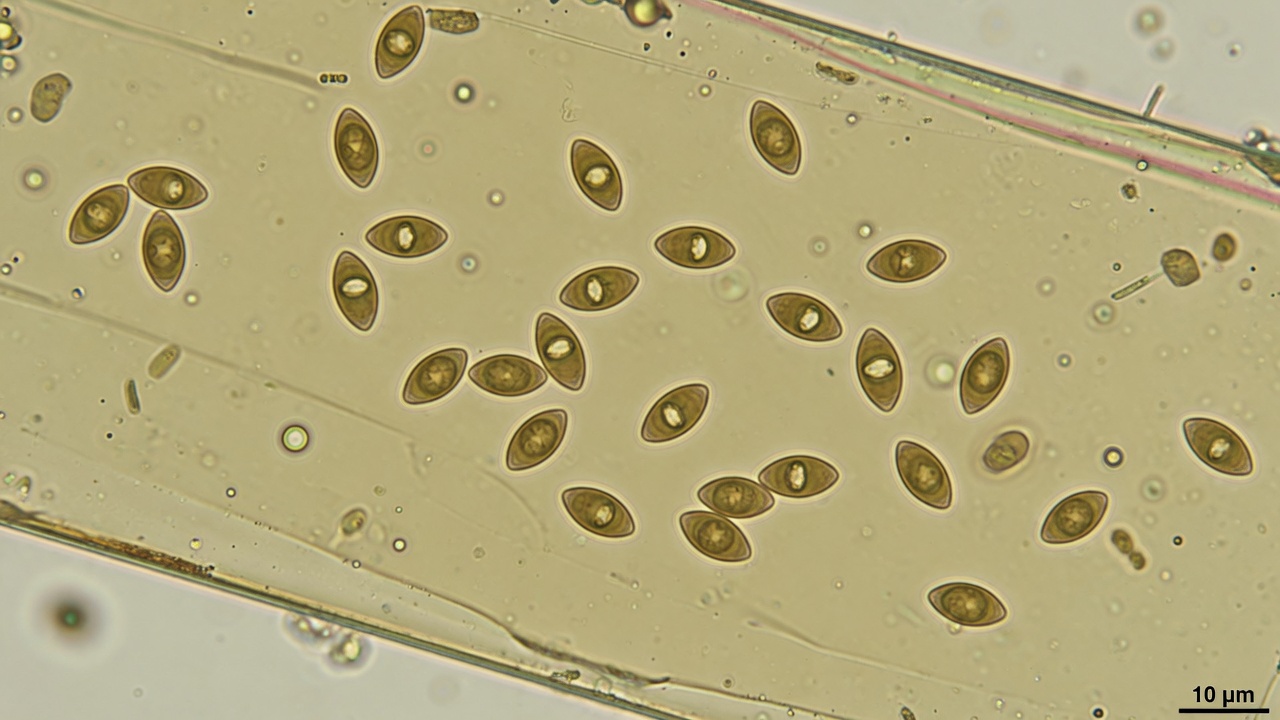
Psilocybin-producing species vary in spore size, but a typical P. cubensis spore is roughly 11–17 micrometres long and 8–11 micrometres wide (species summary). At normal reading distance, the smallest detail an unaided human eye can resolve is around 0.1 millimetres, or 100 micrometres (naked eye). A single spore is therefore about a tenth of the size of the smallest speck you can see. Individually, spores are invisible.
The amount of material involved is also tiny. Treating a spore as an ellipsoid of about 12 × 9 × 9 micrometres gives a volume of around 500 cubic micrometres. A million such spores would occupy only about half a microlitre, a small fraction of a single drop. Spread that evenly through several millilitres of water and it scatters very little light, so the liquid does not look cloudy. Turbidity, the haziness we notice in liquids, needs far more suspended material than that.
So Why Do Some Syringes Have Dark Specks?
The dark bits you sometimes see are clumps: many spores stuck together, or small fragments of the spore print that never broke apart. Because P. cubensis spores are dark purple-brown, a clump of thousands becomes visible as a speck. Clumps are not a sign of a better syringe, and their absence is not a sign of a worse one. Well-dispersed spores simply stay invisible until you put them on a slide.
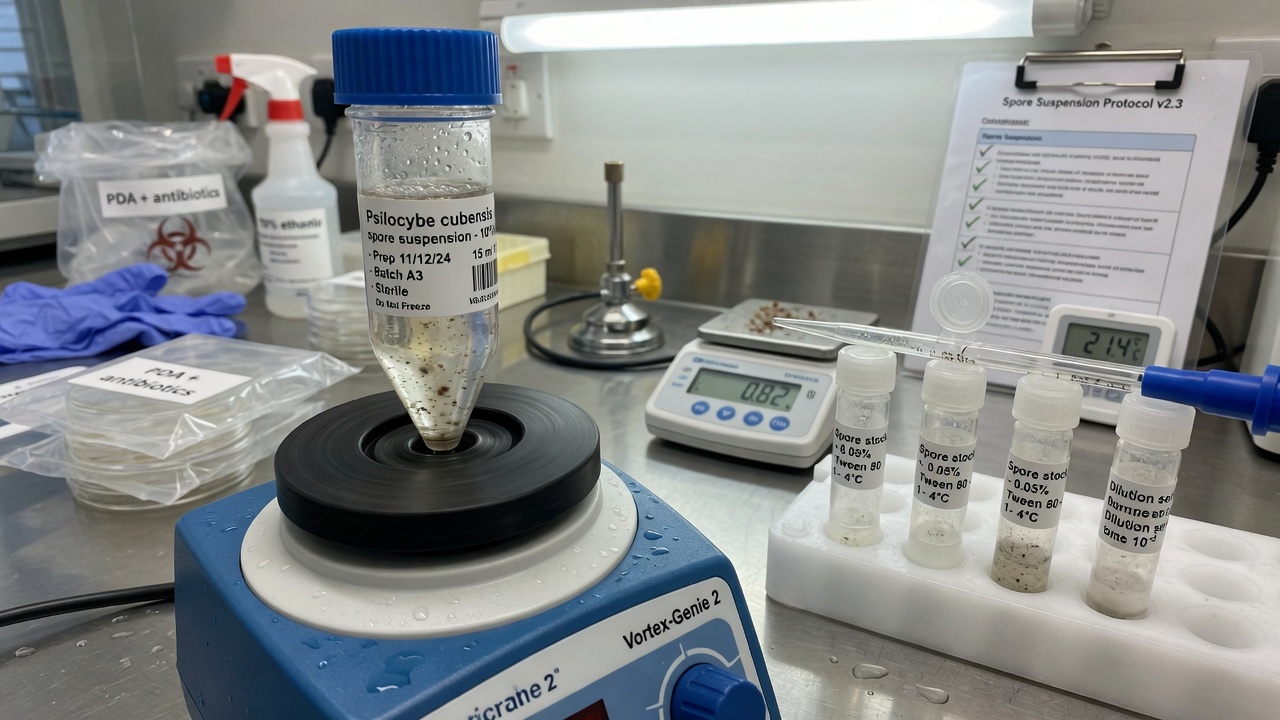
Other things affect appearance too. Spores settle over time, so a syringe that has been sitting still may look clearer at the top. Some species have paler spores than cubensis, which makes them even harder to see in suspension. None of these clues tells you how many spores are present.
When a Clear Syringe Really Is Light on Spores
It would be misleading to say that a clear syringe is always full. A syringe made from a sparse print, or one that was diluted too far, can genuinely contain few spores and look exactly the same as a good one. Some cultures are known for producing light prints, which can lead to thinner syringes. That is why the naked-eye test is useless in both directions, and why the microscope has the final say.
How to Check a Syringe Under the Microscope
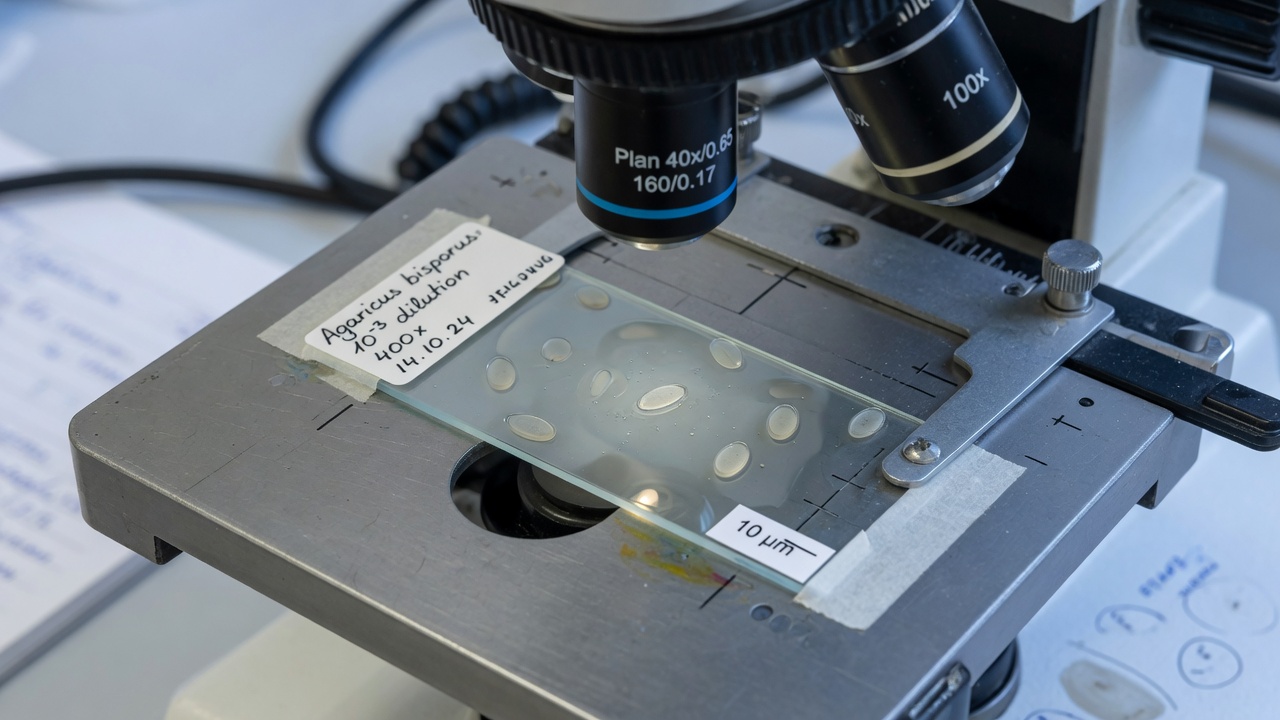
- Gently roll the syringe between your palms to resuspend any settled spores.
- Place a single small drop on a clean glass slide and lower a cover slip over it at an angle to avoid trapping air bubbles.
- Find the focal plane at 100×, then move to 400×. P. cubensis spores appear as smooth, dark purple-brown ellipses, often with a small germ pore at one end. Pigmented spores like these are easy to see with ordinary brightfield illumination; paler species may be easier to see with phase contrast or a lowered condenser.
- Scan several fields of view rather than one. Spores should appear across the slide, not just in a single cluster.
- Record what you see: magnification, approximate number per field, and a few measurements if you have a calibrated eyepiece.
Tiny particles in the drop may jiggle on the spot. That is Brownian motion, caused by water molecules bumping into small particles, and it is not a sign that anything is alive or moving on its own.
If you want a rough number rather than an impression, laboratories use a counting chamber called a hemocytometer, a thick slide with an etched grid of known volume. Counting the spores in a few squares lets you estimate the concentration per millilitre. For most hobby microscopy, “several spores in most fields at 400×” is a perfectly workable benchmark.
Clear Syringes Versus Prints
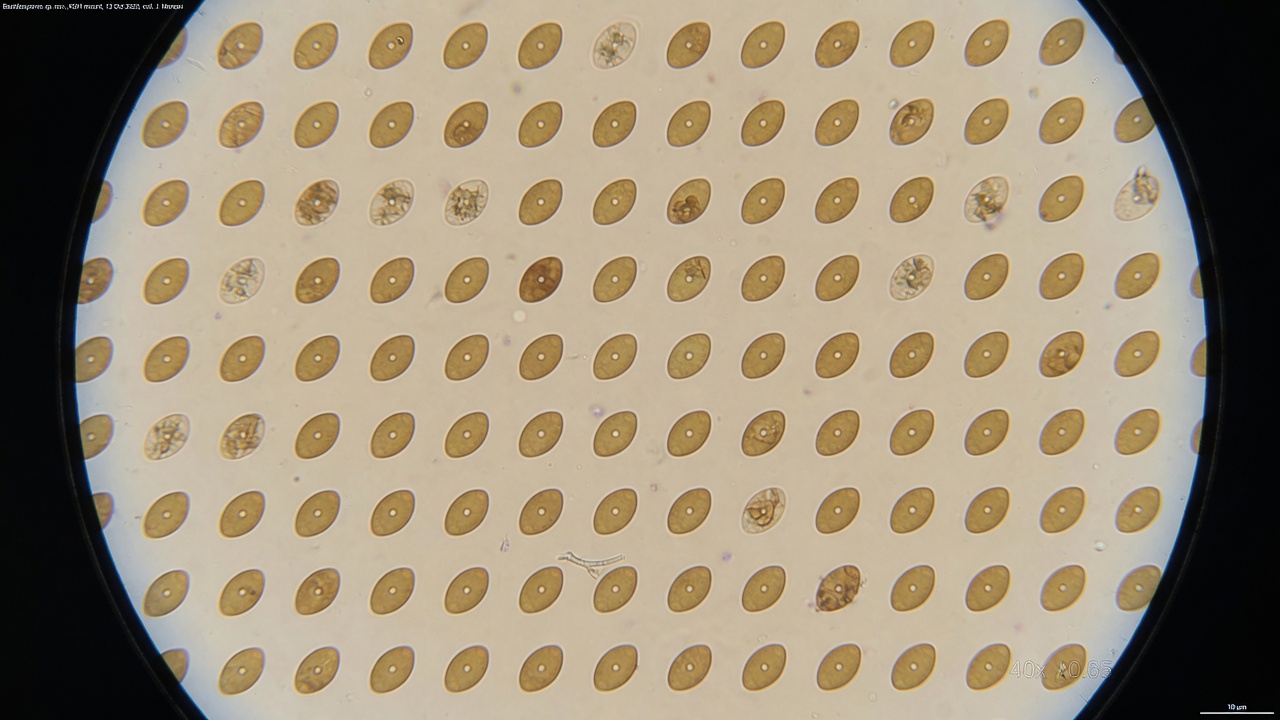
A spore print, the dark deposit left when a cap drops its spores onto foil or paper, is visible because it contains millions of spores packed in one place. A syringe spreads a portion of that material through water. Both are useful for microscopy, and each has its own advantages. Prints are easy to see and to store dry, while syringes deliver a ready-made suspension that is simple to put on a slide. Our guide to spore print techniques covers the print side, and multi-spore vs isolated syringes explains the difference between syringe types.
For general slide technique, start with the microscopy primer. If you have ordered from us and are not sure what you are seeing, our page answering common Reddit complaints explains how we handle “empty syringe” reports. You can browse the current range of spore syringes in the shop.
The Short Version
A clear syringe is normal and expected, because individual spores are far too small to see and too sparse to cloud the water. Dark specks are clumps, not quality. A syringe can still be light on spores, though, and the only reliable check is a drop on a slide at 400×.
Mushroom spores are sold strictly for microscopy and research purposes only. The cultivation of psilocybin mushrooms is illegal in many jurisdictions.


