

Short answer: Golden Teacher is a catalogue name for Psilocybe Cubensis (Earle) Singer. It is not a published species. A microscope can show that spores fit the published description of P. cubensis, but it usually cannot show that a sample is Golden Teacher rather than another cubensis label.
In this guide
- What Golden Teacher is (and isn't)
- The species behind the name
- Spore measurements
- Print color and cap color
- Why it is a popular first strain for microscopy
- How to prepare a spore slide
- How to store spore syringes
- Where the name came from
- Comparing strains
- Identifying it safely
- Legal note
- References
- FAQ
What Golden Teacher is
Golden Teacher is a trade name. Index Fungorum record 290107, Species Fungorum, and NCBI Taxonomy 181762 list the species Psilocybe Cubensis and do not list this name. A PubMed search for the quoted phrase "Golden Teacher," including with cubensis, returned no papers on 1 October 2026.
The practical consequence is that measurements belong to the species, not to the label. Mushly offers Golden Teacher as a 12 cc spore syringe and a spore print, for microscopy and taxonomic study.
"Golden Teacher is a catalogue name for Psilocybe cubensis, not a species. Spore size is a species measurement, and a microscope cannot prove the trade name."

The species behind the name
Short answer: the species was described in 1906 and moved to Psilocybe in 1948.
Earle described Stropharia cubensis in 1906 from Cuba. Singer moved it to Psilocybe in Sydowia 2: 37 (1948). That Cuban type and that 1948 combination are the species. They are not a Golden Teacher collection.
Index Fungorum and NCBI place Psilocybe cubensis in the family Agrocybaceae. That is not the family on the Index Fungorum or NCBI records.
Spore measurements
Short answer: about 11.5-17.3 × 8-11.5 µm, smooth, with a truncate apex, and these figures describe the species, not the label.
Singer and Smith (Mycologia 50, 1958) describe P. cubensis spores as:
- Size: 11.5-17.3 × 8-11.5 × 7-9 µm
- Surface: smooth, with a thick, complex wall
- Apex: truncate, from a distinct apical pore
- Color in a mountant: dark yellow brown in KOH, dark olive brown in NH4OH
The KOH color is a mountant color, not a spore-print color. The paper does not mention Golden Teacher. Do not treat a size printed on a syringe page, or a range repeated by vendors, as a Golden Teacher measurement. A spore inside the 1958 range still cannot tell you which cubensis label it came from.
If you examine tissue as well as spores, basidia in this species bear four spores each.
Print color and cap color
Short answer: sources disagree, so record what you see.
- Mushly's syringe and print listings: dark purplish-brown spores.
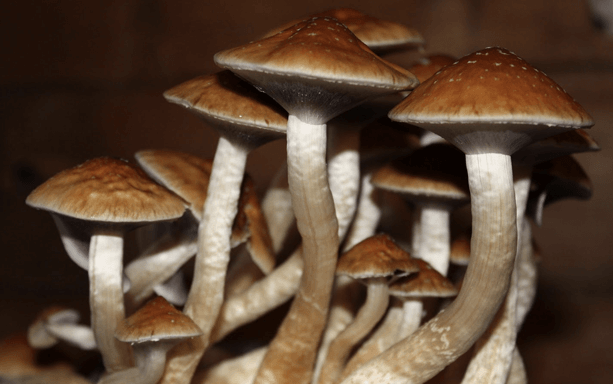
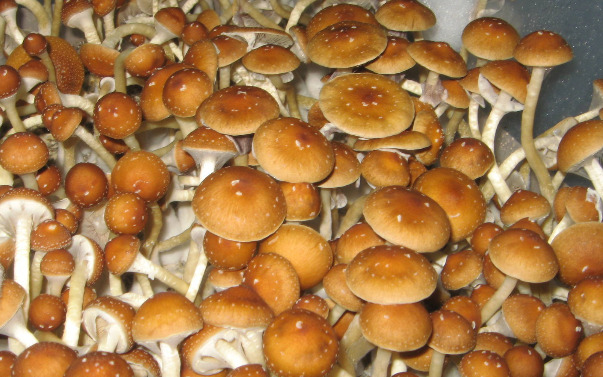
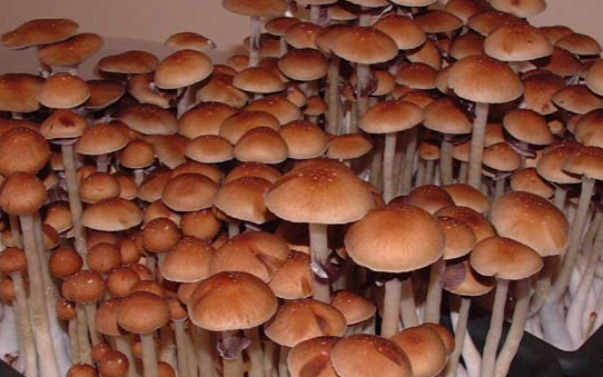
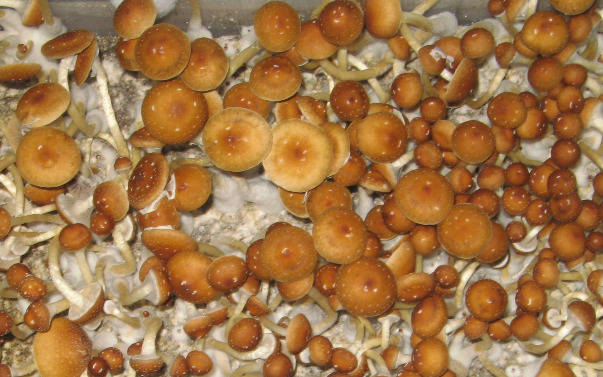
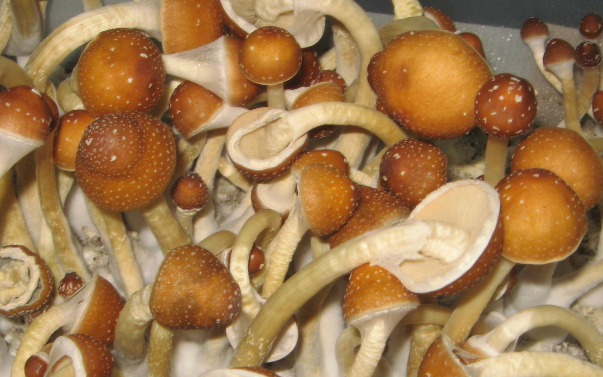
- Sporeworks: dark purplish-brown, subellipsoid spores on four-spored basidia, and a cap that goes from reddish cinnamon-brown to golden brown to light yellow, with veil remnants as spots. Spores101 repeats this wording and adds a cap that matures from pale yellow to golden.
- Spore Genetics: deep purple-black spores and broad golden-caramel caps.
- Ralphsters: a light golden cap and a dark spore deposit, without naming a purple or brown.
A match to one of these descriptions is that source's claim, not proof of the catalogue name.
General appearance. These are typical descriptions of the species, not markers specific to Golden Teacher: a cap roughly 2-8 cm across, conical when young and becoming convex to flat, golden to light brown, sometimes with veil remnants; closely spaced gills that darken as spores mature; and a thick, fibrous, pale stem, often with a ring.
Why it is a popular first strain for microscopy
Short answer: it is widely sold, widely photographed, and spore deposits are dark and easy to see, but those are practical reasons, not taxonomic ones.
Golden Teacher is one of the most commonly stocked P. cubensis names, so it is easy to find and easy to compare against published images. Spores of the species are large and smooth enough to be seen at ordinary compound-microscope magnifications, and a dark deposit makes prints easy to read. None of this is specific to Golden Teacher. Any cubensis syringe or print will behave similarly, and claims that one label sporulates more heavily than another are vendor observations, not published measurements.
How to prepare a spore slide
Short answer: clean slide, one small drop, coverslip at an angle, then work up from low to high magnification.
You will need: a compound microscope (400x at minimum, 1000x with oil immersion for fine detail), glass slides and #1.5 coverslips, immersion oil, isopropyl alcohol and lens tissue, your spore syringe or print, and a notebook.
- Clean the slide. Wipe it with lens tissue and isopropyl alcohol and let it dry. Fingerprints and dust show up as artifacts.
- Mix the syringe. Spores settle in storage. Roll the syringe between your palms and shake gently so they are evenly suspended.
- Place one small drop on the center of the slide. Too much liquid makes the coverslip float.
- Lower the coverslip at an angle, letting one edge touch the liquid first, to avoid air bubbles.
- Start at low power (10x objective) to check spore density and spot debris or contamination.
- Move to 400x to look at individual spores and practice measuring.
- Use oil immersion at 1000x for wall structure and the apical pore.
- Record what you see. See the checklist below.
What to write down:
- Spore shape, and whether the apex looks truncate.
- A size range from at least 20 spores (length × width, plus the third dimension if you measure it), with the magnification and mountant. A single spore tells you very little.
- Spore color in the mountant, recorded separately from print color.
- Print color, if a print was examined.
- Number of spores per basidium, if tissue is on the slide.
- The limit: a fit to P. cubensis does not prove the Golden Teacher catalogue name.
How to store spore syringes
Short answer: cool, dark, upright.
Vendor guidance for spore syringes is typically to keep them refrigerated (commonly cited as roughly 2-8°C or 35-46°F), away from light, and standing upright so spores do not pack against the plunger. Do not freeze them. Vendors commonly quote six to twelve months of useful life; treat that as a rule of thumb, since clumping or degraded spores make slides harder to read. Mix the syringe thoroughly before use.
Where the name came from
Short answer: accounts vary, no source names a collector or a parent strain, and the name appears to date to the mid-to-late 1980s.
- Informal label: the name appears to have emerged as an informal trade label in the mid-to-late 1980s. Gulf Coast and other regions are often repeated, but it is not a typed herbarium collection.
- Spore Genetics says the stories point to Georgia, Florida, or Cuba in the 1980s. The Cuba story there is not Earle's 1906 type.
- Inoculate the World says an unnamed member of the mushroom community is believed to have found a wild specimen on dung and straw at a farm in Georgia.
- The Hawks Eye says the spores have been sold since the late 1990s and that the mushroom was first found on dung and straw at a horse ranch in Georgia. That is the vendor's own account.
- Sporeworks lists bovine and equine dung as habitat for the species. That is a habitat note, not a statement that a Golden Teacher specimen was collected there.
- Wikipedia notes that the species is commonly known as "golden teacher" (lowercase) in South Africa. That is a common-name note about the species, not a source for this trade name.
Some pages place its origin in Southeast Asia. None of the sources above do, and no source reviewed documents it.
The Psilosophy species index lists Golden Teacher as a named strain of P. cubensis, not as its own species.
Ecology of the species: P. cubensis is a saprotroph of tropical and subtropical regions, typically found in grassy pastures and nutrient-rich soils, often on or near dung. Its spores can be spread by wind, water, and grazing animals.
Comparing strains
Short answer: all named P. cubensis strains share one species-level spore description.
Any per-strain spore size table you find online should be treated with caution unless it cites measurements made on documented material. For how named strains differ in appearance and sold characteristics, see Strain vs Strain and the full strain encyclopedia. Related pages: B+, Treasure Coast, Ecuador, Koh Samui, Puerto Rican, PESA.
Identifying it safely
Short answer: never rely on one feature, and never eat a wild fungus based on an online description.
P. cubensis has dangerous lookalikes, including Galerina marginata, which is deadly, and it should be told apart from other Psilocybe species such as P. semilanceata using field guides and expert consultation.
Legal note
Mushly offers spores for microscopy, taxonomy, and mycological research. Laws on spores, and on psilocybin-containing mushrooms, differ by country and by U.S. state, and cultivation of psilocybin- or psilocin-containing species is illegal under U.S. federal law and in many other jurisdictions. Check the law where you live before ordering.
Shop Golden Teacher spore syringes · Spore prints · Mushroom spores for microscopy guide
References
- Earle, F.S. (1906). Original description of Stropharia cubensis, from Cuba.
- Singer, R. (1948). Sydowia 2: 37. Transfer of the species to Psilocybe.
- Singer, R. & Smith, A.H. (1958). Mycologia 50. Spore description of P. cubensis.
- Index Fungorum, record 290107; Species Fungorum; NCBI Taxonomy ID 181762.
- Vendor and reference pages cited above (Spore Genetics, Inoculate the World, The Hawks Eye, Sporeworks, Spores101, Ralphsters, Psilosophy, Wikipedia), accessed October 2026.




Is Golden Teacher a species or a strain?