

About Koh Samui (Psilocybe cubensis): Name, Origin Claims and the "Super Strain" Mushrooms
Updated: October 9, 2026
Mushroom spores are sold strictly for microscopy and research purposes only. Cultivation of Psilocybin-containing fungi is illegal in many jurisdictions. This page is not a guide to finding, growing, or taking mushrooms.
Short answer: Koh Samui is a trade name for material sold as Psilocybe Cubensis (Earle) Singer. It is not a separate species, a published variety, or a recognised variant. Sellers say it was collected on the island of Koh Samui in Thailand by John Allen, usually in the 1990s, but no voucher or record is published. "Koh Samui Super Strain" (also sold as KSSS or SSKS) is described by sellers as an isolation, a selection, or a squat form, and the descriptions conflict. A different, real species, Psilocybe samuiensis, was described from the same island and is not this line.
Home » Strain Encyclopedia » Psilocybe Cubensis » Koh Samui
In this guide
- What Koh Samui is
- Taxonomy
- What is documented and what is lore
- Spore and cap traits
- Origin claims, source by source
- Koh Samui and the "Super Strain"
- Not the same as Psilocybe samuiensis
- Identifying it, and what a microscope can't tell you
- Examining a slide
- Mushly products
- Legal note
- References
- FAQ
What Koh Samui is
Koh Samui is one of several Thai-labelled lines of Psilocybe cubensis in Mushly's all-strains library. The name is a catalogue label used by spore sellers. It describes a product and not a taxon, and an island in the name is a seller's claim and not a specimen record. For the wider group, see our Thai umbrella page. For the difference between a species and a trade name, see our species vs strain primer and the Psilocybe cubensis species guide.
"Koh Samui is a trade name for Psilocybe cubensis, not a species or published variety, and not Psilocybe samuiensis. Sellers credit John Allen in the 1990s; the Super Strain is described as an isolation, or as squat, or as larger. Claims compared."


Taxonomy
| Rank | Entry |
|---|---|
| Kingdom | Fungi |
| Phylum | Basidiomycota |
| Class | Agaricomycetes |
| Order | Agaricales |
| Family | Placement varies by source: Index Fungorum, Species Fungorum and NCBI list Agrocybaceae, while Wikipedia and many other references use Hymenogastraceae |
| Genus | Psilocybe |
| Species | Psilocybe cubensis (Earle) Singer, Sydowia 2(1-6): 37 (1948) |
| Basionym | Stropharia cubensis Earle (1906), described from Cuba |
| Trade names | Koh Samui, Koh Samui Super Strain, KSSS, SSKS (informal) |
Species records: Index Fungorum 290107, the Species Fungorum synonymy and NCBI Taxonomy 181762. None lists Koh Samui.
What is documented and what is lore
| Question | Status |
|---|---|
| Is Koh Samui a species or published variety? | No. The only formal name is Psilocybe cubensis. |
| Is it Psilocybe samuiensis? | No. That is a separate species described from the same island. |
| Spore size and shape | Published for the species only, with no Koh Samui-specific measurements. |
| Collected on Koh Samui | Seller claim only. No voucher, site or herbarium record is published. |
| Collected by John Allen | Credited by several sellers. Unverified. |
| Date | "The 1990s" (several sellers), or none given. |
| What "Super Strain" means | Sellers disagree. See below. |
| Published literature using the line names | None is known. |
Spore and cap traits
Short answer: the published measurements describe the species, not this name.
Singer and Smith's 1958 Mycologia monograph (Mycological investigations on Teonanácatl) describes P. cubensis spores as:
- Size: 11.5-17.3 × 8-11.5 × 7-9 µm
- Surface: smooth, with a thick, complex wall
- Apex: truncate, from a distinct apical pore
- Colour in a mountant: dark yellow brown in KOH, dark olive brown in NH4OH
The KOH and NH4OH colours are mountant colours, not spore-print colours. The paper does not mention Koh Samui. Guzmán et al. (2012), a review of Psilocybe in Thailand, give a second species-level range of (12-)13-15(-17) × 8-10(-11) × 7-9 µm.
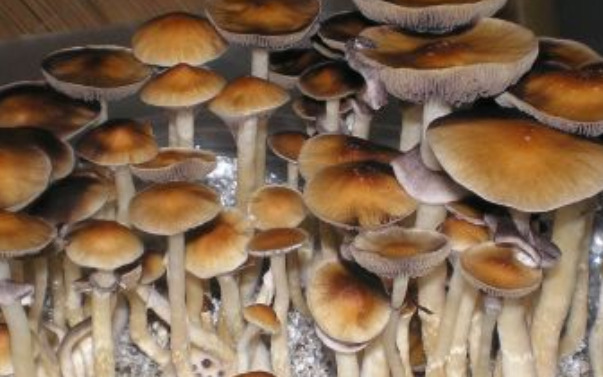
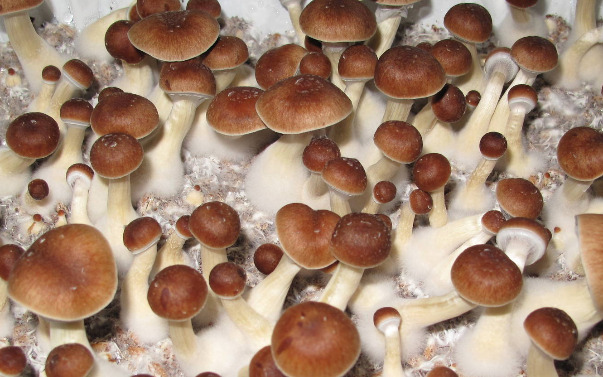
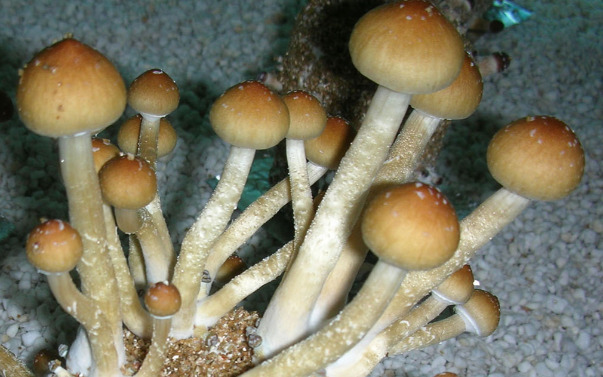
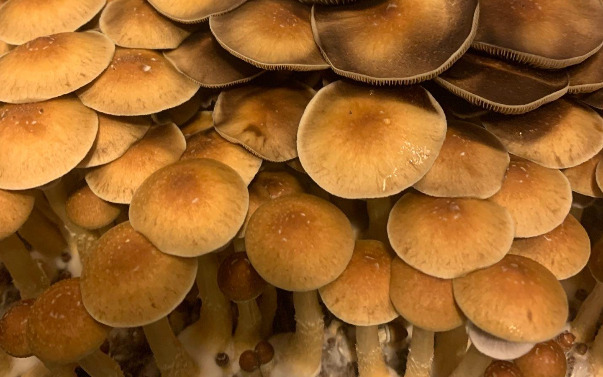
Seller descriptions are not diagnostic. Spore Genetics describes "broad caramel-brown caps" and a "dark-purple hue" for the spores, and PNW Spore's image text says "brown/beige caps, white stems." Those are descriptions and not measurements. None of the pages we checked gives a measured spore size for this label. Record what you actually see on your own slide.
Origin claims
Short answer: the sellers agree on Koh Samui and John Allen, and add nothing checkable.
| Source | What it says |
|---|---|
| Spore Genetics | "Collected on the tropical island of Koh Samui, Thailand … by famed mycologist John Allen" "in the 1990s." |
| PNW Spore | "First collected in Thailand by amateur mycologist John Allen in the 1990's," and "used in Thai medicine long before John Allen 'discovered' it." |
| Mycotown | "Originally discovered on the island of Koh Samui," "first collected by renowned mycologist John Allen." Gives no date. |
| Complete Myco | "Obtained from buffalo dung samples collected by mycologist John Allen." Gives no date. |
The sellers agree on the island and the name. They describe John Allen as "famed," "renowned" and "amateur," and give a date only as "the 1990s." None cites a specimen or a paper that names the line, and PNW Spore's remark about Thai medicine is a claim of use with no source. A repeated claim is still one claim. We do not state a collector, a year or a site as fact, and we do not repeat the claim about traditional use.
Koh Samui and the "Super Strain"
Short answer: sellers disagree on what the "Super Strain" is.
| Source | How it describes Koh Samui Super Strain |
|---|---|
| Complete Myco | "An isolation from the original Koh Samui strain," with "notable vigor and larger size." |
| Mycotown | "Selectively refined" over time, with "authentic genetics from the original Thai island strain." |
| Spore Genetics | Lists the aliases KSSS, Koh Samui Super Strain and "KSSS Squat." Elsewhere it distinguishes the line from the taller Thai Lipa Yai. |
One seller says "larger," and another's alias says "squat." Whether it is an alias, a selection or an isolation, none documents the selection step. The acronym also varies (KSSS or SSKS). A plain "Koh Samui" listing and a "Super Strain" listing should be treated as two different catalogue names until a seller documents otherwise. Don't confuse either with Thai Lipa Yai, which is a separate catalogue name with its own origin claims.
Not the same as Psilocybe samuiensis
Psilocybe samuiensis Guzmán, Bandala & J.W. Allen is a separate species described from Koh Samui. Wikipedia gives 1993 as the year and soil near the village of Ban Hua Thanon as the type locality, and describes a small cap (7-15 mm) with rhomboid spores of about 10.4-12.8 × 6.4-8 µm. None of the seller pages we checked says its line is P. samuiensis. If a listing treats "Koh Samui" and "samuiensis" as one thing, ask the seller which species they mean.
Identifying it
Short answer: microscopy supports a species-level note, not a line identity.
- What a match shows: smooth, thick-walled spores with a truncate apex and germ pore, within the published species range, support P. cubensis as the species to compare. The rhomboid spores described for P. samuiensis should look different. Ramírez-Cruz et al. 2013 notes that spore characters overlap across Psilocybe.
- What it cannot show: that a packet is Koh Samui rather than another cubensis label, whether it is the "Super Strain," that it came from Thailand, or that a named person collected it.
- Chemistry: Mushly makes no claims about the chemical content of Koh Samui, and no published laboratory analysis under this name is known.
Examining a slide
Follow the general method in our Golden Teacher guide and the mushroom spores guide, and then:
- Measure at least 20 spores (length × width) and record the magnification and mountant.
- Note the germ pore, the wall, and the shape in face and side view.
- Record the colour in the mountant and the print colour separately.
- Write down the exact label (Koh Samui or Koh Samui Super Strain), supplier and date.
- Remember the limit: a fit to P. cubensis does not prove the Koh Samui label or the "Super Strain" selection.
Mushly products
Mushly offers Koh Samui Super as a spore syringe, for microscopy and taxonomic study. It does not list a product named plain "Koh Samui," so the name on this page and the name on the product are not the same. Browse our spore syringes and check size, price and availability on the product page.
Legal note
Mushly offers spores for microscopy, taxonomy, and mycological research. Laws on spores, and on psilocybin-containing mushrooms, differ by country and by U.S. state, and cultivation of psilocybin- or psilocin-containing species is illegal under U.S. federal law and in many other jurisdictions. Check the law where you live before ordering.
Spore syringes · Strain library · Mushroom spores for microscopy guide
References
- Index Fungorum 290107; Species Fungorum synonymy; NCBI Taxonomy 181762
- Singer, R. & Smith, A.H. (1958), Mycologia 50
- Guzmán et al. 2012, Mycotaxon 119: 65-81
- Ramírez-Cruz et al. 2013, Canadian Journal of Botany
- Wikipedia: Psilocybe samuiensis (year, type locality, spores; used only to separate it from the cubensis lines)
- Seller claims (not papers, not verified): Spore Genetics; PNW Spore; Mycotown; Complete Myco




What is Koh Samui?