

Search for spore swabs and you will find shops selling them one strain at a time. That works. But look closely at what a swab really is, and a simpler path opens up. A spore swab is a sterile cotton or foam tip that has been rubbed across a spore print. That is the whole product. The spores on the tip came from a print, and once they leave it, there are only so many on that little tip.
So here is the idea worth sitting with: if you own the print, you own the source. One print can supply as many swabs as your slide work needs. That is why Mushly sells spore prints and spore syringes, but no swabs.
Three ways spores arrive
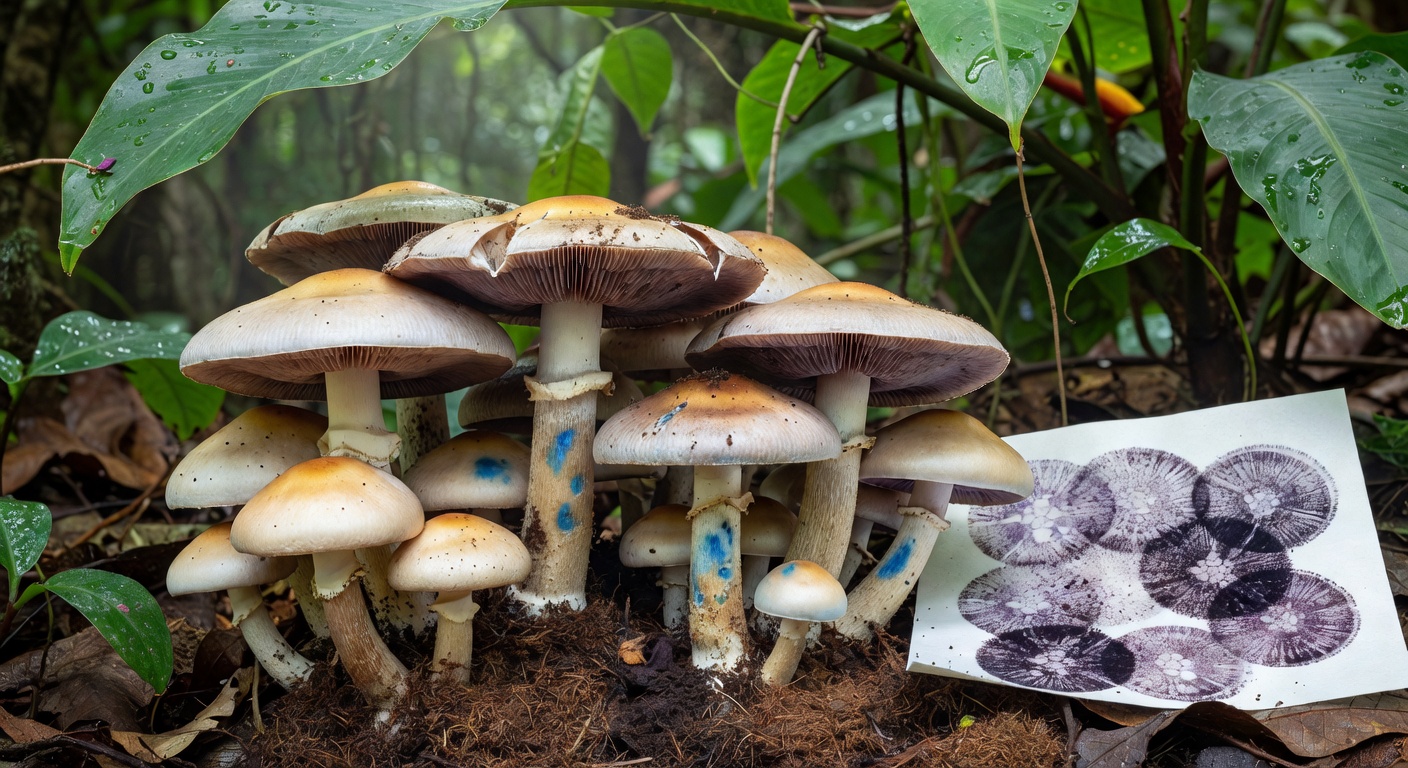
Spores are tiny reproductive cells, far too small to see one at a time without a microscope. When a mature cap drops them onto paper or foil, millions pile up into a dark pattern that traces the gills. That pattern is a spore print. Our guide to mushroom spores covers what they are and why researchers study them.
- Spore print: dry spores on foil or paper, sealed in a bag. The original source material.
- Spore syringe: spores suspended in sterile water, ready to place a drop on a slide.
- Spore swab: a sterile tip carrying a small sample of dry spores taken from a print.
A syringe and a swab are both made from a print. The difference is packaging, not the spores themselves. Under the microscope, a spore from a swab and a spore from a syringe show the same shape, size and color as the print they came from. For a fuller side by side, see spore syringe vs spore print vs liquid culture.
Why a print gives you more
A bought swab is a single sample. Once you tap it onto a slide, most of what it held is spent. A print is different. Even a modest print holds far more spores than any one slide needs, so you can return to it again and again, a light touch each time.
A print also shows you things a swab hides. You can see its color and density with your own eyes before any glass is involved. You know where the sample came from because you took it. And if a slide comes out crowded or thin, you simply make another.
Dry prints also keep well. Stored sealed, cool, dark and dry, they hold up for a long time, which suits slow, careful study over many sessions.
Prints also travel well. Outside the US and Canada, prints are the only format Mushly ships, because they hold up better over long distances than syringes. See worldwide shipping for details.
Making your own swab for slide work
Making a swab is mostly about keeping things clean. Stray dust, skin cells and mold spores in the air can end up on a slide and confuse what you see.
- Gather your tools. Individually wrapped sterile swabs, clean glass slides, cover slips, and a small bottle of distilled or sterile water.
- Clean your space. Wipe the table with isopropyl alcohol, wash your hands, and work away from drafts and fans.
- Open the print briefly. Unseal the bag only as long as you need to.
- Touch, do not scrub. Lightly brush the swab tip across one small corner of the print. A gentle touch picks up plenty.
- Reseal the print right away so the rest stays clean and dry for next time.
From swab to slide
You have two simple choices, and both work well.
Dry mount. Tap or roll the swab tip lightly over the center of a clean slide, then lay a cover slip on top. This is quick and shows the natural color of the spores in a mass.
Wet mount. Place one small drop of water on the slide, touch the swab tip into the drop, and swirl gently. Lower a cover slip at an angle so it pushes out air bubbles. Water spreads the spores into a thinner layer, which makes single spores easier to see.
Start at low power to find the spores, then move up. Around 400x total magnification, many spores show their outline and color. At 1000x with oil immersion, finer detail such as size and wall shape comes into view. Write the strain, the date and the method on each slide so your observations stay comparable.
If too many spores pile up, use a lighter touch next time. If you find too few, touch the print again. With a print on hand, a thin slide is a small problem, not a lost sample.
When a syringe makes sense
Some people prefer spores already in water. A spore syringe lets you place a drop directly on a slide without handling dry material. It is a good choice if you want a wet mount every time and do not want to keep a print. For many, though, a print and a pack of sterile swabs give more flexibility for the money.
Prints to start with
If you want to try the swab method, any print will do. A few in-stock places to begin are the Golden Teacher spore print, the Blue Meanie spore print and the African Transkei spore print. Comparing two prints side by side under the same magnification is one of the quiet pleasures of microscopy.
A note on the law
Spores do not contain Psilocybin or psilocin. In a January 2024 letter, the DEA stated that spores without those compounds are not controlled under the federal Controlled Substances Act, while material becomes controlled once it contains them, for example after germination. Some states go further. California, Georgia, Idaho and Florida restrict these spores, so do not order them if you live there. Growing psilocybin mushrooms is illegal under federal law. Mushly sells spores for microscopy and research only.
References


Does Mushly sell spore swabs?