

On April 18, 2026, the White House signed Executive Order 14401. Its title is Accelerating Medical Treatments for Serious Mental Illness. The order was published in the Federal Register on April 22, 2026 (Document 2026-07907, 91 FR 21709). It tells federal agencies to put certain review and access paths first for investigational psychedelic drugs. These include products related to Psilocybin and ibogaine compounds. FDA approval standards and Controlled Substances Act scheduling rules stay in place.
Some readers follow fungi through a microscope, not a clinic. For them, the useful question is narrower. What does the order actually change? What does it leave alone? How does policy attention relate to legal mushroom spore work for microscopy and taxonomy? This article sticks to the public record. It leaves medical claims out. It keeps drug-review policy apart from what a spore catalog is for.

What Executive Order 14401 Actually Directs
The order’s own text, and the White House fact sheet that came with it, say more than “speed everything up.” In plain terms, EO 14401 tells agencies to:
- FDA / Commissioner’s National Priority Vouchers (CNPVs): Give CNPVs to suitable psychedelic drugs that already have Breakthrough Therapy designation and meet the program’s criteria. This is a review tool for qualifying applications. It does not change how Breakthrough Therapy designations are granted.
- FDA and DEA / Right to Try: Make a path for eligible patients to access investigational psychedelic drugs, including ibogaine compounds, under the Right to Try Act. This includes the Schedule I handling permits that treating doctors and researchers need, where the law allows.
- HHS / ARPA-H funding: Set aside at least $50 million from existing funds. It supports partnerships with state programs that advance psychedelic-drug research for serious mental illness.
- HHS, FDA and VA collaboration: Grow clinical-trial participation, data sharing and real-world evidence. Products with Breakthrough Therapy designation come first.
- Attorney General (with HHS) / timely rescheduling review: Start and finish a review of products that contain a Schedule I substance and have completed Phase 3 trials for a serious mental health disorder. The aim is that rescheduling, if proper under 21 U.S.C. 811, can move as fast as practical. This applies to specific products that are finally approved under FD&C Act section 505.
That last point matters for headlines. Rescheduling review is for specific products. It depends on finishing Phase 3 and on later FDA approval. It must still meet Controlled Substances Act criteria. The order does not reschedule psilocybin, ibogaine or mushrooms as a whole group.
What EO 14401 does not do is just as important. It does not approve any psychedelic drug. It does not legalize recreational use. It does not end Schedule I status on its own. It does not change federal rules on growing mushrooms. It does not set a public “agencies must report by late 2026” deadline. That timeline is not in the order text. It is also not a green light for home labs. Clinical and Right to Try paths run through licensed doctors, researchers and regulated handling. They do not run through consumer mycology kits.
Psilocybin, Psilocybe, and Clear Species Language
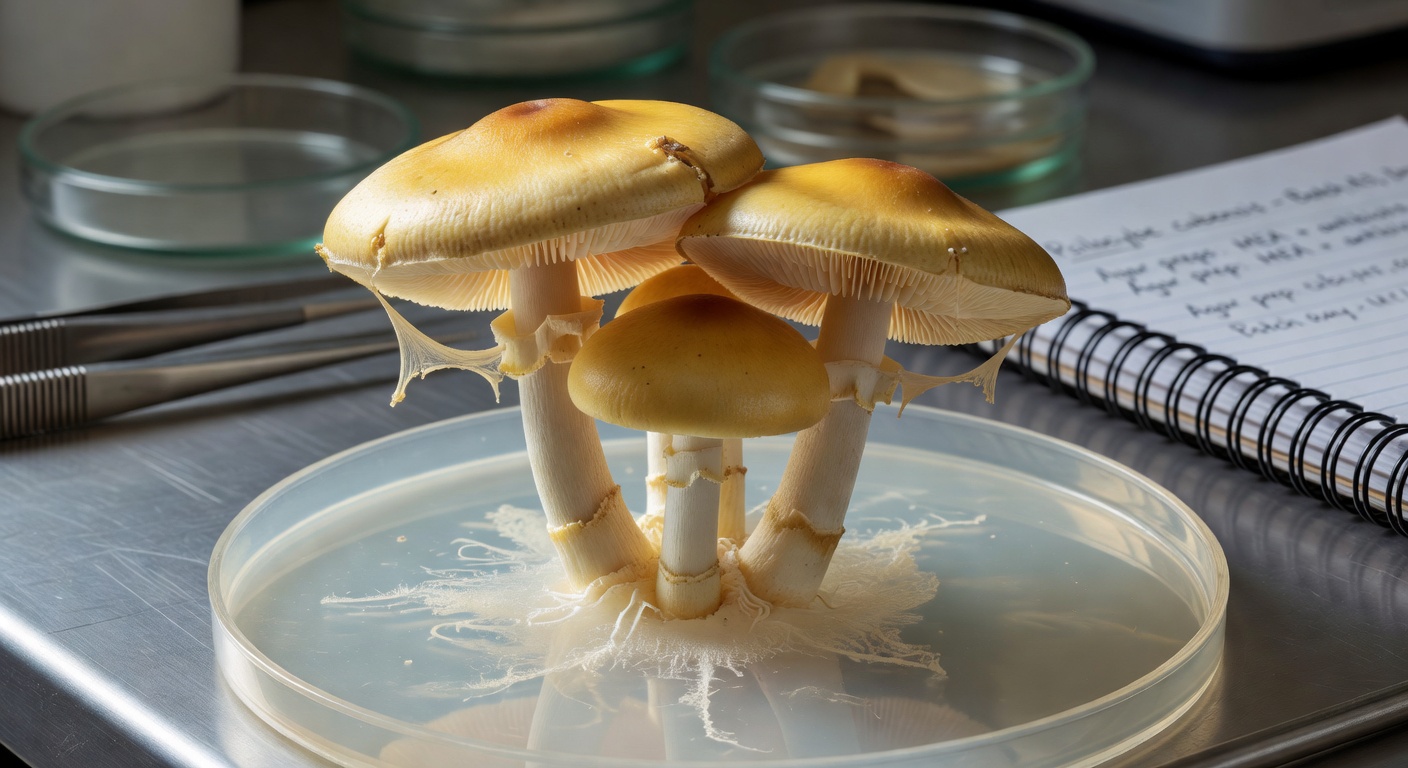
Psilocybin is the tryptamine compound many clinical programs study. In nature, it is linked to mushrooms in the genus Psilocybe and related taxa. In microscopy and taxonomy, the fungus is the specimen, not the drug product. Species names such as Psilocybe Cubensis are formal scientific labels. Catalogs also use informal “strain” names. You may see them in Mushly strain listings or on pages about Psilocybe cubensis strains. These are breeder or vendor shorthand. They help sort prints and syringes for comparison. They are not FDA product names. Vendor stories about “potency tiers” do not replace peer-reviewed chemistry.
Under the microscope, classic P. cubensis spores are usually described as smooth-walled. In face view they range from ellipsoid to nearly rhomboid or six-sided. You record these traits with scale bars, the same mountant each time and notes on sample size. Apparent “wrinkles” or heavy surface detail are often caused by focus, debris or mounting. Be careful before giving them taxonomic weight. A good habit is to compare several prints from the same labeled lot. Keep spore form separate from any clinical story about psilocybin as a drug.
EO 14401’s interest in psilocybin-related drugs does not turn spore microscopy into medicine. If you are building a reference library, start with guides on form and naming, such as Mushly’s mushroom spores overview. Use spore syringes or prints as microscopy specimens. They do not stand in for approved medicines.
You can see which clinical studies are publicly registered. Search psilocybin entries on ClinicalTrials.gov. A listing is not proof of safety or efficacy. Registry pages describe protocols and status. They are not endorsements.
Ibogaine in the Same Federal Conversation—Not a Mushroom Spore
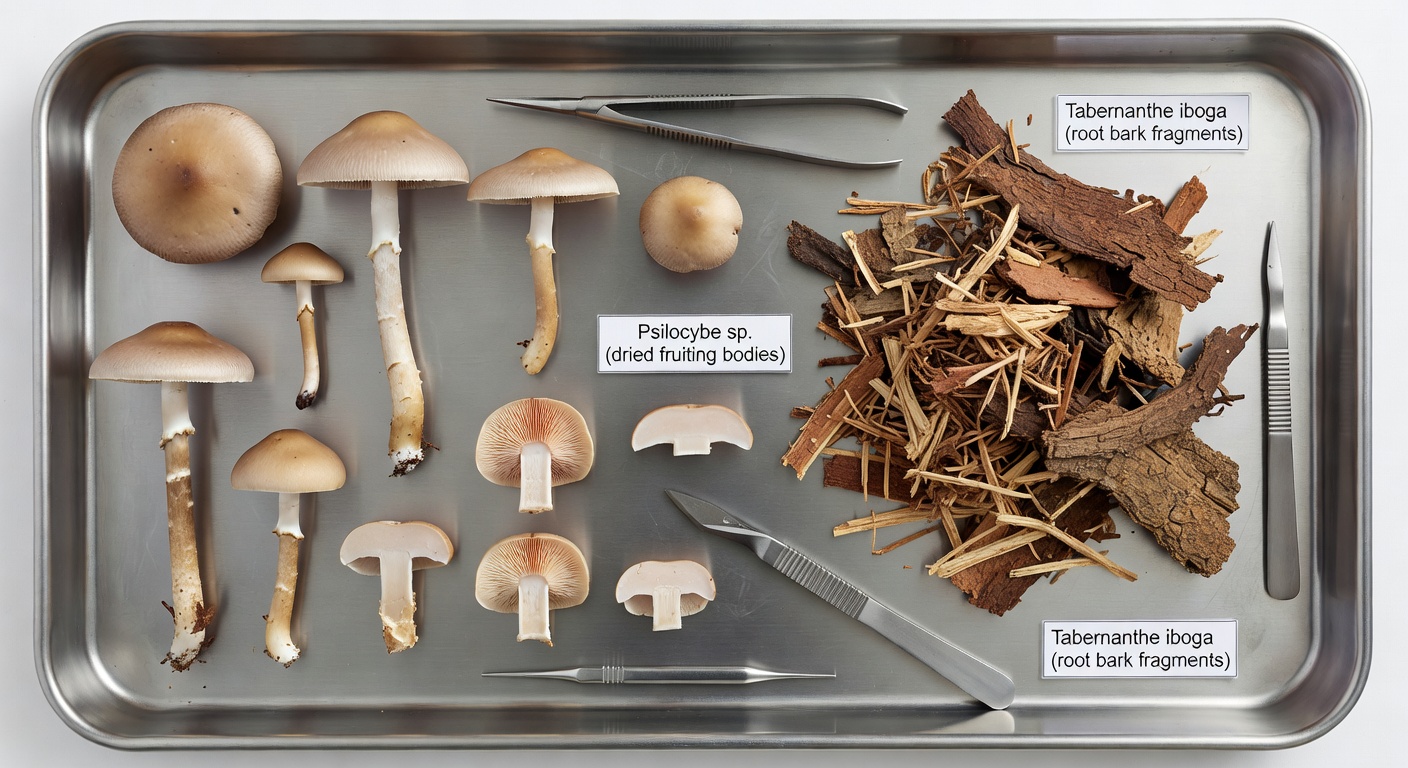
Ibogaine is a plant alkaloid linked to Tabernanthe iboga, not to Psilocybe mushrooms. EO 14401 names psychedelic drugs, including ibogaine compounds, in the context of investigational access and agency teamwork. That is a regulatory and research topic for controlled substances under FDA and DEA oversight. It is no reason to mix iboga chemistry into a mushroom-spore catalog.
Public talk often overstates how close any compound is to “legitimacy.” Under U.S. federal law, Schedule I controls still apply until a specific product is approved and properly rescheduled. Heart and other safety concerns about ibogaine have been widely reported, in clinical and non-clinical settings. Medical regulators and trial sponsors must weigh those risks. A microscopy shop should not sell them as outcomes. For primary trial listings instead of headlines, use ibogaine searches on ClinicalTrials.gov. Read the eligibility and safety sections closely.
For Mushly readers, the practical lesson is simple. Keep plant alkaloids and mushroom spore form in separate mental folders. A policy paper may name both. That does not make them the same specimen, the same product or the same legal category for hobby microscopy.

Research Landscape: Follow Institutions, Not Hype Cycles
Long before EO 14401, universities and nonprofits ran controlled studies on psychedelic compounds. They worked under Investigational New Drug rules and ethics review. Two lasting public sources give context. They are the Johns Hopkins Center for Psychedelic & Consciousness Research and MAPS. Neither is an approval notice. Those sites describe programs, papers and advocacy around clinical research. They do not replace FDA decision letters. Small early studies should not be blown up into claims about whole populations.
Blinding, expectation effects and careful reporting of side effects are still hard problems in this field. Brain-imaging results and pathway theories belong in the science literature, with methods attached. They are not blog-sized medical advice. For mycology fans, one related skill does carry over well. That skill is careful records: voucher notes, spore measurements and a clear line between “what the fungus looks like” and “what a drug sponsor asks FDA to review.”
EO 14401 may speed up how qualifying applications move through some federal queues. On its own, it does not widen consumer access to controlled substances. It does not allow cultivation. State programs and clinical sites follow their own rules. None of that changes how private people should handle spores sold for microscopy.
Policy Attention Versus Spore Law and Microscopy Practice
Headlines about “accelerating psychedelics” are easy to misread as a change in everyday law. At the federal level, Schedule I still limits making, distributing and possessing listed substances. Spore legality is a different question, and it varies by place. It depends on whether spores contain controlled chemicals, and on state and local rules. Mushly’s explainer on understanding spore laws is the right place to start. This article is not legal advice. EO 14401 is not a spore law.
Here is what a microscopy shop can honestly say when federal drug-review policy is in the news:
- Interest in fungal compounds as investigational drugs can raise public curiosity about Psilocybe form. Taxonomy and careful slides are the best answer to that curiosity, not dosage talk.
- Catalog labels and strain names remain tools for comparing prints and syringes across all strains. They are not clinical trial arms.
- Spore syringes and prints sold for microscopy and research stay in that lane. They are not medicines or Right to Try products. They are not a way around Controlled Substances Act limits on cultivation or consumption.
Stay skeptical of both overclaiming vendors and overclaiming press releases. Fast-track tools and vouchers can matter for sponsors who already passed Breakthrough Therapy gates. They do not promise that any compound will be approved, rescheduled or sold over the counter.
What Microscopy Enthusiasts Can Do With This News
If EO 14401 brings new readers to mycology, give them substance. Photograph spores with a calibrated scale. Record the mountant and magnification, and whether you are viewing a print or a syringe prep. Compare labeled P. cubensis material side by side, so informal strain names are not mistaken for species lines. Read the White House order and the Federal Register entry when a claim sounds too broad. The primary sources are short enough to check.
Use institution pages and trial registries to learn what clinical researchers study. Then go back to the bench for what you can check yourself: shape, size ranges, wall look and record quality. Keep policy knowledge in one hand and microscopy skill in the other. That keeps the hobby honest while federal agencies debate paths that were never meant to run through a home desk.
Executive Order 14401 is a real, dated document. It aims at review priority, Right to Try access, state research partnerships and rescheduling review for specific products approved after Phase 3. It is not FDA approval. It is not legalization. It does not change how microscopy-grade spores should be bought, sold or studied. Stay with the text, skip the medical spin and let the slides do the talking.
Mushroom spores are sold strictly for microscopy and research purposes only. The cultivation of psilocybin mushrooms is illegal in many jurisdictions.


