

Short answer on Penis Envy genetics: Penis Envy, Albino Penis Envy (APE), Tidal Wave, and Enigma are trade names for lines of a single species, Psilocybe Cubensis, so under the microscope their spores share the same basic shape. The differences worth recording are mostly about spore color and how many spores a line releases. APE is reported to drop only a few pale to colorless spores, Tidal Wave is sold with ordinary dark spores, and Enigma is reported to produce essentially no spores at all, so it leaves nothing to put on a slide.
The Penis Envy family stands out among hobby mycologists and spore collectors for its range of unusual forms. From the pale, low-pigmentation spores reported for APE to the cap-less, brain-like growths described for Enigma, these lines show some striking differences, although the most dramatic ones are visible to the naked eye rather than under the microscope. This article traces the reported history of these mutants, points out where the stories disagree, and outlines practical approaches for labeling and comparing research samples. You will find notes on what each line shows at common magnifications and how to organize your observations in a notebook. Focus stays on spore appearance, sample documentation, and strain background rather than any other use.
Documented Origins of Penis Envy Mutants
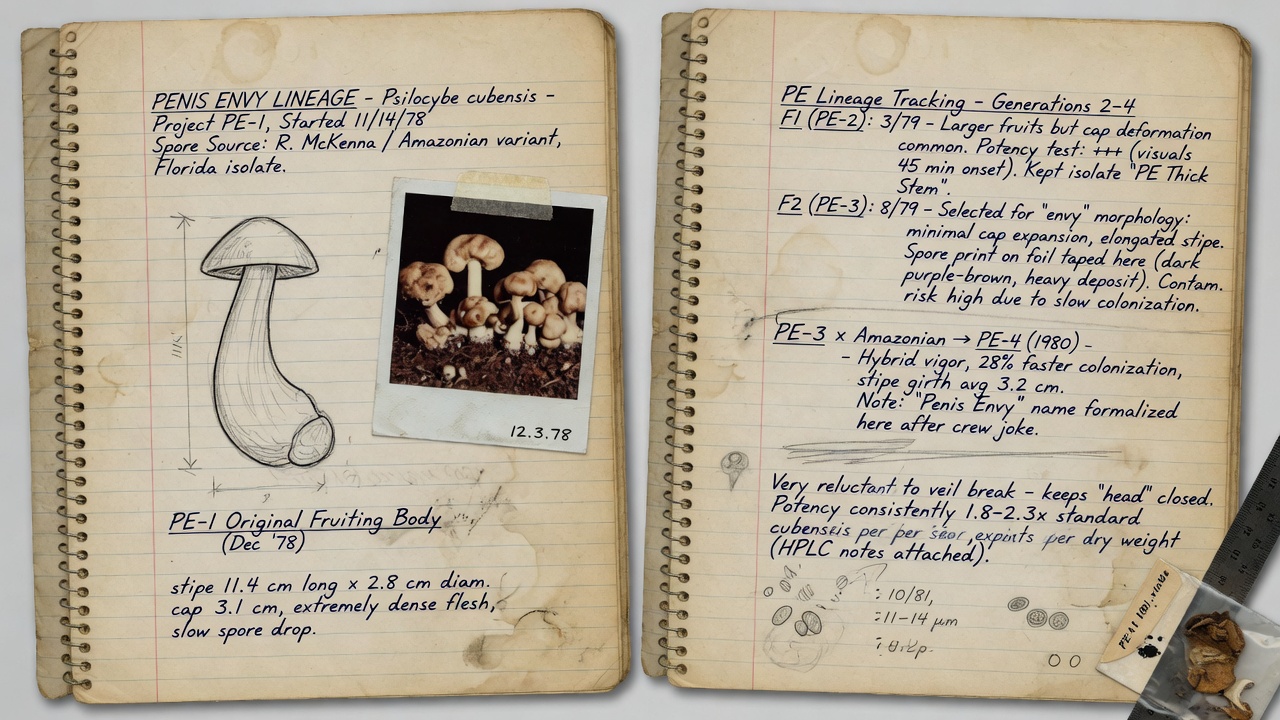
Where Penis Envy came from is a story with two versions, and neither has been independently documented. The popular version comes from a 2009 Vice feature by Hamilton Morris: Terence McKenna collected Psilocybe cubensis spores in the Colombian Amazon in 1971, and a print later reached the Texas physician and mushroom enthusiast Steven Pollock, who grew out an unusually thick-stemmed form. Morris later said one of his sources had misled him, and in a 2022 podcast he presented a revised account in which a cultivator known as Rich Gee grew the odd form from spores traced back to McKenna's collection and kept it going by cloning. Treat both versions as community history rather than established fact. What is well described is the look: vendors characterize Penis Envy by thick, often bulbous stems and small caps that do not develop normally. The spore vendor Sporeworks lists the line's origin simply as Colombia and reports that only about 10 to 25 percent of the mushrooms give a visible spore print, which is why Penis Envy spores are hard to get in quantity.
Trade names such as Penis Envy, APE, and Tidal Wave are meant to identify separate lineages kept apart in collections, but they are names, not formal scientific ranks. The accepted name for all of them, and for every other named cubensis strain, is Psilocybe cubensis (Earle) Singer, which Index Fungorum places in the family Agrocybaceae. A 2025 peer-reviewed review points out that most strain descriptions still come from community reports rather than academic study, and that genetic work has found commercially labeled cultivars often lack genetic similarity across suppliers, so the same name from two sources may not mean the same genetics. Spore prints from these lines are best viewed the way mycologists view any cubensis sample. At 400x you can see shape and color clearly, while measurements and fine detail such as the germ pore are normally done at about 1000x with an oil immersion objective. Published descriptions of the species give spores roughly 11.5 to 17 microns long by 8 to 11.5 microns wide, smooth, thick-walled, and yellowish brown in transmitted light, with a flat, cut-off end where the germ pore sits.
Albino Penis Envy Spore Characteristics
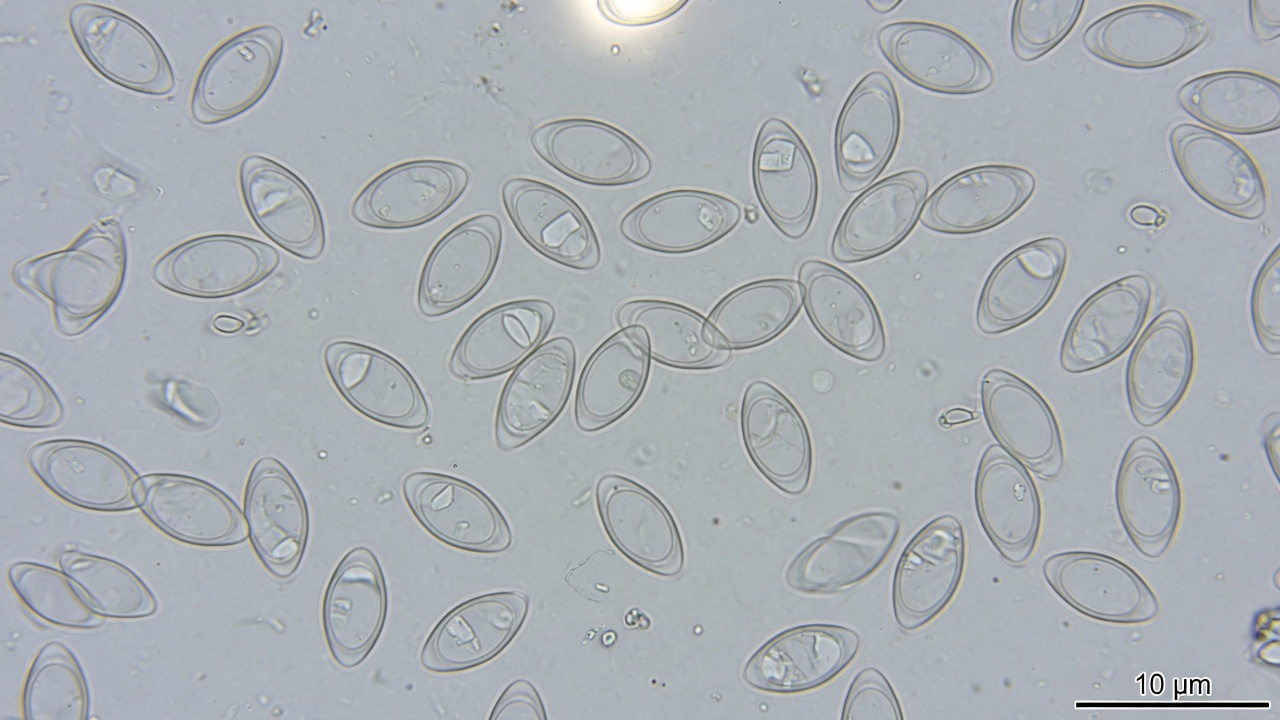
APE samples are recognized for producing spores with reduced pigmentation. The line is credited to John Workman of the spore vendor Sporeworks, who describes crossing the pale PF Albino line with Penis Envy starting in 2005 and releasing the first APE in 2006. That is the breeder's own account and has not been independently checked. Sporeworks describes APE spores as few, transparent, and white in deposit, and other vendors report prints that are faint or invisible to the naked eye, which is why APE spores are often collected by swabbing the gills instead of taking a print. Under transmitted light, such spores appear nearly clear or very pale. That actually makes them harder to see than normal cubensis spores, not easier, because a colorless spore has very little contrast against a bright background. Closing the condenser diaphragm a little, or using phase contrast or darkfield if your microscope has it, helps the outline and the wall stand out. Ordinary cubensis spores need no stain at all because they carry their own brown pigment, and for pale APE spores, adjusting the light is usually the simplest fix. This pale-spore trait sets APE apart from standard cubensis prints, which are dark purple-brown.
When preparing slides, you may come across claims that APE spores are smaller than those of pigmented lines. No peer-reviewed measurements back this up, and no APE-specific spore sizes have been published, so treat it as a question to test with your own calibrated measurements rather than a known fact. The shape remains roughly ellipsoid, just like the rest of the species. At least one vendor describes APE genetics as a mix of albino and normally pigmented spores, so write down the color you actually see on each slide. Because APE releases so few spores, expect a sparse slide and note how many spores you were able to measure. Keeping separate labeled slides for APE allows direct side-by-side comparison with other Penis Envy variants in the same session.
Tidal Wave and Related Hybrid Expressions
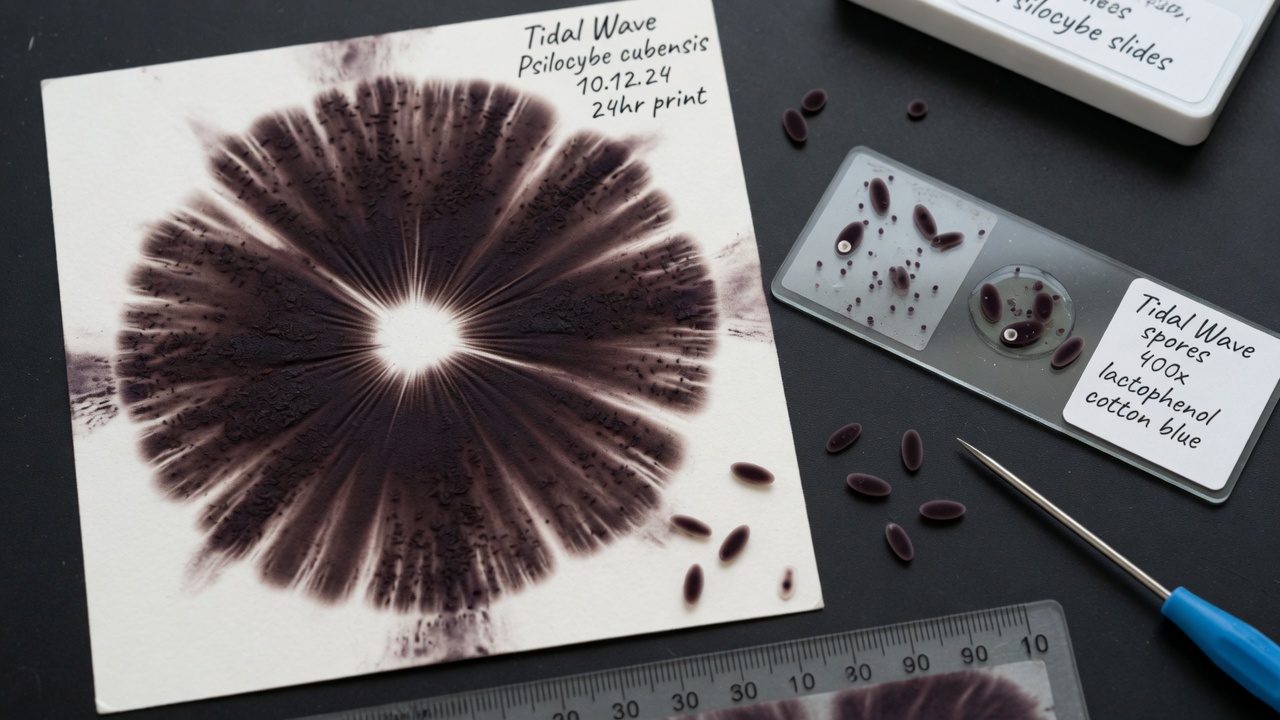
Tidal Wave is sold as a cross of Penis Envy with another cubensis line, B+. That parentage is a breeder and vendor claim rather than a documented pedigree. Sporeworks and Spore Genetics credit the cross to a breeder known as Doma of Magic Myco, but vendors disagree on the date, with one placing it around 2017 and another around 2020. Spore prints from Tidal Wave are described by vendors, Mushly included, as dark purple-brown, much like any typical cubensis print, and Sporeworks lists the spores at about 13 by 8 microns, well inside the normal range for the species. Under the microscope, expect the standard cubensis profile: smooth, ellipsoid spores with a thick wall and a flat end where the germ pore sits. That flat end is a normal feature of every cubensis spore, so it should not be logged as an irregularity unique to Tidal Wave.
Some vendors claim Tidal Wave spores look visibly different from both parent lines at high magnification, but no published study supports this, so it is something to test rather than assume. Notebook entries can record differences in wall thickness or refractivity when switching between APE and Tidal Wave slides at the same magnification. The most obvious contrast you are likely to see is color: a dark, pigmented Tidal Wave spore next to a pale APE spore shows exactly what a pigment difference looks like, even though their shapes match closely.
Enigma and Brain-Like Morphological Variants
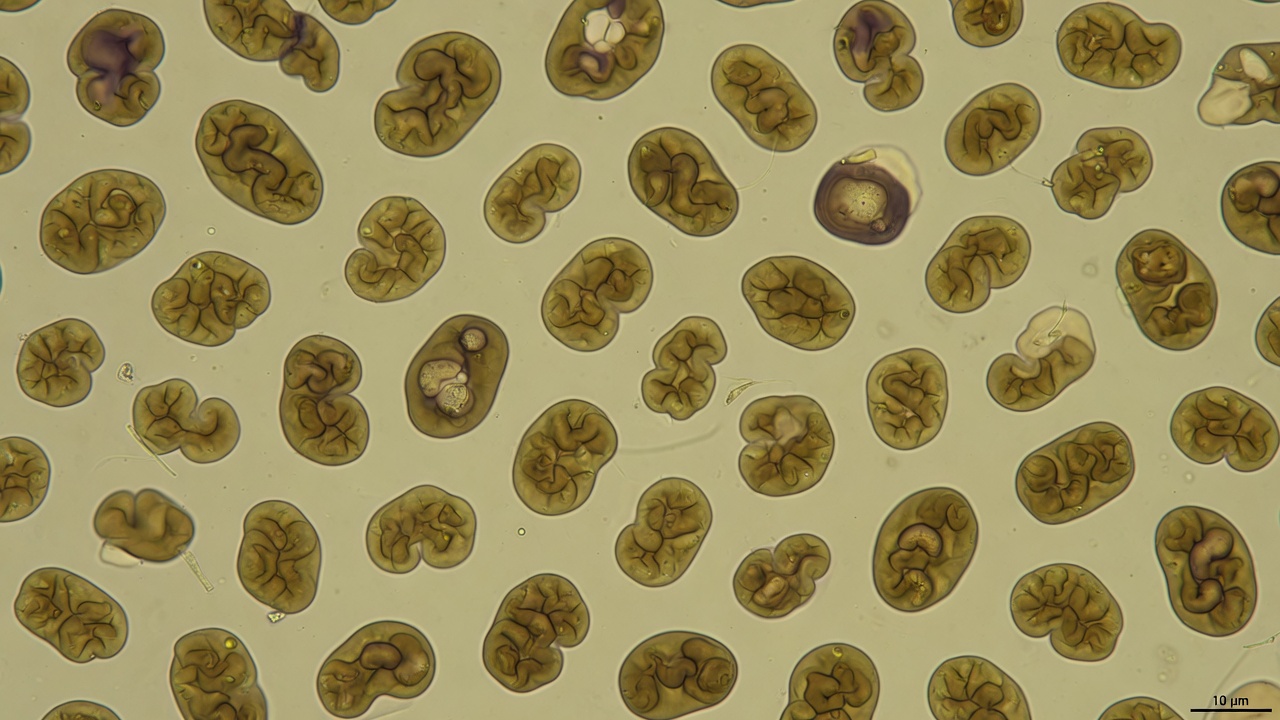
Enigma is reported to be a mutant form that turned up in a Tidal Wave culture, which ties it to the Penis Envy family through Tidal Wave's reported Penis Envy parent. Instead of a normal cap and stem, it forms dense, brain-like or coral-like masses. Sporeworks describes Enigma as sterile, and the form is widely described as having no caps or gills, so it is reported to produce little or no spores and is kept going as cloned tissue cultures rather than from prints. That means there are no real Enigma spore prints to study, and Mushly does not sell Enigma.
If you want to see how these mutations show up at the microscopic level, work with the lines that do release spores: APE and Tidal Wave, alongside a typical cubensis line as a reference. Anything sold under the Enigma name as a spore product deserves a careful look and a note about its source, because the original form is described as sporeless. Clear labeling of each print or syringe helps maintain accurate records across multiple viewing sessions.
Side-by-Side Microscopy Comparison
| Line | Species | Why searched | First notebook use | Syringe vs print | Microscopy notes |
|---|---|---|---|---|---|
| APE | P. cubensis | Pale to colorless spores (breeder report) | Low-pigment comparison | Syringe or swab; prints faint or absent | Few spores, pale walls, low contrast |
| Tidal Wave | P. cubensis | Reported B+ x Penis Envy hybrid | Pigmented reference beside APE | Either format | Dark purple-brown spores, species-typical shape and germ pore |
| Enigma | P. cubensis | Cap-less, brain-like form | Background reading only | Neither; little or no spore production reported | No spores to compare; kept as tissue cultures |
Organizing Research Sample Records
Consistent labeling supports reliable comparisons across Penis Envy lines. Record the trade name exactly as printed on the label, the supplier, the source date, the magnification used, and visible traits such as color intensity or outline shape for each slide. Similar names are not interchangeable. Penis Envy 6 (PE6), for example, is sold as a separate hybrid of Penis Envy and a Texas line, so log it as PE6, not as Penis Envy. A microscope can confirm that spores fit the published description of Psilocybe cubensis, but it cannot confirm which trade line a sample came from.
Store prints and syringes in cool, dark conditions to maintain sample integrity for future microscopy sessions. Keep prints dry and sealed, since moisture invites mold, and keep syringes in the refrigerator rather than the freezer, because ice crystals can damage the spores. Cross-reference entries with photos taken through the eyepiece to build a visual library of spore features.
Tracing Penis Envy mutant lines through microscopy reveals real differences in spore color and spore output, and careful observation and record keeping are what turn those differences, and the colorful stories behind each name, into notes you can trust.
Mushly sells mushroom spores strictly for microscopy and research purposes only. The spores themselves contain no Psilocybin and are not a controlled substance under US federal law, but California, Florida, Georgia, and Idaho restrict them, so check your local laws before ordering. Growing psilocybin mushrooms is illegal under US federal law and in many other jurisdictions.
References
- Index Fungorum, Psilocybe cubensis (Earle) Singer, name record.
- Alban et al. (2021), Psilocybe cubensis (Agaricales, Basidiomycota) en Ecuador, Lilloa 58(2) (in Spanish).
- Kurzbaum et al. (2025), Exploring Psilocybe cubensis Strains: Cultivation Techniques, Psychoactive Compounds, Genetics and Research Gaps, Journal of Fungi 11: 99.
- The Hamilton Morris Podcast (2022), The True Story of the Penis Envy Mushroom.
- Sporeworks (breeder and vendor listing), Albino Penis Envy (APE ver. 1.0).
- Sporeworks (vendor listing), Tidal Wave.


