

About Maitake (Grifola frondosa): Taxonomy, Family, Spore Data and Look-alikes Mushrooms
Updated: October 12, 2026
Maitake mushroom spores and cultures are sold for microscopy and research purposes. This page is a reference for observing a species. It is not a foraging guide, a growing guide or medical advice.
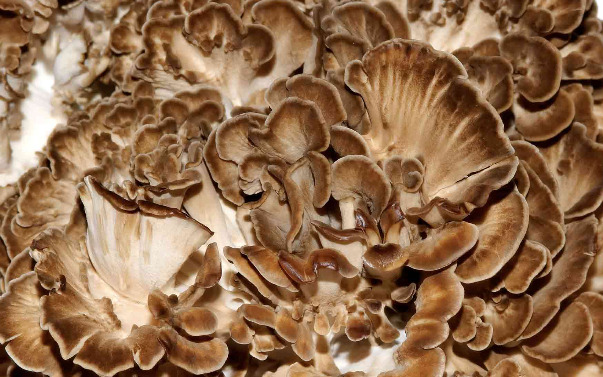
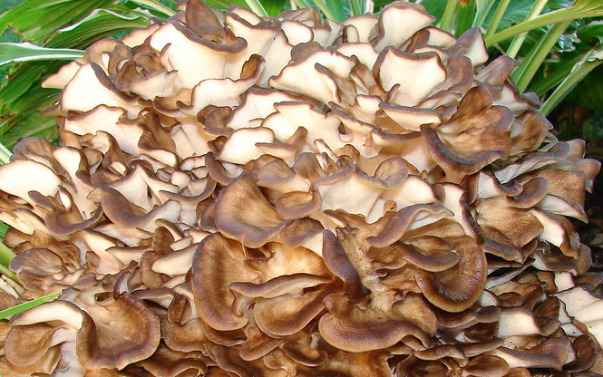
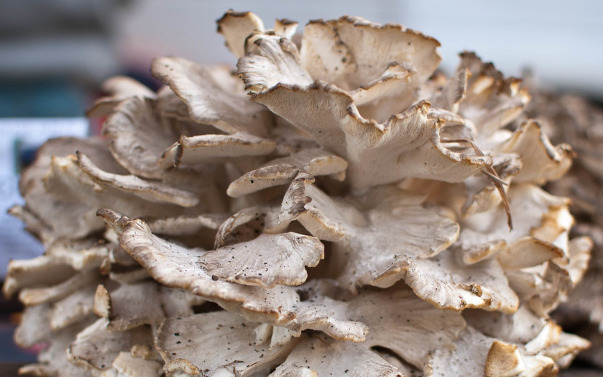
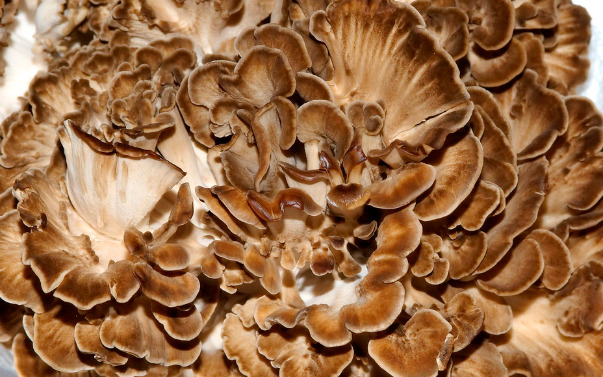
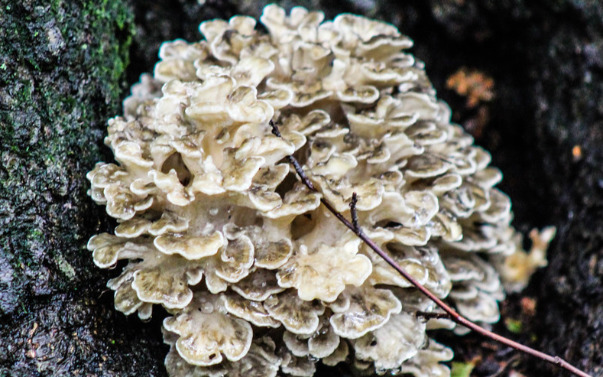
Short answer: Maitake (also hen-of-the-woods, sheep's head or ram's head) is a common name for Grifola frondosa (Dicks.) Gray (1821), a polypore that forms large clustered fronds at the base of trees. It is a formally named species and not a Psilocybe Cubensis strain. Sources disagree on the family, with Species Fungorum, Wikipedia and MushroomExpert using Grifolaceae and First Nature using Meripilaceae. Published spore figures are small, smooth and ellipsoid, roughly 4-7 × 3-5 µm across two general references.
Home » Strain Encyclopedia » Edible and Medicinal Species » Maitake
In this guide
- What the name covers
- Taxonomy
- What sources agree on and where they differ
- Spore data
- Hosts, ecology and range
- Look-alikes
- Examining a slide
- Mushly products
- Legal note
- References
- FAQ
What the name covers
According to Wikipedia, G. frondosa is known as hen-of-the-woods, sheep's head, ram's head and, in Japanese, maitake (舞茸, "dancing mushroom"). "Hen-of-the-woods" is also used for other large clustered polypores, so check the scientific name on a label. Laetiporus ("chicken of the woods") is a different genus and a look-alike name, not a synonym.
"Maitake mushroom, or hen-of-the-woods, is Grifola frondosa, a named polypore. Sources disagree on its family and spore range. Taxonomy and look-alikes."

Taxonomy
| Rank | Entry |
|---|---|
| Kingdom | Fungi |
| Phylum | Basidiomycota |
| Class | Agaricomycetes |
| Order | Polyporales |
| Family | Placement varies by source: Species Fungorum, Wikipedia and MushroomExpert list Grifolaceae, while First Nature lists Meripilaceae. Neither is an error. |
| Genus | Grifola |
| Species | Grifola frondosa (Dicks.) Gray (1821) |
| Earliest name | Boletus frondosus Dicks. (1785), listed by Wikipedia as a synonym |
| Common names | Maitake, hen-of-the-woods, sheep's head, ram's head |
Species record: Species Fungorum, record 362177, which shows the name as accepted, in Grifolaceae.
What sources agree on and where they differ
| Question | What the sources say |
|---|---|
| Is it a Psilocybe cubensis strain? | No. It is a different genus and family, and it is not psychoactive. |
| Family | Grifolaceae (Species Fungorum, Wikipedia, MushroomExpert). Meripilaceae (First Nature). |
| Spore size | 4-6 × 3-4 µm (MushroomExpert). 5-7 × 3.5-5 µm (First Nature). See below. |
| Spore print | White in all three general references. |
| Host | Oaks first, with maples and other hardwoods also named. |
| Range | Wikipedia gives China, Europe and eastern North America, most abundant in eastern North America. MushroomExpert says east of the Rocky Mountains and rare in the west. First Nature says uncommon and localised in Britain and Ireland. |
| Health and nutrition | Mushly makes no nutritional or wellness claims. |
Spore data
Short answer: the figures below are general-reference values and not Mushly measurements, and the two sources do not agree.
| Source | Spores |
|---|---|
| MushroomExpert | 4-6 × 3-4 µm, ellipsoid, smooth, colourless in KOH, often with one large oil droplet, inamyloid. Print white. |
| First Nature | "Broadly ellipsoidal, smooth, 5-7 × 3.5-5 µm," inamyloid. Print white. |
The ranges overlap, but the upper and lower ends differ, which is common between regions and authors. Maitake spores are small, smooth and pale, so they look very different from the dark, thick-walled, much larger spores of Psilocybe. For comparison, P. cubensis spores are measured at 11.5-17.3 × 8-11.5 × 7-9 µm in Singer and Smith (1958), with a truncate apex and germ pore. General references are not monographs, so check a primary treatment before citing a size. Measure your own sample and record the mountant.
Hosts, ecology and range
MushroomExpert describes G. frondosa as weakly parasitic on living oaks and other hardwoods, and also saprobic on decaying wood, causing a white butt rot. It grows near the base of the tree, often reappearing in the same place in later years, and fruits in summer and autumn. Wikipedia names old-growth oaks and maples, and gives a season of August to October in Europe and September to October in eastern North America. First Nature says it is uncommon and localised in Britain and Ireland.
So it is a wood-associated fungus and not a dung or soil species, and it grows in large clusters and not as single caps. Wikipedia reports it as found as far west as Idaho in North America. Mushly gives no growing advice.
Look-alikes
This is a taxonomy note, not an identification guide. Never eat a wild fungus on the strength of a web page.
- Meripilus sumstinei: named by Wikipedia and MushroomExpert. MushroomExpert says it has larger individual caps, smaller pores and surfaces that bruise black.
- Polyporus umbellatus: has more clearly defined individual caps and stems (MushroomExpert, Wikipedia).
- Laetiporus sulphureus (chicken of the woods): a bright yellow-orange shelf fungus, listed by Wikipedia as a look-alike.
- Sparassis spathulata: also listed by Wikipedia.
MushroomExpert notes that microscopic features can help separate these species.
Examining a slide
Follow the general method in our mushroom spores guide, and then:
- Mount a spore deposit in water first, then in KOH, and record both. White prints look faint, so use dark paper or glass.
- Measure at least 20 spores (length × width) and record the magnification.
- Note the shape (broadly ellipsoid), the smooth surface and any oil droplet.
- Record the print colour separately from the mountant colour.
- Remember the limit: a size match supports a comparison but does not separate G. frondosa from other polypores on its own.
Mushly products
Mushly does not currently list a product named Maitake. This page is a reference note and not a product page. To browse what Mushly does list, see the edible cultures category and the mushroom spores guide.
Legal note
Grifola frondosa is not a psilocybin-containing species and is legal to possess in most places, but laws on spores and cultures differ by country and region. Check the rules where you live. Mushly's microscopy products are sold for research and study and not for consumption or cultivation. Mushly gives no cooking, storage or nutrition advice.
Edible cultures · Strain library · Mushroom spores for microscopy guide
References
- Species Fungorum, Grifola frondosa (record 362177)
- Wikipedia: Grifola frondosa (authority, synonyms, common names, hosts, range, look-alikes)
- MushroomExpert: Grifola frondosa (family, spores, hosts, range, look-alikes)
- First Nature: Grifola frondosa (family, spores, hosts, distribution)
- Singer, R. & Smith, A.H. (1958), Mycologia 50 (P. cubensis range, for comparison only)


Is maitake a Psilocybe cubensis strain?