

About Psilocybe mexicana: Taxonomy, Spore Traits and the "Mexicana" Trade Name Mushrooms
Updated: October 6, 2026
Psilocybe mexicana spores are sold strictly for microscopy and research purposes only. Cultivation of Psilocybin-containing fungi is illegal in many jurisdictions. This page is not a guide to finding, growing, or taking mushrooms.
Short answer: Psilocybe mexicana R. Heim is a formally described species, published in 1957 from Oaxaca, Mexico. It is not a Psilocybe Cubensis strain and not a catalogue name. Its spores are smaller than those of P. cubensis, about 8-12 × 5-8 µm in one general reference. The word "Mexicana" is also used on sclerotia ("magic truffle") listings, and a label does not prove the species behind it. Mushly does not currently list a P. mexicana product.
Home » Strain Encyclopedia » Other Psilocybe Species » Mexicana
In this guide
- What Mexicana is
- Taxonomy
- What sources agree on and where they differ
- Spore and fruiting body traits
- Sclerotia and the "Mexicana" trade name
- Ecology and distribution
- A short history
- Examining a slide
- Mushly products
- Legal note
- References
- FAQ
What Mexicana is
"Mexicana" is the short name for Psilocybe mexicana, a species with its own published description, type specimen and authority. That sets it apart from the cubensis lines in Mushly's all-strains library, where names such as Golden Teacher are catalogue labels for one species. For that difference, see our species vs strain primer.
"Psilocybe mexicana is a species formally described in 1957, not a cubensis strain. Published spore data, the sclerotia trade name, history and microscopy."


Taxonomy
| Rank | Entry |
|---|---|
| Kingdom | Fungi |
| Phylum | Basidiomycota |
| Class | Agaricomycetes |
| Order | Agaricales |
| Family | Placement varies by source: Index Fungorum lists Agrocybaceae, while Wikipedia and many other references use Hymenogastraceae |
| Genus | Psilocybe |
| Species | Psilocybe mexicana R. Heim, Revue de Mycologie (Paris) 22(1): 77 (1957) |
| Type | Holotype PC 0085751; Oaxaca, Mexico, per Index Fungorum |
Wikipedia lists Psilocybe galindoi Guzmán (1978) and Psilocybe armandii Guzmán & S.H. Pollock (1979) among the names later treated as synonyms. The Index Fungorum record 304487 lists none, so check both if you need the synonymy.
What sources agree on and where they differ
| Question | Status |
|---|---|
| Is Mexicana a formal species? | Yes. P. mexicana R. Heim (1957). |
| Is it a P. cubensis strain? | No. It is a separate species. |
| Family | Agrocybaceae in Index Fungorum, Hymenogastraceae in Wikipedia. We pick neither. |
| Spore size | Published figures are secondary. See below. |
| Is every "Mexicana" listing this species? | Not shown. The name is also used for sclerotia products. |
| Effects and potency | Mushly makes no claims about either. |
Spore and fruiting body traits
Short answer: small, smooth, ovoid spores in a dark purple-brown print.
Wikipedia gives the spores as ovoid and smooth, 8-12 × 5-8 µm, with a dark purple-brown print. These are general-reference figures and not a primary taxonomic treatment, so check Heim's description or a later monograph before you cite sizes. For comparison, P. cubensis spores are measured at 11.5-17.3 × 8-11.5 × 7-9 µm in Singer and Smith (1958), with a truncate apex, so the two should look different on a slide.
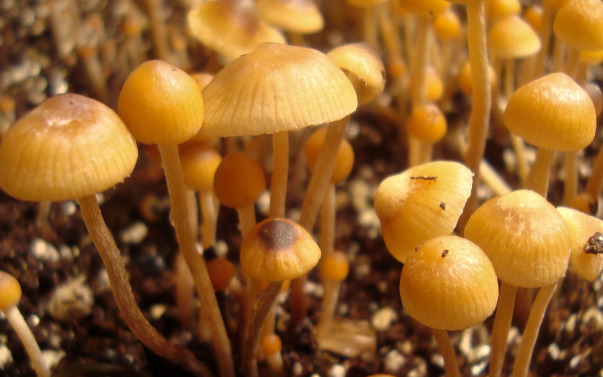
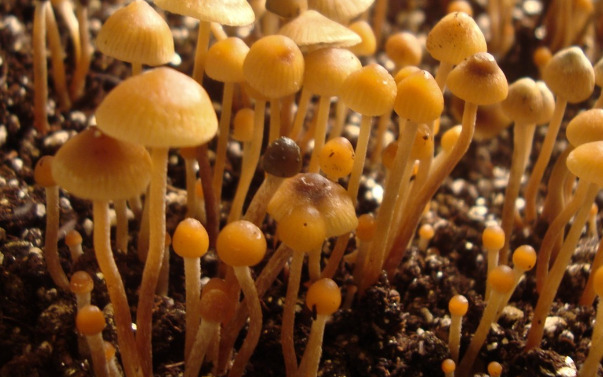
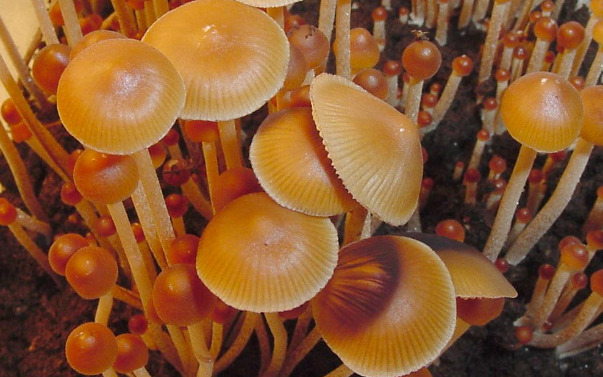
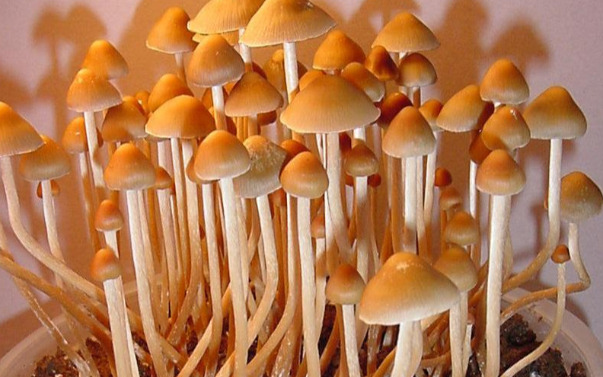
Fruiting body (per Wikipedia): a small cap, 0.5-2 (3) cm across, conic to bell-shaped, ochre to brown or straw-coloured with age. It is much smaller than a typical cubensis cap.
Sclerotia and the "Mexicana" trade name
Short answer: "Mexicana" on a sclerotia listing names a product, not a confirmed species.
Wikipedia notes that P. mexicana can form sclerotia, a dormant form that protects it from fire. Sellers also use "Mexicana" for sclerotia ("magic truffles"), and some labels may not match the species. One seller page we found shows the same pattern: a listing titled "Psilocybe tampanensis 'Mex A'" sits at a "psilocybe-mexicana" web address (Dino Spores). That shows naming confusion on one seller's site and proves nothing about the contents.
According to Wikipedia, P. tampanensis was described from Florida and is treated as intermediate between P. mexicana and another species, with P. mexicana occurring only in Mexico and Guatemala. The practical point is that a sclerotia label, a web address and a species name can disagree, and only DNA work settles which one is right.
Ecology and distribution
Wikipedia lists Mexico, Costa Rica, El Salvador and Guatemala, typically at about 300-550 m, growing alone or in small groups among moss along roadsides and trails, in humid meadows or in cornfields, and fruiting from about May to October. It is not a foraging guide, and Mushly gives no advice on finding it.
A short history
P. mexicana has a place in the history of psilocybin research. The 1958 paper "Psilocybin, ein psychotroper Wirkstoff aus dem mexikanischen Rauschpilz Psilocybe mexicana Heim" (Hofmann and colleagues) reports the compound from laboratory-grown material of this species. Treat the history as background, and read the original papers for details.
Examining a slide
- Mount a spore deposit in water first, then in KOH, and record both. A dark purple-brown print on white paper is the usual starting point.
- Measure at least 20 spores (length × width) and record the magnification.
- Note the shape (ovoid), the wall and the germ pore, and record print colour separately from mountant colour.
- Write down the exact label (Mexicana), the scientific name the supplier gives, and the date.
- Remember the limit: matching a published range supports a comparison, but spores alone do not separate P. mexicana from P. tampanensis or other close Psilocybe species, and they say nothing about what a sclerotia product is.
Mushly products
Mushly does not currently stock P. mexicana spores or sclerotia. This page is a reference note and not a product page. To browse what Mushly does list, see our spore syringes for microscopy and the mushroom spores guide.
Legal note
Psilocybe mexicana contains psilocybin. Mushly offers spores for microscopy, taxonomy, and mycological research. Laws on spores, sclerotia and psilocybin-containing mushrooms differ by country and by U.S. state, and sclerotia are treated differently from spores in some places. Cultivation of psilocybin- or psilocin-containing species is illegal under U.S. federal law and in many other jurisdictions. Check the law where you live before ordering.
Spore syringes · Strain library · Mushroom spores for microscopy guide
References
- Index Fungorum 304487 (name, authority, publication, holotype, family)
- Wikipedia: Psilocybe mexicana (synonyms, spores, cap, distribution, sclerotia)
- Wikipedia: Psilocybe tampanensis (authority, type locality, relation to P. mexicana)
- Hofmann et al. 1958, "Psilocybin, ein psychotroper Wirkstoff aus dem mexikanischen Rauschpilz Psilocybe mexicana Heim," Experientia (title only; the paper itself was not reviewed)
- Singer, R. & Smith, A.H. (1958), Mycologia 50 (P. cubensis spore range, for comparison only)
- Seller example (not a paper, not verified): Dino Spores


What is Psilocybe mexicana?